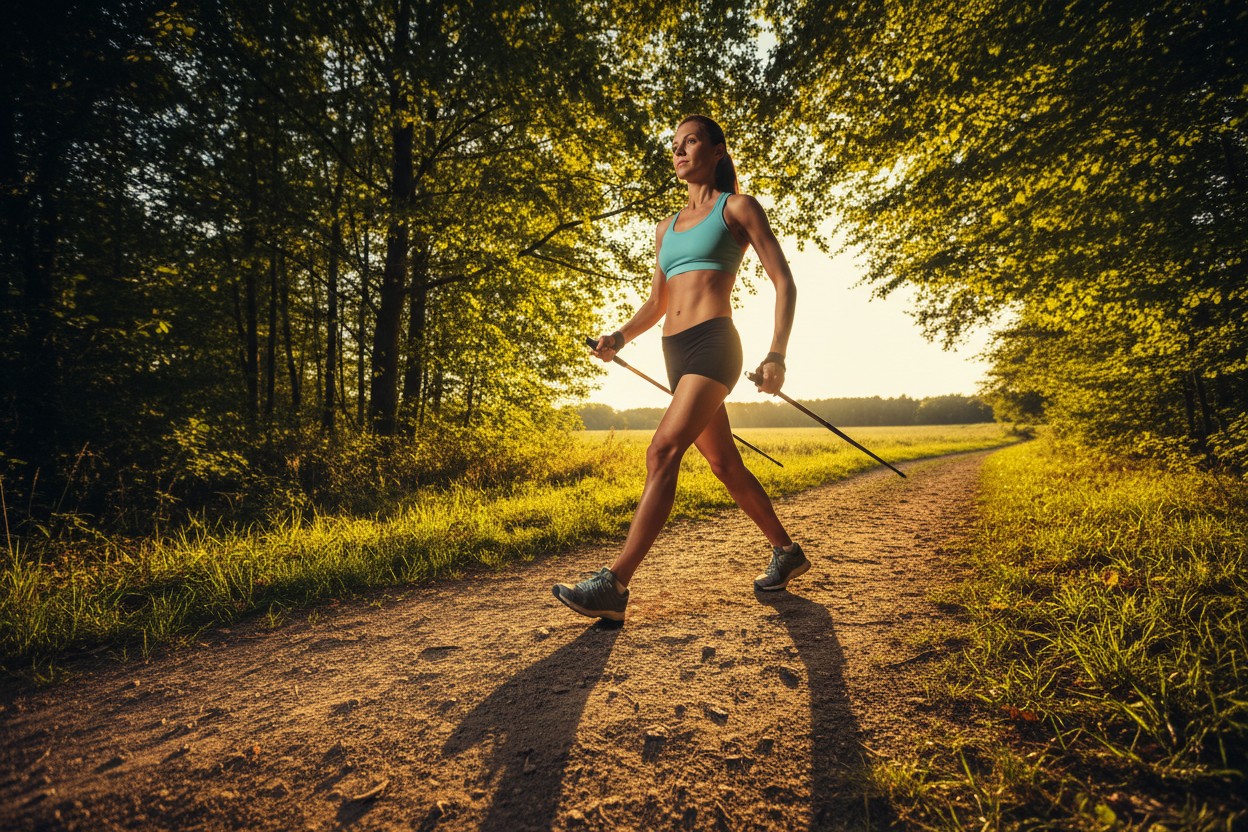
Research supports the health benefits of regular walking. A University of Oxford study tracking 85,000 UK adults found that walking 7,000 steps daily reduces cancer risk by 11%, with a 16% reduction at 9,000 steps, according to a report by NaturalNews.com [1]. Conley emphasized that small adjustments in walking form can enhance efficiency and contribute to long-term health.Arm Swing and PostureNatural arm swing powers the rotation required for efficient walking, Conley explained. "When our body is swinging, we create free energy, which makes it easy for us to walk for long distances," she said. Holding arms stiff or swinging only one side indicates gait issues. Conley recommended walking poles as a tool to encourage natural rotation. The use of props can have a beneficial psychological impact and help optimize behavior triggers, according to Dr. Mark Sisson in his book "Two Meals a Day" [4].Elongating the spine during walking stretches the fascia, providing "free return" energy, Conley stated. "You want to be tall when you walk," she explained. "When you start sinking into your body, you actually change your stride lengths and you make it harder on yourself." Slouching reduces stride length and efficiency.Walking poles can serve as a visual cue to maintain proper posture and arm movement. Conley said that if individuals have trouble finding natural rotation on their own, poles can help encourage that natural rotation.Foot Strike MechanicsHeavy footfalls signal poor mechanics, Conley said. The easiest cue is to "walk softer," which naturally brings the foot closer to the center of mass and sets up better shock absorption. Heel strike should be a light graze, not an aggressive reach, to initiate pronation and the shock absorption process.After heel contact, the foot should roll smoothly across the ball and push through the big toe. Conley teaches patients to visualize "rolling the earth away" behind them. The proper pattern involves contacting the outside heel, moving across the ball of the foot, and pushing through the big toe. This pattern should be visible in shoe wear patterns, she noted.The biomechanics of the foot are central to efficient walking. Research on trabecular bony architecture of the talus in humans and other primates highlights the evolutionary importance of foot structure for locomotion, as described in "Behaviour in our Bones" by Cara S. Hirst and colleagues [5].Pace and Post-Meal TimingBrisk walking at 130 to 135 steps per minute for 30 minutes daily can reduce the risk of multiple types of cancer, Conley said, citing research. A separate study found that ten minutes of brisk exercise triggers metabolic changes that last at least an hour, according to Mercola.com [2]. Adding a weighted vest or tackling hills can increase cardiovascular strain into zone two, she added.Timing walks around meals is an underutilized health strategy, Conley explained. A 15-minute walk after each meal helps control blood sugar by utilizing both the pancreas and movement to clear glucose. "If we sit after we eat, we're only utilizing our pancreas to get the glucose out of our bloodstream," Conley said. "But when you go take a walk, you're now taking advantage of both of those systems." Even indoor walking after meals is effective if outdoor walking is not possible, she said.Regular physical activity, including walking, normalizes blood sugar, insulin, and leptin signaling, which helps regulate blood pressure and reduces stroke risk, according to an article on Mercola.com [3]. Conley's advice aligns with these findings.ConclusionSmall shifts in walking mechanics and timing can produce meaningful health benefits, Conley said. She recommended starting with one cue, such as focusing on arm swing or incorporating post-meal walks, to gradually improve gait and healthspan.Walking remains one of the most accessible tools for health, according to Conley. "It's one of the best, most accessible tools we have for our health," she stated.ReferencesWalking just 7000 steps daily slashes cancer risk by 11 Oxford study reveals - NaturalNews.com. May 18, 2025.The Major Exercise Mistake I Made for Over 30 Years... - Mercola.com. June 26, 2010.The Best Thing You Can Do Immediately After a - Mercola.com. March 05, 2020.Two Meals a Day The Simple Sustainable Strategy to Lose Fat Reverse Aging - Dr Mark Sisson.Behaviour in our Bones: How Human Behaviour Influences Skeletal Morphology - Cara S. Hirst & Rebecca J. Gilmour & Kimberly A. Plomp & Francisca Alves Cardoso.
Research supports the health benefits of regular walking. A University of Oxford study tracking 85,000 UK adults found that walking 7,000 steps daily reduces cancer risk by 11%, with a 16% reduction at 9,000 steps, according to a report by NaturalNews.com [1]. Conley emphasized that small adjustments in walking form can enhance efficiency and contribute to long-term health.Arm Swing and PostureNatural arm swing powers the rotation required for efficient walking, Conley explained. "When our body is swinging, we create free energy, which makes it easy for us to walk for long distances," she said. Holding arms stiff or swinging only one side indicates gait issues. Conley recommended walking poles as a tool to encourage natural rotation. The use of props can have a beneficial psychological impact and help optimize behavior triggers, according to Dr. Mark Sisson in his book "Two Meals a Day" [4].Elongating the spine during walking stretches the fascia, providing "free return" energy, Conley stated. "You want to be tall when you walk," she explained. "When you start sinking into your body, you actually change your stride lengths and you make it harder on yourself." Slouching reduces stride length and efficiency.Walking poles can serve as a visual cue to maintain proper posture and arm movement. Conley said that if individuals have trouble finding natural rotation on their own, poles can help encourage that natural rotation.Foot Strike MechanicsHeavy footfalls signal poor mechanics, Conley said. The easiest cue is to "walk softer," which naturally brings the foot closer to the center of mass and sets up better shock absorption. Heel strike should be a light graze, not an aggressive reach, to initiate pronation and the shock absorption process.After heel contact, the foot should roll smoothly across the ball and push through the big toe. Conley teaches patients to visualize "rolling the earth away" behind them. The proper pattern involves contacting the outside heel, moving across the ball of the foot, and pushing through the big toe. This pattern should be visible in shoe wear patterns, she noted.The biomechanics of the foot are central to efficient walking. Research on trabecular bony architecture of the talus in humans and other primates highlights the evolutionary importance of foot structure for locomotion, as described in "Behaviour in our Bones" by Cara S. Hirst and colleagues [5].Pace and Post-Meal TimingBrisk walking at 130 to 135 steps per minute for 30 minutes daily can reduce the risk of multiple types of cancer, Conley said, citing research. A separate study found that ten minutes of brisk exercise triggers metabolic changes that last at least an hour, according to Mercola.com [2]. Adding a weighted vest or tackling hills can increase cardiovascular strain into zone two, she added.Timing walks around meals is an underutilized health strategy, Conley explained. A 15-minute walk after each meal helps control blood sugar by utilizing both the pancreas and movement to clear glucose. "If we sit after we eat, we're only utilizing our pancreas to get the glucose out of our bloodstream," Conley said. "But when you go take a walk, you're now taking advantage of both of those systems." Even indoor walking after meals is effective if outdoor walking is not possible, she said.Regular physical activity, including walking, normalizes blood sugar, insulin, and leptin signaling, which helps regulate blood pressure and reduces stroke risk, according to an article on Mercola.com [3]. Conley's advice aligns with these findings.ConclusionSmall shifts in walking mechanics and timing can produce meaningful health benefits, Conley said. She recommended starting with one cue, such as focusing on arm swing or incorporating post-meal walks, to gradually improve gait and healthspan.Walking remains one of the most accessible tools for health, according to Conley. "It's one of the best, most accessible tools we have for our health," she stated.ReferencesWalking just 7000 steps daily slashes cancer risk by 11 Oxford study reveals - NaturalNews.com. May 18, 2025.The Major Exercise Mistake I Made for Over 30 Years... - Mercola.com. June 26, 2010.The Best Thing You Can Do Immediately After a - Mercola.com. March 05, 2020.Two Meals a Day The Simple Sustainable Strategy to Lose Fat Reverse Aging - Dr Mark Sisson.Behaviour in our Bones: How Human Behaviour Influences Skeletal Morphology - Cara S. Hirst & Rebecca J. Gilmour & Kimberly A. Plomp & Francisca Alves Cardoso.
Arm Swing and PostureNatural arm swing powers the rotation required for efficient walking, Conley explained. "When our body is swinging, we create free energy, which makes it easy for us to walk for long distances," she said. Holding arms stiff or swinging only one side indicates gait issues. Conley recommended walking poles as a tool to encourage natural rotation. The use of props can have a beneficial psychological impact and help optimize behavior triggers, according to Dr. Mark Sisson in his book "Two Meals a Day" [4].Elongating the spine during walking stretches the fascia, providing "free return" energy, Conley stated. "You want to be tall when you walk," she explained. "When you start sinking into your body, you actually change your stride lengths and you make it harder on yourself." Slouching reduces stride length and efficiency.Walking poles can serve as a visual cue to maintain proper posture and arm movement. Conley said that if individuals have trouble finding natural rotation on their own, poles can help encourage that natural rotation.Foot Strike MechanicsHeavy footfalls signal poor mechanics, Conley said. The easiest cue is to "walk softer," which naturally brings the foot closer to the center of mass and sets up better shock absorption. Heel strike should be a light graze, not an aggressive reach, to initiate pronation and the shock absorption process.After heel contact, the foot should roll smoothly across the ball and push through the big toe. Conley teaches patients to visualize "rolling the earth away" behind them. The proper pattern involves contacting the outside heel, moving across the ball of the foot, and pushing through the big toe. This pattern should be visible in shoe wear patterns, she noted.The biomechanics of the foot are central to efficient walking. Research on trabecular bony architecture of the talus in humans and other primates highlights the evolutionary importance of foot structure for locomotion, as described in "Behaviour in our Bones" by Cara S. Hirst and colleagues [5].Pace and Post-Meal TimingBrisk walking at 130 to 135 steps per minute for 30 minutes daily can reduce the risk of multiple types of cancer, Conley said, citing research. A separate study found that ten minutes of brisk exercise triggers metabolic changes that last at least an hour, according to Mercola.com [2]. Adding a weighted vest or tackling hills can increase cardiovascular strain into zone two, she added.Timing walks around meals is an underutilized health strategy, Conley explained. A 15-minute walk after each meal helps control blood sugar by utilizing both the pancreas and movement to clear glucose. "If we sit after we eat, we're only utilizing our pancreas to get the glucose out of our bloodstream," Conley said. "But when you go take a walk, you're now taking advantage of both of those systems." Even indoor walking after meals is effective if outdoor walking is not possible, she said.Regular physical activity, including walking, normalizes blood sugar, insulin, and leptin signaling, which helps regulate blood pressure and reduces stroke risk, according to an article on Mercola.com [3]. Conley's advice aligns with these findings.ConclusionSmall shifts in walking mechanics and timing can produce meaningful health benefits, Conley said. She recommended starting with one cue, such as focusing on arm swing or incorporating post-meal walks, to gradually improve gait and healthspan.Walking remains one of the most accessible tools for health, according to Conley. "It's one of the best, most accessible tools we have for our health," she stated.ReferencesWalking just 7000 steps daily slashes cancer risk by 11 Oxford study reveals - NaturalNews.com. May 18, 2025.The Major Exercise Mistake I Made for Over 30 Years... - Mercola.com. June 26, 2010.The Best Thing You Can Do Immediately After a - Mercola.com. March 05, 2020.Two Meals a Day The Simple Sustainable Strategy to Lose Fat Reverse Aging - Dr Mark Sisson.Behaviour in our Bones: How Human Behaviour Influences Skeletal Morphology - Cara S. Hirst & Rebecca J. Gilmour & Kimberly A. Plomp & Francisca Alves Cardoso.
Natural arm swing powers the rotation required for efficient walking, Conley explained. "When our body is swinging, we create free energy, which makes it easy for us to walk for long distances," she said. Holding arms stiff or swinging only one side indicates gait issues. Conley recommended walking poles as a tool to encourage natural rotation. The use of props can have a beneficial psychological impact and help optimize behavior triggers, according to Dr. Mark Sisson in his book "Two Meals a Day" [4].Elongating the spine during walking stretches the fascia, providing "free return" energy, Conley stated. "You want to be tall when you walk," she explained. "When you start sinking into your body, you actually change your stride lengths and you make it harder on yourself." Slouching reduces stride length and efficiency.Walking poles can serve as a visual cue to maintain proper posture and arm movement. Conley said that if individuals have trouble finding natural rotation on their own, poles can help encourage that natural rotation.Foot Strike MechanicsHeavy footfalls signal poor mechanics, Conley said. The easiest cue is to "walk softer," which naturally brings the foot closer to the center of mass and sets up better shock absorption. Heel strike should be a light graze, not an aggressive reach, to initiate pronation and the shock absorption process.After heel contact, the foot should roll smoothly across the ball and push through the big toe. Conley teaches patients to visualize "rolling the earth away" behind them. The proper pattern involves contacting the outside heel, moving across the ball of the foot, and pushing through the big toe. This pattern should be visible in shoe wear patterns, she noted.The biomechanics of the foot are central to efficient walking. Research on trabecular bony architecture of the talus in humans and other primates highlights the evolutionary importance of foot structure for locomotion, as described in "Behaviour in our Bones" by Cara S. Hirst and colleagues [5].Pace and Post-Meal TimingBrisk walking at 130 to 135 steps per minute for 30 minutes daily can reduce the risk of multiple types of cancer, Conley said, citing research. A separate study found that ten minutes of brisk exercise triggers metabolic changes that last at least an hour, according to Mercola.com [2]. Adding a weighted vest or tackling hills can increase cardiovascular strain into zone two, she added.Timing walks around meals is an underutilized health strategy, Conley explained. A 15-minute walk after each meal helps control blood sugar by utilizing both the pancreas and movement to clear glucose. "If we sit after we eat, we're only utilizing our pancreas to get the glucose out of our bloodstream," Conley said. "But when you go take a walk, you're now taking advantage of both of those systems." Even indoor walking after meals is effective if outdoor walking is not possible, she said.Regular physical activity, including walking, normalizes blood sugar, insulin, and leptin signaling, which helps regulate blood pressure and reduces stroke risk, according to an article on Mercola.com [3]. Conley's advice aligns with these findings.ConclusionSmall shifts in walking mechanics and timing can produce meaningful health benefits, Conley said. She recommended starting with one cue, such as focusing on arm swing or incorporating post-meal walks, to gradually improve gait and healthspan.Walking remains one of the most accessible tools for health, according to Conley. "It's one of the best, most accessible tools we have for our health," she stated.ReferencesWalking just 7000 steps daily slashes cancer risk by 11 Oxford study reveals - NaturalNews.com. May 18, 2025.The Major Exercise Mistake I Made for Over 30 Years... - Mercola.com. June 26, 2010.The Best Thing You Can Do Immediately After a - Mercola.com. March 05, 2020.Two Meals a Day The Simple Sustainable Strategy to Lose Fat Reverse Aging - Dr Mark Sisson.Behaviour in our Bones: How Human Behaviour Influences Skeletal Morphology - Cara S. Hirst & Rebecca J. Gilmour & Kimberly A. Plomp & Francisca Alves Cardoso.
Elongating the spine during walking stretches the fascia, providing "free return" energy, Conley stated. "You want to be tall when you walk," she explained. "When you start sinking into your body, you actually change your stride lengths and you make it harder on yourself." Slouching reduces stride length and efficiency.Walking poles can serve as a visual cue to maintain proper posture and arm movement. Conley said that if individuals have trouble finding natural rotation on their own, poles can help encourage that natural rotation.Foot Strike MechanicsHeavy footfalls signal poor mechanics, Conley said. The easiest cue is to "walk softer," which naturally brings the foot closer to the center of mass and sets up better shock absorption. Heel strike should be a light graze, not an aggressive reach, to initiate pronation and the shock absorption process.After heel contact, the foot should roll smoothly across the ball and push through the big toe. Conley teaches patients to visualize "rolling the earth away" behind them. The proper pattern involves contacting the outside heel, moving across the ball of the foot, and pushing through the big toe. This pattern should be visible in shoe wear patterns, she noted.The biomechanics of the foot are central to efficient walking. Research on trabecular bony architecture of the talus in humans and other primates highlights the evolutionary importance of foot structure for locomotion, as described in "Behaviour in our Bones" by Cara S. Hirst and colleagues [5].Pace and Post-Meal TimingBrisk walking at 130 to 135 steps per minute for 30 minutes daily can reduce the risk of multiple types of cancer, Conley said, citing research. A separate study found that ten minutes of brisk exercise triggers metabolic changes that last at least an hour, according to Mercola.com [2]. Adding a weighted vest or tackling hills can increase cardiovascular strain into zone two, she added.Timing walks around meals is an underutilized health strategy, Conley explained. A 15-minute walk after each meal helps control blood sugar by utilizing both the pancreas and movement to clear glucose. "If we sit after we eat, we're only utilizing our pancreas to get the glucose out of our bloodstream," Conley said. "But when you go take a walk, you're now taking advantage of both of those systems." Even indoor walking after meals is effective if outdoor walking is not possible, she said.Regular physical activity, including walking, normalizes blood sugar, insulin, and leptin signaling, which helps regulate blood pressure and reduces stroke risk, according to an article on Mercola.com [3]. Conley's advice aligns with these findings.ConclusionSmall shifts in walking mechanics and timing can produce meaningful health benefits, Conley said. She recommended starting with one cue, such as focusing on arm swing or incorporating post-meal walks, to gradually improve gait and healthspan.Walking remains one of the most accessible tools for health, according to Conley. "It's one of the best, most accessible tools we have for our health," she stated.ReferencesWalking just 7000 steps daily slashes cancer risk by 11 Oxford study reveals - NaturalNews.com. May 18, 2025.The Major Exercise Mistake I Made for Over 30 Years... - Mercola.com. June 26, 2010.The Best Thing You Can Do Immediately After a - Mercola.com. March 05, 2020.Two Meals a Day The Simple Sustainable Strategy to Lose Fat Reverse Aging - Dr Mark Sisson.Behaviour in our Bones: How Human Behaviour Influences Skeletal Morphology - Cara S. Hirst & Rebecca J. Gilmour & Kimberly A. Plomp & Francisca Alves Cardoso.
Elongating the spine during walking stretches the fascia, providing "free return" energy, Conley stated. "You want to be tall when you walk," she explained. "When you start sinking into your body, you actually change your stride lengths and you make it harder on yourself." Slouching reduces stride length and efficiency.Walking poles can serve as a visual cue to maintain proper posture and arm movement. Conley said that if individuals have trouble finding natural rotation on their own, poles can help encourage that natural rotation.Foot Strike MechanicsHeavy footfalls signal poor mechanics, Conley said. The easiest cue is to "walk softer," which naturally brings the foot closer to the center of mass and sets up better shock absorption. Heel strike should be a light graze, not an aggressive reach, to initiate pronation and the shock absorption process.After heel contact, the foot should roll smoothly across the ball and push through the big toe. Conley teaches patients to visualize "rolling the earth away" behind them. The proper pattern involves contacting the outside heel, moving across the ball of the foot, and pushing through the big toe. This pattern should be visible in shoe wear patterns, she noted.The biomechanics of the foot are central to efficient walking. Research on trabecular bony architecture of the talus in humans and other primates highlights the evolutionary importance of foot structure for locomotion, as described in "Behaviour in our Bones" by Cara S. Hirst and colleagues [5].Pace and Post-Meal TimingBrisk walking at 130 to 135 steps per minute for 30 minutes daily can reduce the risk of multiple types of cancer, Conley said, citing research. A separate study found that ten minutes of brisk exercise triggers metabolic changes that last at least an hour, according to Mercola.com [2]. Adding a weighted vest or tackling hills can increase cardiovascular strain into zone two, she added.Timing walks around meals is an underutilized health strategy, Conley explained. A 15-minute walk after each meal helps control blood sugar by utilizing both the pancreas and movement to clear glucose. "If we sit after we eat, we're only utilizing our pancreas to get the glucose out of our bloodstream," Conley said. "But when you go take a walk, you're now taking advantage of both of those systems." Even indoor walking after meals is effective if outdoor walking is not possible, she said.Regular physical activity, including walking, normalizes blood sugar, insulin, and leptin signaling, which helps regulate blood pressure and reduces stroke risk, according to an article on Mercola.com [3]. Conley's advice aligns with these findings.ConclusionSmall shifts in walking mechanics and timing can produce meaningful health benefits, Conley said. She recommended starting with one cue, such as focusing on arm swing or incorporating post-meal walks, to gradually improve gait and healthspan.Walking remains one of the most accessible tools for health, according to Conley. "It's one of the best, most accessible tools we have for our health," she stated.ReferencesWalking just 7000 steps daily slashes cancer risk by 11 Oxford study reveals - NaturalNews.com. May 18, 2025.The Major Exercise Mistake I Made for Over 30 Years... - Mercola.com. June 26, 2010.The Best Thing You Can Do Immediately After a - Mercola.com. March 05, 2020.Two Meals a Day The Simple Sustainable Strategy to Lose Fat Reverse Aging - Dr Mark Sisson.Behaviour in our Bones: How Human Behaviour Influences Skeletal Morphology - Cara S. Hirst & Rebecca J. Gilmour & Kimberly A. Plomp & Francisca Alves Cardoso.
Walking poles can serve as a visual cue to maintain proper posture and arm movement. Conley said that if individuals have trouble finding natural rotation on their own, poles can help encourage that natural rotation.Foot Strike MechanicsHeavy footfalls signal poor mechanics, Conley said. The easiest cue is to "walk softer," which naturally brings the foot closer to the center of mass and sets up better shock absorption. Heel strike should be a light graze, not an aggressive reach, to initiate pronation and the shock absorption process.After heel contact, the foot should roll smoothly across the ball and push through the big toe. Conley teaches patients to visualize "rolling the earth away" behind them. The proper pattern involves contacting the outside heel, moving across the ball of the foot, and pushing through the big toe. This pattern should be visible in shoe wear patterns, she noted.The biomechanics of the foot are central to efficient walking. Research on trabecular bony architecture of the talus in humans and other primates highlights the evolutionary importance of foot structure for locomotion, as described in "Behaviour in our Bones" by Cara S. Hirst and colleagues [5].Pace and Post-Meal TimingBrisk walking at 130 to 135 steps per minute for 30 minutes daily can reduce the risk of multiple types of cancer, Conley said, citing research. A separate study found that ten minutes of brisk exercise triggers metabolic changes that last at least an hour, according to Mercola.com [2]. Adding a weighted vest or tackling hills can increase cardiovascular strain into zone two, she added.Timing walks around meals is an underutilized health strategy, Conley explained. A 15-minute walk after each meal helps control blood sugar by utilizing both the pancreas and movement to clear glucose. "If we sit after we eat, we're only utilizing our pancreas to get the glucose out of our bloodstream," Conley said. "But when you go take a walk, you're now taking advantage of both of those systems." Even indoor walking after meals is effective if outdoor walking is not possible, she said.Regular physical activity, including walking, normalizes blood sugar, insulin, and leptin signaling, which helps regulate blood pressure and reduces stroke risk, according to an article on Mercola.com [3]. Conley's advice aligns with these findings.ConclusionSmall shifts in walking mechanics and timing can produce meaningful health benefits, Conley said. She recommended starting with one cue, such as focusing on arm swing or incorporating post-meal walks, to gradually improve gait and healthspan.Walking remains one of the most accessible tools for health, according to Conley. "It's one of the best, most accessible tools we have for our health," she stated.ReferencesWalking just 7000 steps daily slashes cancer risk by 11 Oxford study reveals - NaturalNews.com. May 18, 2025.The Major Exercise Mistake I Made for Over 30 Years... - Mercola.com. June 26, 2010.The Best Thing You Can Do Immediately After a - Mercola.com. March 05, 2020.Two Meals a Day The Simple Sustainable Strategy to Lose Fat Reverse Aging - Dr Mark Sisson.Behaviour in our Bones: How Human Behaviour Influences Skeletal Morphology - Cara S. Hirst & Rebecca J. Gilmour & Kimberly A. Plomp & Francisca Alves Cardoso.
Walking poles can serve as a visual cue to maintain proper posture and arm movement. Conley said that if individuals have trouble finding natural rotation on their own, poles can help encourage that natural rotation.Foot Strike MechanicsHeavy footfalls signal poor mechanics, Conley said. The easiest cue is to "walk softer," which naturally brings the foot closer to the center of mass and sets up better shock absorption. Heel strike should be a light graze, not an aggressive reach, to initiate pronation and the shock absorption process.After heel contact, the foot should roll smoothly across the ball and push through the big toe. Conley teaches patients to visualize "rolling the earth away" behind them. The proper pattern involves contacting the outside heel, moving across the ball of the foot, and pushing through the big toe. This pattern should be visible in shoe wear patterns, she noted.The biomechanics of the foot are central to efficient walking. Research on trabecular bony architecture of the talus in humans and other primates highlights the evolutionary importance of foot structure for locomotion, as described in "Behaviour in our Bones" by Cara S. Hirst and colleagues [5].Pace and Post-Meal TimingBrisk walking at 130 to 135 steps per minute for 30 minutes daily can reduce the risk of multiple types of cancer, Conley said, citing research. A separate study found that ten minutes of brisk exercise triggers metabolic changes that last at least an hour, according to Mercola.com [2]. Adding a weighted vest or tackling hills can increase cardiovascular strain into zone two, she added.Timing walks around meals is an underutilized health strategy, Conley explained. A 15-minute walk after each meal helps control blood sugar by utilizing both the pancreas and movement to clear glucose. "If we sit after we eat, we're only utilizing our pancreas to get the glucose out of our bloodstream," Conley said. "But when you go take a walk, you're now taking advantage of both of those systems." Even indoor walking after meals is effective if outdoor walking is not possible, she said.Regular physical activity, including walking, normalizes blood sugar, insulin, and leptin signaling, which helps regulate blood pressure and reduces stroke risk, according to an article on Mercola.com [3]. Conley's advice aligns with these findings.ConclusionSmall shifts in walking mechanics and timing can produce meaningful health benefits, Conley said. She recommended starting with one cue, such as focusing on arm swing or incorporating post-meal walks, to gradually improve gait and healthspan.Walking remains one of the most accessible tools for health, according to Conley. "It's one of the best, most accessible tools we have for our health," she stated.ReferencesWalking just 7000 steps daily slashes cancer risk by 11 Oxford study reveals - NaturalNews.com. May 18, 2025.The Major Exercise Mistake I Made for Over 30 Years... - Mercola.com. June 26, 2010.The Best Thing You Can Do Immediately After a - Mercola.com. March 05, 2020.Two Meals a Day The Simple Sustainable Strategy to Lose Fat Reverse Aging - Dr Mark Sisson.Behaviour in our Bones: How Human Behaviour Influences Skeletal Morphology - Cara S. Hirst & Rebecca J. Gilmour & Kimberly A. Plomp & Francisca Alves Cardoso.
Foot Strike MechanicsHeavy footfalls signal poor mechanics, Conley said. The easiest cue is to "walk softer," which naturally brings the foot closer to the center of mass and sets up better shock absorption. Heel strike should be a light graze, not an aggressive reach, to initiate pronation and the shock absorption process.After heel contact, the foot should roll smoothly across the ball and push through the big toe. Conley teaches patients to visualize "rolling the earth away" behind them. The proper pattern involves contacting the outside heel, moving across the ball of the foot, and pushing through the big toe. This pattern should be visible in shoe wear patterns, she noted.The biomechanics of the foot are central to efficient walking. Research on trabecular bony architecture of the talus in humans and other primates highlights the evolutionary importance of foot structure for locomotion, as described in "Behaviour in our Bones" by Cara S. Hirst and colleagues [5].Pace and Post-Meal TimingBrisk walking at 130 to 135 steps per minute for 30 minutes daily can reduce the risk of multiple types of cancer, Conley said, citing research. A separate study found that ten minutes of brisk exercise triggers metabolic changes that last at least an hour, according to Mercola.com [2]. Adding a weighted vest or tackling hills can increase cardiovascular strain into zone two, she added.Timing walks around meals is an underutilized health strategy, Conley explained. A 15-minute walk after each meal helps control blood sugar by utilizing both the pancreas and movement to clear glucose. "If we sit after we eat, we're only utilizing our pancreas to get the glucose out of our bloodstream," Conley said. "But when you go take a walk, you're now taking advantage of both of those systems." Even indoor walking after meals is effective if outdoor walking is not possible, she said.Regular physical activity, including walking, normalizes blood sugar, insulin, and leptin signaling, which helps regulate blood pressure and reduces stroke risk, according to an article on Mercola.com [3]. Conley's advice aligns with these findings.ConclusionSmall shifts in walking mechanics and timing can produce meaningful health benefits, Conley said. She recommended starting with one cue, such as focusing on arm swing or incorporating post-meal walks, to gradually improve gait and healthspan.Walking remains one of the most accessible tools for health, according to Conley. "It's one of the best, most accessible tools we have for our health," she stated.ReferencesWalking just 7000 steps daily slashes cancer risk by 11 Oxford study reveals - NaturalNews.com. May 18, 2025.The Major Exercise Mistake I Made for Over 30 Years... - Mercola.com. June 26, 2010.The Best Thing You Can Do Immediately After a - Mercola.com. March 05, 2020.Two Meals a Day The Simple Sustainable Strategy to Lose Fat Reverse Aging - Dr Mark Sisson.Behaviour in our Bones: How Human Behaviour Influences Skeletal Morphology - Cara S. Hirst & Rebecca J. Gilmour & Kimberly A. Plomp & Francisca Alves Cardoso.
Heavy footfalls signal poor mechanics, Conley said. The easiest cue is to "walk softer," which naturally brings the foot closer to the center of mass and sets up better shock absorption. Heel strike should be a light graze, not an aggressive reach, to initiate pronation and the shock absorption process.After heel contact, the foot should roll smoothly across the ball and push through the big toe. Conley teaches patients to visualize "rolling the earth away" behind them. The proper pattern involves contacting the outside heel, moving across the ball of the foot, and pushing through the big toe. This pattern should be visible in shoe wear patterns, she noted.The biomechanics of the foot are central to efficient walking. Research on trabecular bony architecture of the talus in humans and other primates highlights the evolutionary importance of foot structure for locomotion, as described in "Behaviour in our Bones" by Cara S. Hirst and colleagues [5].Pace and Post-Meal TimingBrisk walking at 130 to 135 steps per minute for 30 minutes daily can reduce the risk of multiple types of cancer, Conley said, citing research. A separate study found that ten minutes of brisk exercise triggers metabolic changes that last at least an hour, according to Mercola.com [2]. Adding a weighted vest or tackling hills can increase cardiovascular strain into zone two, she added.Timing walks around meals is an underutilized health strategy, Conley explained. A 15-minute walk after each meal helps control blood sugar by utilizing both the pancreas and movement to clear glucose. "If we sit after we eat, we're only utilizing our pancreas to get the glucose out of our bloodstream," Conley said. "But when you go take a walk, you're now taking advantage of both of those systems." Even indoor walking after meals is effective if outdoor walking is not possible, she said.Regular physical activity, including walking, normalizes blood sugar, insulin, and leptin signaling, which helps regulate blood pressure and reduces stroke risk, according to an article on Mercola.com [3]. Conley's advice aligns with these findings.ConclusionSmall shifts in walking mechanics and timing can produce meaningful health benefits, Conley said. She recommended starting with one cue, such as focusing on arm swing or incorporating post-meal walks, to gradually improve gait and healthspan.Walking remains one of the most accessible tools for health, according to Conley. "It's one of the best, most accessible tools we have for our health," she stated.ReferencesWalking just 7000 steps daily slashes cancer risk by 11 Oxford study reveals - NaturalNews.com. May 18, 2025.The Major Exercise Mistake I Made for Over 30 Years... - Mercola.com. June 26, 2010.The Best Thing You Can Do Immediately After a - Mercola.com. March 05, 2020.Two Meals a Day The Simple Sustainable Strategy to Lose Fat Reverse Aging - Dr Mark Sisson.Behaviour in our Bones: How Human Behaviour Influences Skeletal Morphology - Cara S. Hirst & Rebecca J. Gilmour & Kimberly A. Plomp & Francisca Alves Cardoso.
Source: NaturalNews.com
