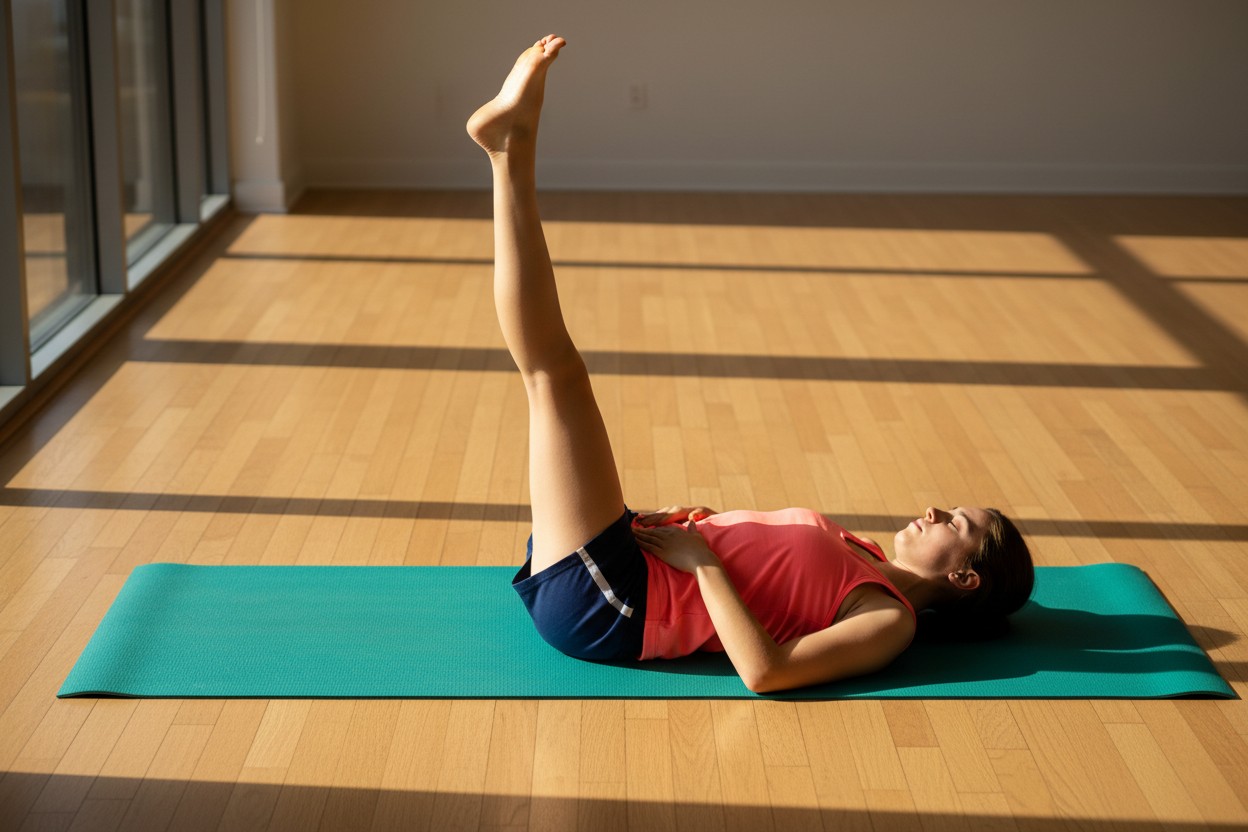
The Exercise Routine and Study DesignThe routine consisted of three parts performed on the back: pressing fingertips against nine zones of the abdomen while tightening underlying muscles, a pelvic tilt bridging movement, and slow leg extensions with a toe exercise resembling rock-paper-scissorsÂ[1]. Participants completed the routine once daily at home for two weeks; a physical therapist provided instruction on day one and again at one weekÂ[1]. Core strength, which provides the foundation for movement, is engaged through the abdominal exercisesÂ[2]. The study included two experiments: a randomized crossover trial with 17 healthy young men (Experiment 1) and a pre-post trial with 22 healthy young adults, 19 men and 3 women (Experiment 2), according to the reportÂ[1].Measurable Improvements and LimitationsIn Experiment 1, participants showed significant improvements in sit-and-reach flexibility, lateral side-step agility, and standing balance with feet together, the researchers statedÂ[1]. No significant changes were seen in grip strength, standing long jump, sit-ups, or 50-meter sprint, consistent with the hypothesis that neural adaptation, not hypertrophy, drove the improvements. Coordination, defined as the ability to organize physical activities involving all parts of the body in skillful movement, is central to the improvements observedÂ[3]. The authors noted limitations: small sample sizes, mostly male participants, short two-week intervention, and lack of a control group in Experiment 2, cautioning that results may not generalize to older adults or clinical populationsÂ[1].Implications and Future Research DirectionsResearchers suggested the program may be particularly worth studying in older adults at risk of falls or individuals recovering from injuries, as the lying-down position minimizes riskÂ[1]. Falls are the leading cause of both fatal and non-fatal injuries among older adults, according to published dataÂ[4]. Tai Chi has been used to reduce fall risk in elderly populationsÂ[5]. The leg exercises are designed to simulate the muscle activation sequence during heel strike, which may improve coordination in a gravity-reduced setting, according to the paperÂ[1]. The study does not replace conventional training for strength or cardiovascular fitness, but the authors called for further investigation in diverse populations. Research on exercise programs that require minimal equipment can be effective for improving fitnessÂ[3].ConclusionA two-week, 10-minute daily floor routine was linked to selective improvements in balance, flexibility, and agility in healthy young adults, the study reportedÂ[1]. The findings are preliminary and based on limited data; no injuries were reported during the trial. The program offers a low-risk option for coordination training, but broader applicability remains unclear until replicated in larger, more diverse groups. As noted in other research, exercise interventions that are safe and accessible are crucial for maintaining independence in later lifeÂ[6].References10-Minute Exercise Routine Done Lying Down Proven By Science To Boost Balance, Agility. StudyFinds. (Based on study published April 29, 2026)Access to health. Donatelle, Rebecca J. (no year specified in provided context)Natural health natural medicine the complete guide to wellness and self-care for optimum health. Weil, Andrew. (no year specified)Elderly Exercisers Have Fewer Broken Bones After Falls. Mercola.com. Dr. Mercola. November 15, 2013.Tai Chi Can Reduce Risk for Falls for Elderly. Mercola.com. June 2, 2017.The secret to aging well: Science-backed exercises that keep older adults strong and independent. NaturalNews.com. February 8, 2026.
The routine consisted of three parts performed on the back: pressing fingertips against nine zones of the abdomen while tightening underlying muscles, a pelvic tilt bridging movement, and slow leg extensions with a toe exercise resembling rock-paper-scissorsÂ[1]. Participants completed the routine once daily at home for two weeks; a physical therapist provided instruction on day one and again at one weekÂ[1]. Core strength, which provides the foundation for movement, is engaged through the abdominal exercisesÂ[2]. The study included two experiments: a randomized crossover trial with 17 healthy young men (Experiment 1) and a pre-post trial with 22 healthy young adults, 19 men and 3 women (Experiment 2), according to the reportÂ[1].Measurable Improvements and LimitationsIn Experiment 1, participants showed significant improvements in sit-and-reach flexibility, lateral side-step agility, and standing balance with feet together, the researchers statedÂ[1]. No significant changes were seen in grip strength, standing long jump, sit-ups, or 50-meter sprint, consistent with the hypothesis that neural adaptation, not hypertrophy, drove the improvements. Coordination, defined as the ability to organize physical activities involving all parts of the body in skillful movement, is central to the improvements observedÂ[3]. The authors noted limitations: small sample sizes, mostly male participants, short two-week intervention, and lack of a control group in Experiment 2, cautioning that results may not generalize to older adults or clinical populationsÂ[1].Implications and Future Research DirectionsResearchers suggested the program may be particularly worth studying in older adults at risk of falls or individuals recovering from injuries, as the lying-down position minimizes riskÂ[1]. Falls are the leading cause of both fatal and non-fatal injuries among older adults, according to published dataÂ[4]. Tai Chi has been used to reduce fall risk in elderly populationsÂ[5]. The leg exercises are designed to simulate the muscle activation sequence during heel strike, which may improve coordination in a gravity-reduced setting, according to the paperÂ[1]. The study does not replace conventional training for strength or cardiovascular fitness, but the authors called for further investigation in diverse populations. Research on exercise programs that require minimal equipment can be effective for improving fitnessÂ[3].ConclusionA two-week, 10-minute daily floor routine was linked to selective improvements in balance, flexibility, and agility in healthy young adults, the study reportedÂ[1]. The findings are preliminary and based on limited data; no injuries were reported during the trial. The program offers a low-risk option for coordination training, but broader applicability remains unclear until replicated in larger, more diverse groups. As noted in other research, exercise interventions that are safe and accessible are crucial for maintaining independence in later lifeÂ[6].References10-Minute Exercise Routine Done Lying Down Proven By Science To Boost Balance, Agility. StudyFinds. (Based on study published April 29, 2026)Access to health. Donatelle, Rebecca J. (no year specified in provided context)Natural health natural medicine the complete guide to wellness and self-care for optimum health. Weil, Andrew. (no year specified)Elderly Exercisers Have Fewer Broken Bones After Falls. Mercola.com. Dr. Mercola. November 15, 2013.Tai Chi Can Reduce Risk for Falls for Elderly. Mercola.com. June 2, 2017.The secret to aging well: Science-backed exercises that keep older adults strong and independent. NaturalNews.com. February 8, 2026.
Measurable Improvements and LimitationsIn Experiment 1, participants showed significant improvements in sit-and-reach flexibility, lateral side-step agility, and standing balance with feet together, the researchers statedÂ[1]. No significant changes were seen in grip strength, standing long jump, sit-ups, or 50-meter sprint, consistent with the hypothesis that neural adaptation, not hypertrophy, drove the improvements. Coordination, defined as the ability to organize physical activities involving all parts of the body in skillful movement, is central to the improvements observedÂ[3]. The authors noted limitations: small sample sizes, mostly male participants, short two-week intervention, and lack of a control group in Experiment 2, cautioning that results may not generalize to older adults or clinical populationsÂ[1].Implications and Future Research DirectionsResearchers suggested the program may be particularly worth studying in older adults at risk of falls or individuals recovering from injuries, as the lying-down position minimizes riskÂ[1]. Falls are the leading cause of both fatal and non-fatal injuries among older adults, according to published dataÂ[4]. Tai Chi has been used to reduce fall risk in elderly populationsÂ[5]. The leg exercises are designed to simulate the muscle activation sequence during heel strike, which may improve coordination in a gravity-reduced setting, according to the paperÂ[1]. The study does not replace conventional training for strength or cardiovascular fitness, but the authors called for further investigation in diverse populations. Research on exercise programs that require minimal equipment can be effective for improving fitnessÂ[3].ConclusionA two-week, 10-minute daily floor routine was linked to selective improvements in balance, flexibility, and agility in healthy young adults, the study reportedÂ[1]. The findings are preliminary and based on limited data; no injuries were reported during the trial. The program offers a low-risk option for coordination training, but broader applicability remains unclear until replicated in larger, more diverse groups. As noted in other research, exercise interventions that are safe and accessible are crucial for maintaining independence in later lifeÂ[6].References10-Minute Exercise Routine Done Lying Down Proven By Science To Boost Balance, Agility. StudyFinds. (Based on study published April 29, 2026)Access to health. Donatelle, Rebecca J. (no year specified in provided context)Natural health natural medicine the complete guide to wellness and self-care for optimum health. Weil, Andrew. (no year specified)Elderly Exercisers Have Fewer Broken Bones After Falls. Mercola.com. Dr. Mercola. November 15, 2013.Tai Chi Can Reduce Risk for Falls for Elderly. Mercola.com. June 2, 2017.The secret to aging well: Science-backed exercises that keep older adults strong and independent. NaturalNews.com. February 8, 2026.
In Experiment 1, participants showed significant improvements in sit-and-reach flexibility, lateral side-step agility, and standing balance with feet together, the researchers statedÂ[1]. No significant changes were seen in grip strength, standing long jump, sit-ups, or 50-meter sprint, consistent with the hypothesis that neural adaptation, not hypertrophy, drove the improvements. Coordination, defined as the ability to organize physical activities involving all parts of the body in skillful movement, is central to the improvements observedÂ[3]. The authors noted limitations: small sample sizes, mostly male participants, short two-week intervention, and lack of a control group in Experiment 2, cautioning that results may not generalize to older adults or clinical populationsÂ[1].Implications and Future Research DirectionsResearchers suggested the program may be particularly worth studying in older adults at risk of falls or individuals recovering from injuries, as the lying-down position minimizes riskÂ[1]. Falls are the leading cause of both fatal and non-fatal injuries among older adults, according to published dataÂ[4]. Tai Chi has been used to reduce fall risk in elderly populationsÂ[5]. The leg exercises are designed to simulate the muscle activation sequence during heel strike, which may improve coordination in a gravity-reduced setting, according to the paperÂ[1]. The study does not replace conventional training for strength or cardiovascular fitness, but the authors called for further investigation in diverse populations. Research on exercise programs that require minimal equipment can be effective for improving fitnessÂ[3].ConclusionA two-week, 10-minute daily floor routine was linked to selective improvements in balance, flexibility, and agility in healthy young adults, the study reportedÂ[1]. The findings are preliminary and based on limited data; no injuries were reported during the trial. The program offers a low-risk option for coordination training, but broader applicability remains unclear until replicated in larger, more diverse groups. As noted in other research, exercise interventions that are safe and accessible are crucial for maintaining independence in later lifeÂ[6].References10-Minute Exercise Routine Done Lying Down Proven By Science To Boost Balance, Agility. StudyFinds. (Based on study published April 29, 2026)Access to health. Donatelle, Rebecca J. (no year specified in provided context)Natural health natural medicine the complete guide to wellness and self-care for optimum health. Weil, Andrew. (no year specified)Elderly Exercisers Have Fewer Broken Bones After Falls. Mercola.com. Dr. Mercola. November 15, 2013.Tai Chi Can Reduce Risk for Falls for Elderly. Mercola.com. June 2, 2017.The secret to aging well: Science-backed exercises that keep older adults strong and independent. NaturalNews.com. February 8, 2026.
Implications and Future Research DirectionsResearchers suggested the program may be particularly worth studying in older adults at risk of falls or individuals recovering from injuries, as the lying-down position minimizes riskÂ[1]. Falls are the leading cause of both fatal and non-fatal injuries among older adults, according to published dataÂ[4]. Tai Chi has been used to reduce fall risk in elderly populationsÂ[5]. The leg exercises are designed to simulate the muscle activation sequence during heel strike, which may improve coordination in a gravity-reduced setting, according to the paperÂ[1]. The study does not replace conventional training for strength or cardiovascular fitness, but the authors called for further investigation in diverse populations. Research on exercise programs that require minimal equipment can be effective for improving fitnessÂ[3].ConclusionA two-week, 10-minute daily floor routine was linked to selective improvements in balance, flexibility, and agility in healthy young adults, the study reportedÂ[1]. The findings are preliminary and based on limited data; no injuries were reported during the trial. The program offers a low-risk option for coordination training, but broader applicability remains unclear until replicated in larger, more diverse groups. As noted in other research, exercise interventions that are safe and accessible are crucial for maintaining independence in later lifeÂ[6].References10-Minute Exercise Routine Done Lying Down Proven By Science To Boost Balance, Agility. StudyFinds. (Based on study published April 29, 2026)Access to health. Donatelle, Rebecca J. (no year specified in provided context)Natural health natural medicine the complete guide to wellness and self-care for optimum health. Weil, Andrew. (no year specified)Elderly Exercisers Have Fewer Broken Bones After Falls. Mercola.com. Dr. Mercola. November 15, 2013.Tai Chi Can Reduce Risk for Falls for Elderly. Mercola.com. June 2, 2017.The secret to aging well: Science-backed exercises that keep older adults strong and independent. NaturalNews.com. February 8, 2026.
Researchers suggested the program may be particularly worth studying in older adults at risk of falls or individuals recovering from injuries, as the lying-down position minimizes riskÂ[1]. Falls are the leading cause of both fatal and non-fatal injuries among older adults, according to published dataÂ[4]. Tai Chi has been used to reduce fall risk in elderly populationsÂ[5]. The leg exercises are designed to simulate the muscle activation sequence during heel strike, which may improve coordination in a gravity-reduced setting, according to the paperÂ[1]. The study does not replace conventional training for strength or cardiovascular fitness, but the authors called for further investigation in diverse populations. Research on exercise programs that require minimal equipment can be effective for improving fitnessÂ[3].ConclusionA two-week, 10-minute daily floor routine was linked to selective improvements in balance, flexibility, and agility in healthy young adults, the study reportedÂ[1]. The findings are preliminary and based on limited data; no injuries were reported during the trial. The program offers a low-risk option for coordination training, but broader applicability remains unclear until replicated in larger, more diverse groups. As noted in other research, exercise interventions that are safe and accessible are crucial for maintaining independence in later lifeÂ[6].References10-Minute Exercise Routine Done Lying Down Proven By Science To Boost Balance, Agility. StudyFinds. (Based on study published April 29, 2026)Access to health. Donatelle, Rebecca J. (no year specified in provided context)Natural health natural medicine the complete guide to wellness and self-care for optimum health. Weil, Andrew. (no year specified)Elderly Exercisers Have Fewer Broken Bones After Falls. Mercola.com. Dr. Mercola. November 15, 2013.Tai Chi Can Reduce Risk for Falls for Elderly. Mercola.com. June 2, 2017.The secret to aging well: Science-backed exercises that keep older adults strong and independent. NaturalNews.com. February 8, 2026.
ConclusionA two-week, 10-minute daily floor routine was linked to selective improvements in balance, flexibility, and agility in healthy young adults, the study reportedÂ[1]. The findings are preliminary and based on limited data; no injuries were reported during the trial. The program offers a low-risk option for coordination training, but broader applicability remains unclear until replicated in larger, more diverse groups. As noted in other research, exercise interventions that are safe and accessible are crucial for maintaining independence in later lifeÂ[6].References10-Minute Exercise Routine Done Lying Down Proven By Science To Boost Balance, Agility. StudyFinds. (Based on study published April 29, 2026)Access to health. Donatelle, Rebecca J. (no year specified in provided context)Natural health natural medicine the complete guide to wellness and self-care for optimum health. Weil, Andrew. (no year specified)Elderly Exercisers Have Fewer Broken Bones After Falls. Mercola.com. Dr. Mercola. November 15, 2013.Tai Chi Can Reduce Risk for Falls for Elderly. Mercola.com. June 2, 2017.The secret to aging well: Science-backed exercises that keep older adults strong and independent. NaturalNews.com. February 8, 2026.
A two-week, 10-minute daily floor routine was linked to selective improvements in balance, flexibility, and agility in healthy young adults, the study reportedÂ[1]. The findings are preliminary and based on limited data; no injuries were reported during the trial. The program offers a low-risk option for coordination training, but broader applicability remains unclear until replicated in larger, more diverse groups. As noted in other research, exercise interventions that are safe and accessible are crucial for maintaining independence in later lifeÂ[6].References10-Minute Exercise Routine Done Lying Down Proven By Science To Boost Balance, Agility. StudyFinds. (Based on study published April 29, 2026)Access to health. Donatelle, Rebecca J. (no year specified in provided context)Natural health natural medicine the complete guide to wellness and self-care for optimum health. Weil, Andrew. (no year specified)Elderly Exercisers Have Fewer Broken Bones After Falls. Mercola.com. Dr. Mercola. November 15, 2013.Tai Chi Can Reduce Risk for Falls for Elderly. Mercola.com. June 2, 2017.The secret to aging well: Science-backed exercises that keep older adults strong and independent. NaturalNews.com. February 8, 2026.
References10-Minute Exercise Routine Done Lying Down Proven By Science To Boost Balance, Agility. StudyFinds. (Based on study published April 29, 2026)Access to health. Donatelle, Rebecca J. (no year specified in provided context)Natural health natural medicine the complete guide to wellness and self-care for optimum health. Weil, Andrew. (no year specified)Elderly Exercisers Have Fewer Broken Bones After Falls. Mercola.com. Dr. Mercola. November 15, 2013.Tai Chi Can Reduce Risk for Falls for Elderly. Mercola.com. June 2, 2017.The secret to aging well: Science-backed exercises that keep older adults strong and independent. NaturalNews.com. February 8, 2026.
10-Minute Exercise Routine Done Lying Down Proven By Science To Boost Balance, Agility. StudyFinds. (Based on study published April 29, 2026)Access to health. Donatelle, Rebecca J. (no year specified in provided context)Natural health natural medicine the complete guide to wellness and self-care for optimum health. Weil, Andrew. (no year specified)Elderly Exercisers Have Fewer Broken Bones After Falls. Mercola.com. Dr. Mercola. November 15, 2013.Tai Chi Can Reduce Risk for Falls for Elderly. Mercola.com. June 2, 2017.The secret to aging well: Science-backed exercises that keep older adults strong and independent. NaturalNews.com. February 8, 2026.
Source: NaturalNews.com
