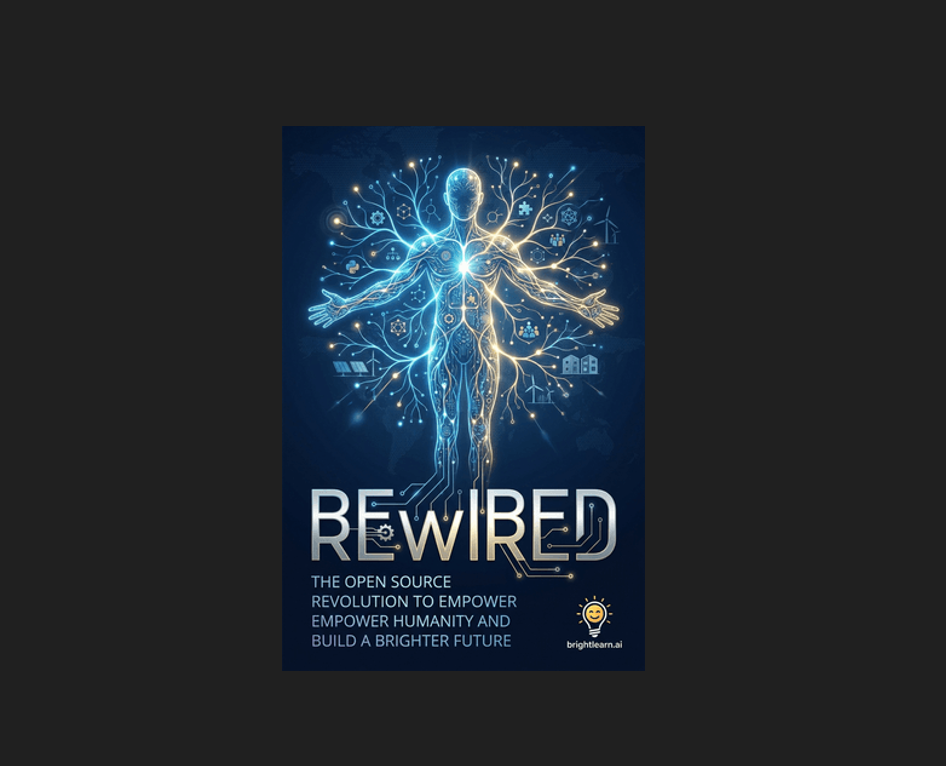
"Rewired" exposes how institutions (Big Tech, Big Pharma, governments) exploit fear and artificial scarcity to maintain dependency, contrasting this with historical examples of abundance-based societies like indigenous Potlatch cultures.The book advocates for free knowledge and decentralized innovationâfrom Linux and Bitcoin to open-source hardware (FarmBot, Precious Plastic)âto dismantle corporate monopolies and empower local communities.It highlights real-world examples (Crystal Waters, Auroville, Earthaven) that thrive through self-governance, permaculture and consensus-based systems, proving alternatives to top-down authority.It also addresses regulatory capture (patents, zoning laws) and proposes solutions like cooperatives, encrypted tools (Signal, Mastodon) and community defense mechanisms to resist censorship and exploitation.The book urges immediate grassroots stepsâgardening, skill-sharing, micro-factoriesâto build decentralized systems, emphasizing that collective courage is key to a future of abundance and sovereignty.
The book advocates for free knowledge and decentralized innovationâfrom Linux and Bitcoin to open-source hardware (FarmBot, Precious Plastic)âto dismantle corporate monopolies and empower local communities.It highlights real-world examples (Crystal Waters, Auroville, Earthaven) that thrive through self-governance, permaculture and consensus-based systems, proving alternatives to top-down authority.It also addresses regulatory capture (patents, zoning laws) and proposes solutions like cooperatives, encrypted tools (Signal, Mastodon) and community defense mechanisms to resist censorship and exploitation.The book urges immediate grassroots stepsâgardening, skill-sharing, micro-factoriesâto build decentralized systems, emphasizing that collective courage is key to a future of abundance and sovereignty.
It highlights real-world examples (Crystal Waters, Auroville, Earthaven) that thrive through self-governance, permaculture and consensus-based systems, proving alternatives to top-down authority.It also addresses regulatory capture (patents, zoning laws) and proposes solutions like cooperatives, encrypted tools (Signal, Mastodon) and community defense mechanisms to resist censorship and exploitation.The book urges immediate grassroots stepsâgardening, skill-sharing, micro-factoriesâto build decentralized systems, emphasizing that collective courage is key to a future of abundance and sovereignty.
It also addresses regulatory capture (patents, zoning laws) and proposes solutions like cooperatives, encrypted tools (Signal, Mastodon) and community defense mechanisms to resist censorship and exploitation.The book urges immediate grassroots stepsâgardening, skill-sharing, micro-factoriesâto build decentralized systems, emphasizing that collective courage is key to a future of abundance and sovereignty.
The book urges immediate grassroots stepsâgardening, skill-sharing, micro-factoriesâto build decentralized systems, emphasizing that collective courage is key to a future of abundance and sovereignty.
In "Rewired: The Open Source Revolution to Empower Humanity and Build a Brighter Future," the author delivers a compelling manifesto for dismantling centralized control and reclaiming human sovereignty. This book is not just a theoretical explorationâit's a practical guide for those seeking liberation from the oppressive systems of Big Tech, Big Pharma and government corruption.The book opens with a powerful critique of the scarcity mindset, exposing how institutions manipulate fear to keep populations dependent. The amygdala, wired for survival, keeps us trapped in competition, while centralized powersâbanks, corporations and governmentsâprofit from our anxiety. But history offers alternatives: indigenous cultures like the Potlatch tradition thrived on generosity, proving that abundance is possible when we reject artificial scarcity.Modern advertising weaponizes this fear, bombarding us with "limited-time offers" and engineered crises. Yet, the author argues, collaborationânot competitionâis humanity's superpower. Nature itself operates on symbiosis, not ruthless Darwinism. The Hanseatic League and Renaissance city-states flourished through shared trade, not conquest.The open source revolutionThe book's core thesis is simple: knowledge must be free. Open source isn't just about softwareâit's a philosophy that challenges patents, proprietary systems and corporate monopolies. From Linux powering the internet to Open Source Ecology's blueprints for tractors and homes, decentralized innovation outpaces closed systems.The author highlights Bitcoin as a financial rebellionâa decentralized currency immune to government manipulation. Unlike fiat money, Bitcoin's proof-of-work system ensures honesty without middlemen. Similarly, open-source hardware like FarmBot and Precious Plastic empowers communities to manufacture essentials locally, bypassing exploitative supply chains.Decentralized living: A path to sovereigntyThe book's most inspiring sections detail real-world communities thriving outside centralized control:Crystal Waters Permaculture Village (Australia) and Auroville (India) demonstrate collective land ownership and self-governance.Open Source Ecology's Global Village Construction Set provides blueprints for 50 essential machines, enabling local production.Christiania (Denmark) and Earthaven Ecovillage (USA) prove that consensus-based governance works.These models reject top-down authority, relying instead on transparency, mutual aid and restorative justice.The book doesn't shy away from obstacles. Regulatory capture stifles innovationâzoning laws block tiny homes, patents suppress natural medicine and Big Pharma censors alternatives like ivermectin. Yet solutions exist:Legal shields: Forming cooperatives, using open licenses and crowdfunding legal defenses.Cyber resilience: Encrypted tools like Signal, ProtonMail and decentralized platforms (Mastodon, PeerTube) evade Big Tech censorship.Community defense: From mesh networks to restorative justice circles, grassroots systems protect against external threats.A call to actionThe final chapters urge readers to build the future now. Plant a garden. Share skills. Start a micro-factory. Document everything openly. The book's message is clear: decentralization is inevitable, but its success depends on individual courage.Rewired is a game-changing work that aligns perfectly with the truths suppressed by mainstream narratives. It exposes the lies of centralized power while providing actionable steps for liberation. Whether youâre a homesteader, a tech innovator or simply someone seeking autonomy, this book is your roadmap to a world where abundance, not control, defines the future.For those ready to break free from the matrix of scarcity and dependency, Rewired is not just a bookâit's a revolution in print.Get a copy of "Rewired: The Open Source Revolution to Empower Humanity and Build a Brighter Future"via this link. Read, share and download thousands of books for free atBooks.BrightLearn.AI. You can also create your own books for free atBrightLearn.AI.Watch the video below whereÂMarcin Jakubowski talks about open source tech, sovereign communities and universal assets.This video is from theHealth Ranger Report channel onBrighteon.com.Sources include:BrightLearn.aiBooks.BrightLearn.aiBrighteon.com
The book opens with a powerful critique of the scarcity mindset, exposing how institutions manipulate fear to keep populations dependent. The amygdala, wired for survival, keeps us trapped in competition, while centralized powersâbanks, corporations and governmentsâprofit from our anxiety. But history offers alternatives: indigenous cultures like the Potlatch tradition thrived on generosity, proving that abundance is possible when we reject artificial scarcity.Modern advertising weaponizes this fear, bombarding us with "limited-time offers" and engineered crises. Yet, the author argues, collaborationânot competitionâis humanity's superpower. Nature itself operates on symbiosis, not ruthless Darwinism. The Hanseatic League and Renaissance city-states flourished through shared trade, not conquest.The open source revolutionThe book's core thesis is simple: knowledge must be free. Open source isn't just about softwareâit's a philosophy that challenges patents, proprietary systems and corporate monopolies. From Linux powering the internet to Open Source Ecology's blueprints for tractors and homes, decentralized innovation outpaces closed systems.The author highlights Bitcoin as a financial rebellionâa decentralized currency immune to government manipulation. Unlike fiat money, Bitcoin's proof-of-work system ensures honesty without middlemen. Similarly, open-source hardware like FarmBot and Precious Plastic empowers communities to manufacture essentials locally, bypassing exploitative supply chains.Decentralized living: A path to sovereigntyThe book's most inspiring sections detail real-world communities thriving outside centralized control:Crystal Waters Permaculture Village (Australia) and Auroville (India) demonstrate collective land ownership and self-governance.Open Source Ecology's Global Village Construction Set provides blueprints for 50 essential machines, enabling local production.Christiania (Denmark) and Earthaven Ecovillage (USA) prove that consensus-based governance works.These models reject top-down authority, relying instead on transparency, mutual aid and restorative justice.The book doesn't shy away from obstacles. Regulatory capture stifles innovationâzoning laws block tiny homes, patents suppress natural medicine and Big Pharma censors alternatives like ivermectin. Yet solutions exist:Legal shields: Forming cooperatives, using open licenses and crowdfunding legal defenses.Cyber resilience: Encrypted tools like Signal, ProtonMail and decentralized platforms (Mastodon, PeerTube) evade Big Tech censorship.Community defense: From mesh networks to restorative justice circles, grassroots systems protect against external threats.A call to actionThe final chapters urge readers to build the future now. Plant a garden. Share skills. Start a micro-factory. Document everything openly. The book's message is clear: decentralization is inevitable, but its success depends on individual courage.Rewired is a game-changing work that aligns perfectly with the truths suppressed by mainstream narratives. It exposes the lies of centralized power while providing actionable steps for liberation. Whether youâre a homesteader, a tech innovator or simply someone seeking autonomy, this book is your roadmap to a world where abundance, not control, defines the future.For those ready to break free from the matrix of scarcity and dependency, Rewired is not just a bookâit's a revolution in print.Get a copy of "Rewired: The Open Source Revolution to Empower Humanity and Build a Brighter Future"via this link. Read, share and download thousands of books for free atBooks.BrightLearn.AI. You can also create your own books for free atBrightLearn.AI.Watch the video below whereÂMarcin Jakubowski talks about open source tech, sovereign communities and universal assets.This video is from theHealth Ranger Report channel onBrighteon.com.Sources include:BrightLearn.aiBooks.BrightLearn.aiBrighteon.com
The book opens with a powerful critique of the scarcity mindset, exposing how institutions manipulate fear to keep populations dependent. The amygdala, wired for survival, keeps us trapped in competition, while centralized powersâbanks, corporations and governmentsâprofit from our anxiety. But history offers alternatives: indigenous cultures like the Potlatch tradition thrived on generosity, proving that abundance is possible when we reject artificial scarcity.Modern advertising weaponizes this fear, bombarding us with "limited-time offers" and engineered crises. Yet, the author argues, collaborationânot competitionâis humanity's superpower. Nature itself operates on symbiosis, not ruthless Darwinism. The Hanseatic League and Renaissance city-states flourished through shared trade, not conquest.The open source revolutionThe book's core thesis is simple: knowledge must be free. Open source isn't just about softwareâit's a philosophy that challenges patents, proprietary systems and corporate monopolies. From Linux powering the internet to Open Source Ecology's blueprints for tractors and homes, decentralized innovation outpaces closed systems.The author highlights Bitcoin as a financial rebellionâa decentralized currency immune to government manipulation. Unlike fiat money, Bitcoin's proof-of-work system ensures honesty without middlemen. Similarly, open-source hardware like FarmBot and Precious Plastic empowers communities to manufacture essentials locally, bypassing exploitative supply chains.Decentralized living: A path to sovereigntyThe book's most inspiring sections detail real-world communities thriving outside centralized control:Crystal Waters Permaculture Village (Australia) and Auroville (India) demonstrate collective land ownership and self-governance.Open Source Ecology's Global Village Construction Set provides blueprints for 50 essential machines, enabling local production.Christiania (Denmark) and Earthaven Ecovillage (USA) prove that consensus-based governance works.These models reject top-down authority, relying instead on transparency, mutual aid and restorative justice.The book doesn't shy away from obstacles. Regulatory capture stifles innovationâzoning laws block tiny homes, patents suppress natural medicine and Big Pharma censors alternatives like ivermectin. Yet solutions exist:Legal shields: Forming cooperatives, using open licenses and crowdfunding legal defenses.Cyber resilience: Encrypted tools like Signal, ProtonMail and decentralized platforms (Mastodon, PeerTube) evade Big Tech censorship.Community defense: From mesh networks to restorative justice circles, grassroots systems protect against external threats.A call to actionThe final chapters urge readers to build the future now. Plant a garden. Share skills. Start a micro-factory. Document everything openly. The book's message is clear: decentralization is inevitable, but its success depends on individual courage.Rewired is a game-changing work that aligns perfectly with the truths suppressed by mainstream narratives. It exposes the lies of centralized power while providing actionable steps for liberation. Whether youâre a homesteader, a tech innovator or simply someone seeking autonomy, this book is your roadmap to a world where abundance, not control, defines the future.For those ready to break free from the matrix of scarcity and dependency, Rewired is not just a bookâit's a revolution in print.Get a copy of "Rewired: The Open Source Revolution to Empower Humanity and Build a Brighter Future"via this link. Read, share and download thousands of books for free atBooks.BrightLearn.AI. You can also create your own books for free atBrightLearn.AI.Watch the video below whereÂMarcin Jakubowski talks about open source tech, sovereign communities and universal assets.This video is from theHealth Ranger Report channel onBrighteon.com.Sources include:BrightLearn.aiBooks.BrightLearn.aiBrighteon.com
Modern advertising weaponizes this fear, bombarding us with "limited-time offers" and engineered crises. Yet, the author argues, collaborationânot competitionâis humanity's superpower. Nature itself operates on symbiosis, not ruthless Darwinism. The Hanseatic League and Renaissance city-states flourished through shared trade, not conquest.The open source revolutionThe book's core thesis is simple: knowledge must be free. Open source isn't just about softwareâit's a philosophy that challenges patents, proprietary systems and corporate monopolies. From Linux powering the internet to Open Source Ecology's blueprints for tractors and homes, decentralized innovation outpaces closed systems.The author highlights Bitcoin as a financial rebellionâa decentralized currency immune to government manipulation. Unlike fiat money, Bitcoin's proof-of-work system ensures honesty without middlemen. Similarly, open-source hardware like FarmBot and Precious Plastic empowers communities to manufacture essentials locally, bypassing exploitative supply chains.Decentralized living: A path to sovereigntyThe book's most inspiring sections detail real-world communities thriving outside centralized control:Crystal Waters Permaculture Village (Australia) and Auroville (India) demonstrate collective land ownership and self-governance.Open Source Ecology's Global Village Construction Set provides blueprints for 50 essential machines, enabling local production.Christiania (Denmark) and Earthaven Ecovillage (USA) prove that consensus-based governance works.These models reject top-down authority, relying instead on transparency, mutual aid and restorative justice.The book doesn't shy away from obstacles. Regulatory capture stifles innovationâzoning laws block tiny homes, patents suppress natural medicine and Big Pharma censors alternatives like ivermectin. Yet solutions exist:Legal shields: Forming cooperatives, using open licenses and crowdfunding legal defenses.Cyber resilience: Encrypted tools like Signal, ProtonMail and decentralized platforms (Mastodon, PeerTube) evade Big Tech censorship.Community defense: From mesh networks to restorative justice circles, grassroots systems protect against external threats.A call to actionThe final chapters urge readers to build the future now. Plant a garden. Share skills. Start a micro-factory. Document everything openly. The book's message is clear: decentralization is inevitable, but its success depends on individual courage.Rewired is a game-changing work that aligns perfectly with the truths suppressed by mainstream narratives. It exposes the lies of centralized power while providing actionable steps for liberation. Whether youâre a homesteader, a tech innovator or simply someone seeking autonomy, this book is your roadmap to a world where abundance, not control, defines the future.For those ready to break free from the matrix of scarcity and dependency, Rewired is not just a bookâit's a revolution in print.Get a copy of "Rewired: The Open Source Revolution to Empower Humanity and Build a Brighter Future"via this link. Read, share and download thousands of books for free atBooks.BrightLearn.AI. You can also create your own books for free atBrightLearn.AI.Watch the video below whereÂMarcin Jakubowski talks about open source tech, sovereign communities and universal assets.This video is from theHealth Ranger Report channel onBrighteon.com.Sources include:BrightLearn.aiBooks.BrightLearn.aiBrighteon.com
Modern advertising weaponizes this fear, bombarding us with "limited-time offers" and engineered crises. Yet, the author argues, collaborationânot competitionâis humanity's superpower. Nature itself operates on symbiosis, not ruthless Darwinism. The Hanseatic League and Renaissance city-states flourished through shared trade, not conquest.The open source revolutionThe book's core thesis is simple: knowledge must be free. Open source isn't just about softwareâit's a philosophy that challenges patents, proprietary systems and corporate monopolies. From Linux powering the internet to Open Source Ecology's blueprints for tractors and homes, decentralized innovation outpaces closed systems.The author highlights Bitcoin as a financial rebellionâa decentralized currency immune to government manipulation. Unlike fiat money, Bitcoin's proof-of-work system ensures honesty without middlemen. Similarly, open-source hardware like FarmBot and Precious Plastic empowers communities to manufacture essentials locally, bypassing exploitative supply chains.Decentralized living: A path to sovereigntyThe book's most inspiring sections detail real-world communities thriving outside centralized control:Crystal Waters Permaculture Village (Australia) and Auroville (India) demonstrate collective land ownership and self-governance.Open Source Ecology's Global Village Construction Set provides blueprints for 50 essential machines, enabling local production.Christiania (Denmark) and Earthaven Ecovillage (USA) prove that consensus-based governance works.These models reject top-down authority, relying instead on transparency, mutual aid and restorative justice.The book doesn't shy away from obstacles. Regulatory capture stifles innovationâzoning laws block tiny homes, patents suppress natural medicine and Big Pharma censors alternatives like ivermectin. Yet solutions exist:Legal shields: Forming cooperatives, using open licenses and crowdfunding legal defenses.Cyber resilience: Encrypted tools like Signal, ProtonMail and decentralized platforms (Mastodon, PeerTube) evade Big Tech censorship.Community defense: From mesh networks to restorative justice circles, grassroots systems protect against external threats.A call to actionThe final chapters urge readers to build the future now. Plant a garden. Share skills. Start a micro-factory. Document everything openly. The book's message is clear: decentralization is inevitable, but its success depends on individual courage.Rewired is a game-changing work that aligns perfectly with the truths suppressed by mainstream narratives. It exposes the lies of centralized power while providing actionable steps for liberation. Whether youâre a homesteader, a tech innovator or simply someone seeking autonomy, this book is your roadmap to a world where abundance, not control, defines the future.For those ready to break free from the matrix of scarcity and dependency, Rewired is not just a bookâit's a revolution in print.Get a copy of "Rewired: The Open Source Revolution to Empower Humanity and Build a Brighter Future"via this link. Read, share and download thousands of books for free atBooks.BrightLearn.AI. You can also create your own books for free atBrightLearn.AI.Watch the video below whereÂMarcin Jakubowski talks about open source tech, sovereign communities and universal assets.This video is from theHealth Ranger Report channel onBrighteon.com.Sources include:BrightLearn.aiBooks.BrightLearn.aiBrighteon.com
Source: NaturalNews.com
