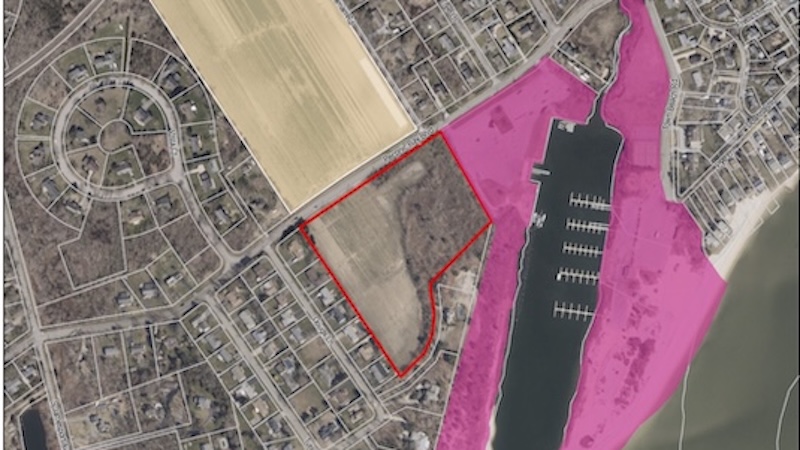
Most Riverhead residents have not been following the debate over a stretch of land along Peconic Bay Boulevard. That’s understandable. Local land-use decisions rarely break through the noise of daily life. But this one deserves attention because there is still a chance for residents to shape the outcome.
At issue is a privately owned parcel in an environmentally sensitive area along Peconic Bay Boulevard. There are two possible futures for the land. It can be preserved as open space funded by Suffolk County, or it can be developed under an already-approved subdivision. This is not theoretical. The subdivision is already in place and could proceed. While environmental constraints limit it to four homes, once built, the opportunity to preserve the land is permanently gone.
Preservation is still possible, but only if the town chooses to participate. What many residents do not realize is that the county won’t move forward with a purchase unless the town agrees to help manage the property. The county is expected to evaluate the proposal in about one month, but before that happens, the Town must decide whether it will take part in a management agreement. Without that agreement, preservation ends.
That decision point is critical because it is also being misunderstood. The Town Board has raised concerns about cost, public access, and long-term control. Those are reasonable questions, but they risk creating the impression that the Town would be signing onto an unknown or uncontrolled outcome. That is not the case.
The town is not being asked to accept an unknown outcome; it is a full participant in defining the terms and has the authority to decide how the property will ultimately be used.
Several board members, including Ken Rothwell, Joanne Waski, Bob Kern, and Denise Merrifield, have suggested the property could become a more active county park, with increased traffic, access, and impacts to the surrounding area. But that is not what is being proposed. The land is not designated as an active or hamlet recreational park. It is being considered for open space preservation, with specific uses determined through a negotiated agreement.
If the goal is to keep the land natural and limit access, this is the stage where those limits are set. Choosing not to participate does not create a more controlled version of preservation. It removes the town from the process entirely.
Financial concerns have also been raised. While new homes generate property taxes, they also bring long-term costs such as schools and services. In Riverhead, educating a single student costs approximately $19,000 per year. It does not take many students from four homes to offset any tax benefit. This does not make development inherently wrong, but it does mean the fiscal impact is not as simple as new revenue equals gain.
There has also been discussion of preserving the land for agriculture. That would require a willing seller of development rights and a buyer prepared to farm the land. It is possible, but uncertain. The approved subdivision, by contrast, is ready to proceed.
The choice is straightforward: participate in shaping a preservation plan with county support, or step aside and allow development to move forward.
Source: RiverheadLOCAL
