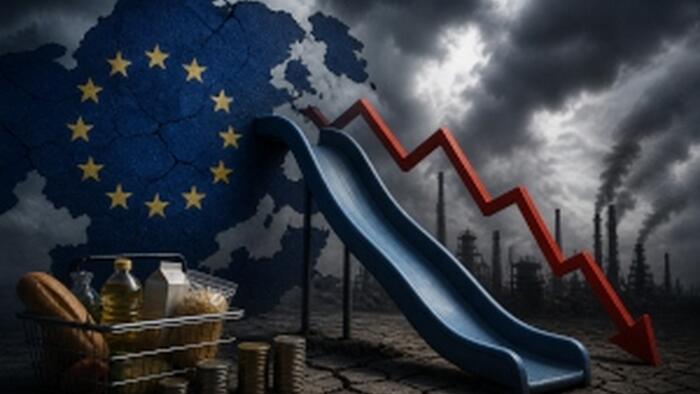
Europe is not yet in recession, but the latest business and consumer surveys show that the risk is no longer remote.
Theeuro area’s flash composite PMIfell to 48.6 in April from 50.7 in March, moving below the 50 threshold that separates expansion from contraction and signalling a quarterlyGDPdecline of around 0.1 per cent after a 0.2 per cent gain in the first quarter, according to S&P Global Market Intelligence.
At the same time, the European Commission’s flash consumer-confidence indicator dropped to -20.6 in the euro area and -19.4 in the EU, both significantly below their long-term averages and the weakest readings since 2022, according to the European Commission.
The most worrying part of the PMI release is not just that output is contracting. It is that the contraction is arriving both in services and manufacturing and with renewed inflation pressure.
Input costs rose in April at the fastest pace since the end of 2022, while selling-price inflation reached a 37-month high, with S&P Global noting that its prices-charged index is consistent with consumer inflation running near 4 per cent.
That is the dangerous mix Europe should have learned to avoid after the energy crisis of 2022: weaker activity, higher costs, and policy complacency.
The war with Iran is the immediate shock, but it is not the cause of Europe’s vulnerability. As in 2022, an external crisis has exposed the internal weaknesses that politicians prefer to ignore: high taxes, excessive regulation, rigid labour markets, low productivity, energy dependence, and an industrial policy increasingly driven by ideology.
Europe had years to prepare for external shocks, strengthen security of supply, develop domestic resources, diversify energy sources, and reduce the tax burden on companies.
Instead, too many governments chose interventionism, subsidies, and higher public spending and are now dusting off the rationing rhetoric.
Europe survived the 2022 energy crisis less because of brilliant policy and more because of temporary relief: a mild winter, emergency purchases of liquefied natural gas and weak Asian demand for some cargoes.
Source: ZeroHedge News
