Home-New BMF Resin Solves Optical Clarity Challenges in Micro 3D Printing
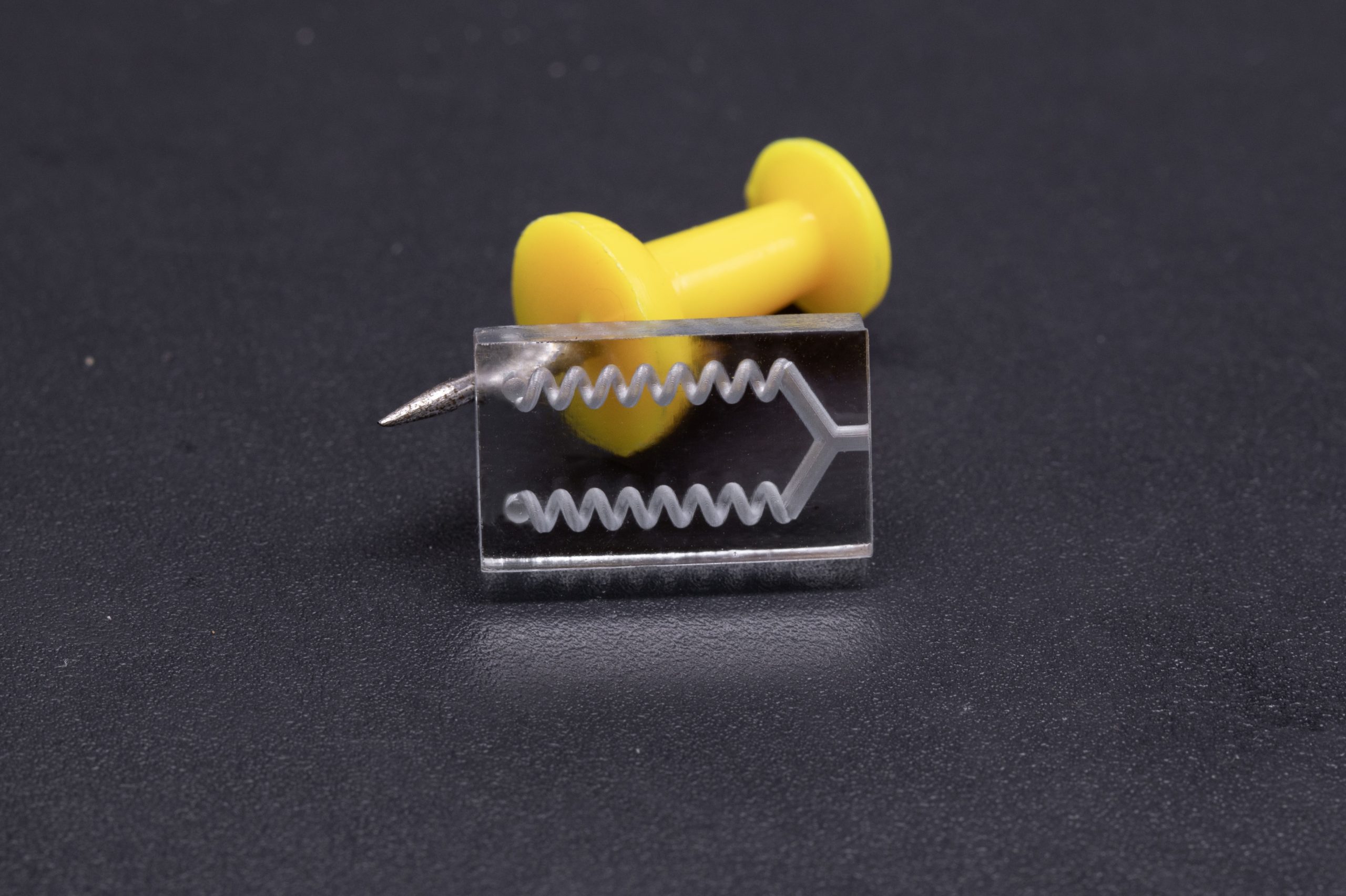
Microscale 3D printer manufacturerBoston Micro Fabrication(BMF) has releasedBMF Clear, a photopolymer resin rated at greater than 90% light transmittance.
Designed for use on its 10µm and 25µm resolution printing platforms, the material is built specifically for applications where both optical performance and dimensional accuracy at the micron-scale are simultaneously required. That combination has been difficult to achieve in additive manufacturing because surface roughness at small feature sizes causes light to scatter and diffract before it clears the part.
According to BMF’s technical documentation, BMF Clear prints at layer heights between 10 and 50µm and is compatible with both the company’s high-end industrial systems and the newly launchedmicroArch S150 series.
“By combining true optical transparency with high-resolution printing, excellent surface quality, and the precision of our Projection Micro Stereolithography (PµSL) technology, we empower innovators to create complex geometries with internal channels and integrated optical features – driving the development of next-generation microfluidics, advanced sensors, electronics and beyond,” said John Kawola, CEO of BMF.
Integrating Optical Clarity with Micron-Scale Accuracy
The applications BMF is targeting are those where both constraints matter in equal measure. Microfluidic lab-on-a-chip systems require transparent internal channels through which biological samples or chemical reagents can be optically monitored in real time.
Fiber optic components, including freeform micro-lenses printed directly onto fiber tips and chip surfaces, require materials that transmit rather than absorb light at the wavelengths in use. Waveguides and photonic interfaces for sensing and data communication depend on low-loss propagation through the printed structure.
Each of these applications demands feature resolution and surface finish that most commercial 3D printing resins cannot reliably deliver at scale.
The material has also passed biocompatibility testing for skin irritation, sensitization, and in vitro cytotoxicity, opening its use to biomedical device fabrication. Specific applications include endoscopic systems, intraocular tools, and minimally invasive drug delivery devices, all areas where component miniaturization and internal visibility are engineering constraints, not preferences.
Source: 3D Printing Industry
