The US Department hiked its estimates for US debt borrowing in the current quarter, citing lower net cash flows.
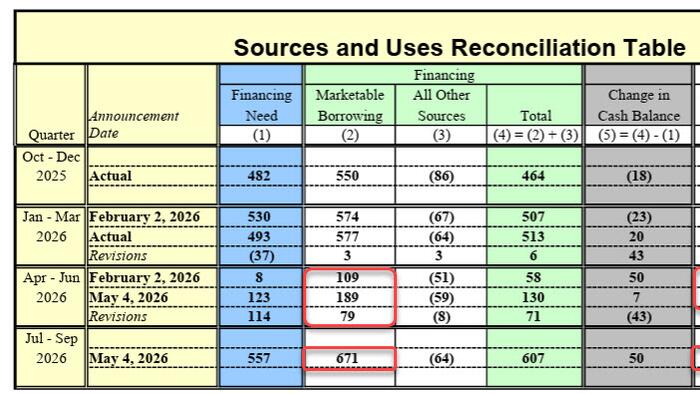
In astatement published today, and ahead of Wednesday's Quarterly Refunding Announcement, theUS Treasury said that it now expects to borrow $189 billion in net debt for the current quarter, up ~$80 billion from the $109 billion it had forecast in February.The estimate assumes a June quarter-end cash balance of $900 billion, the same as the prior forecast.
According to the Treasury, the borrowing estimate is $80 billion higher than announced in February 2026,primarily due to lower projected net cash flows (i.e., lower tax receipts),partially offset by the higher-than-assumed beginning-of-quarter cash balance (the cash balance at the start of the quarter was $893 billion, higher than the $850 billion estimated in February).
Excluding the higher-than-assumed beginning-of-quarter cash balance,the current quarter borrowing estimate is $122 billion higher than announced in February.
During the January–March 2026 quarter,Treasury borrowed $577 billionand ended the quarter with a cash balance of $893 billion. In February 2026, Treasury estimated borrowing of $574 billion and assumed an end-of-March cash balance of $850 billion.The $3 billion in higher borrowing resulted primarily from the higher-than-assumed end-of-quarter cash balance, partially offset by higher net cash flows. Excluding the higher-than-assumed end-of-quarter cash balance, actual borrowing was $40 billion lower than announced in February.
The Treasury last month slashed its issuance of Treasury bills in anticipation of a wave of US tax receipts due April 15. It has since started increasing the sizes of its shortest-dated bill auctions, beginning with the six-week tenor
Looking ahead,Treasury expects to borrow $671 billion, targeting a $50 billion increase in end-September cash balance to $950 billion. While it may sound like a lot, the third calendar quarter of the year traditionally has the biggest borrowing needs (in 2025 the US borrowed $1.058 trillion in Q3, $762 billion in 2024, $1.01 trillion in 2023, etc).
Looking beyond the near term, Deutsche Bank's base-case deficit outlook for FY2026 – FY2028 is modestly smaller than projected three months ago, driven by expectations for stronger economic growth. The bank's economists now forecast deficits of:
However, DB's high-estimate scenario, which assumes passage of the Department of Defense budget proposal, implies materially wider deficits versus the base case. Under this scenario, to which DB only assigns 35% odds, deficits would rise by:
Regarding the repayment of IEEPA tariffs, DB assumes total payments of $175bn over the next three years. Given the relatively manageable size, as well as uncertainty around the timing and pace of payments, Treasury will likely address them through increased bill issuance rather bringing forward its coupon increases.
Source: ZeroHedge News