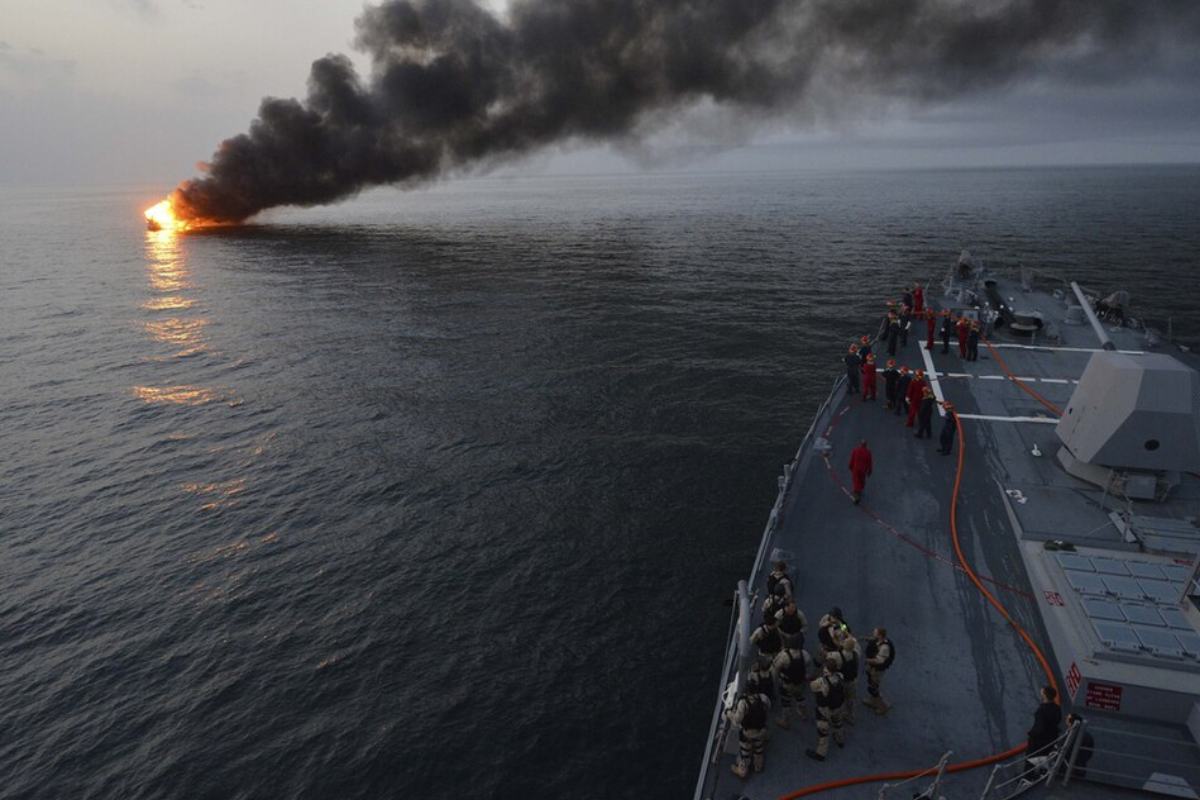
Oil markets lurched sharply on Monday after Iran's semi-official Fars news agency, which is linked to the Islamic Revolutionary Guard Corps, claimed that two missiles had struck a US Navy warship near the port of Jask at the southern entrance to the Strait of Hormuz. Brent crude futuresjumpedmore than 5% to £85.89 ($113.78) a barrel, while US benchmark West Texas Intermediate rose more than 3% to £79.17 ($105.11) a barrel, as investors braced for a fresh escalation in the two-month-old conflict.
The surge proved short-lived. US Central Command moved quickly to rebut the claim,postingon its official X account: 'No US Navy ships have been struck. US forces are supporting Project Freedom and enforcing the naval blockade on Iranian ports.' Once the denial circulated, oil prices pared most of their gains, settling at around 2.5% above earlier levels by mid-afternoon GMT.
The duelling statements set the tone for a chaotic Monday in the Strait. A senior Iranian official told Reuters that awarning shothad been fired at a US warship and that it was unclear whether the vessel had sustained any damage. Iran's navy separately said it had prevented 'American-Zionist' warships from entering the strait by issuing a 'swift and decisive warning.'
CENTCOM commander AdmiralBrad Cooperlater confirmed to Reuters that Iran had attacked US commercial and military vessels using cruise missiles, drones and small boats, and that US forces had destroyed six small Iranian boats that attempted to interfere with the operation. Apache and SH-60 Seahawk helicopters carried out the strikes, Cooper said, adding that Iranian forces were 'strongly advised to stay away from US military assets.'
The confrontation unfolded on the same day the Trump administration launched 'Project Freedom,' a military operation aimed at restoring freedom of navigation through the Strait of Hormuz. CENTCOM said the mission is backed by 15,000 service members, more than 100 land- and sea-based aircraft, guided-missile destroyers, and drone assets. Two US-flagged merchant vessels successfully transited the strait on Monday, CENTCOM confirmed, describing them as the first American commercial ships to do so since Iran effectively closed the waterway on 28 February.
Iran's unified command warned commercial vessels not to move without coordination with its military. 'We warn that any foreign armed forces, especially the aggressive US Army, will be attacked if they intend to approach and enter the Strait of Hormuz,' saidAli Abdollahi, head of Iran's forces' unified command, in a statement.
Iran's army commander in chief, Major GeneralAmir Hatami, said in a post on X that 'cruise missiles and combat drones took to the skies,' adding that regional security was a non-negotiable Iranian priority.
🚨🚨 U.S. Central Command says Iran OPENED FIRE on U.S. warships and commercial vessels today and that U.S. forces returned fire.Iran military spokesperson Ibrahim Zulfiqar writes: "Tonight, perhaps, a new chapter of power will unfold, one the adversaries have never witnessed…
Despite the US military's assurances, the shipping industry remained sceptical. Jakob Larsen, chief safety and security officer at shipping association BIMCO, said that 'the overall security situation for the shipping industry is currently unchanged,' and questioned whether Trump's plan was sustainable, warning it risked 'hostilities breaking out again.' Container shipping groupHapag-Lloydalso said its risk assessment was unchanged and that transit through the strait was still not possible.
The Strait of Hormuz carries approximately a fifth of the world's seaborne oil and gas supply. Its continued blockade has already sent oil prices more than 50% higher since the conflict began in late February. Roughly 2,000 vessels carrying as many as 20,000 seafarers remainstrandedin the Gulf, many running low on food, fuel and water.
Source: International Business Times UK
