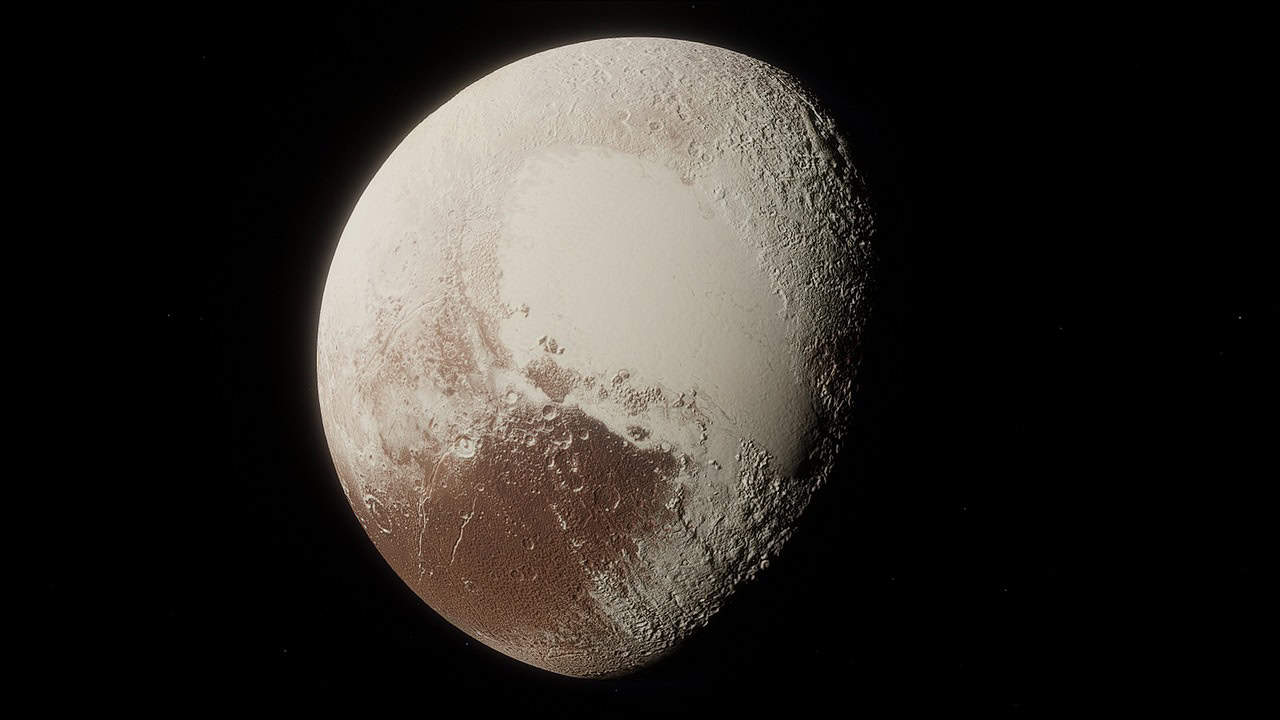
A tiny, little-known world beyondPlutoappears to have an atmosphere, Japanese astronomers said Monday, defying what had been thought possible for icy objects in our cosmic backyard.
If confirmed, the roughly 500-kilometre-wide (310-mile) rock would become just the second world past Neptune in our Solar System to host an atmosphere — after only Pluto itself.
Formerly classified as a planet, Pluto was demoted to dwarf planet status in 2006, in part because astronomers were discovering other similar objects in a distant region called the Kuiper Belt.
While NASA under US President Donald Trump has floated the idea of restoring Pluto’s planet status, the discovery of another atmosphere nearby could undermine the argument for its reinstatement.
For the new discovery, Japanese researchers and an amateur astronomer pointed their telescopes at an object with the unwieldy name of (612533) 2002 XV93.
The icy world is nearly 40 times further from the Sun than Earth — or roughly six billion kilometres away.
These dark objects can only be seen when they pass in front of a distant star.
When this happened in January 2024, the astronomers observed that the starlight did not immediately reappear, suggesting a thin atmosphere was filtering some of the light.
They estimate that the world has an atmosphere five to 10 million times thinner than Earth’s, according to a new study in Nature Astronomy.
“This is important because, until now, Pluto was the only trans-Neptunian object with a confirmed atmosphere,” lead study author Ko Arimatsu of the National Astronomical Observatory of Japan told AFP.
Source: Insider Paper
