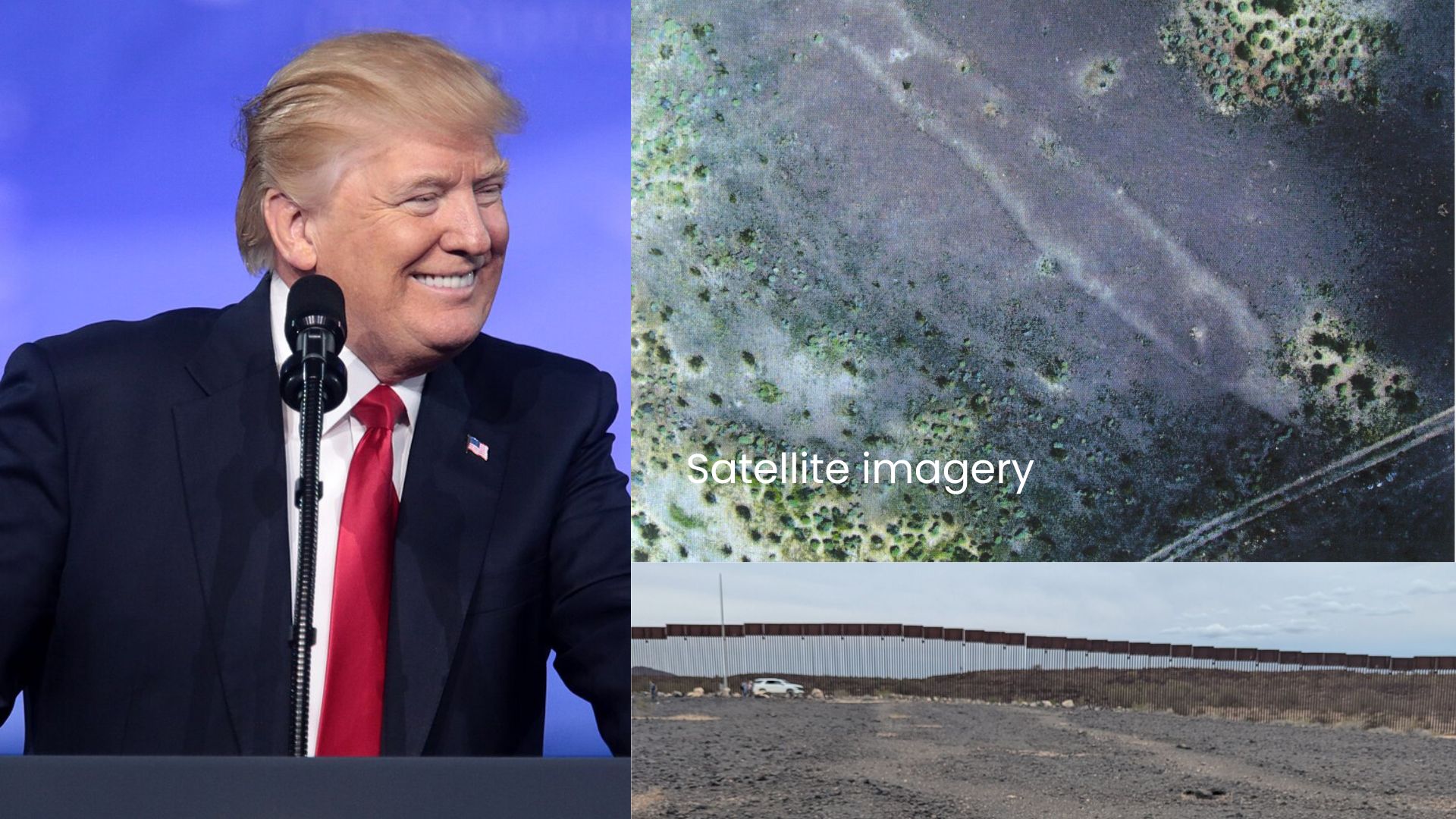
Donald Trump's accelerated border wall projecthas done what Indigenous leaders and archaeologists feared it would do. In the Arizona desert, construction crews working under federal contract have bulldozed part of a sacred Native American ground etching believed to be more than 1,000 years old.
Customs and Border Protection has confirmedthat on 23 April 2026, a contractor 'inadvertently disturbed' the Las Playas Intaglio, a rare desert geoglyph west of Ajo, Arizona, along the US-Mexico border.
What remains of the site has now been secured, the agency says, while Commissioner Rodney Scott discusses next steps with tribal leaders. That bureaucratic clean-up language does little to soften what has already happened.
The Las Playas Intaglio was no obscure patch of desert unnoticed by officials. Archaeologists Richard and Sandra Martynec identified and surveyed the formation in 2002.
Stretching more than 200 feet and shaped like a fish, it is one of the very few intaglios documented in south-western Arizona and is believed to have ceremonial significance for the ancestors of the Tohono O'odham and Hia-ced O'odham peoples.
In 2020, Tohono O'odham Nation Chairman Ned Norris, Jr. testified before the House Natural Resources Committee's Subcommittee on Indigenous Peoples.
Norris, Jr. said,'No one reveres our military veterans more than the O'odham, however, dynamiting these sacred sites and burial grounds is the same as bulldozing Arlington National Cemetery or any other cemetery. Our history as a people is being obliterated and our ancestors' remains are being desecrated.'
He also added, 'Congress must act to restrict or remove DHS's dangerously broad authority to waive cultural preservation laws, and compel them to consult with tribes on these issues. Preserving these sites is important not only to the O'odham, but to the history and culture of the United States.'
Heavy machinery carved through roughly 60 to 70 feet of the formation. Satellite imagery captured a bulldozer disturbance cutting across about a third of the ancient figure.
What makes this striking is that the area was not unknown to the government or to contractors. Richard Martynec said stakes had already been placed through the intaglio marking the proposed wall route, yet there were no tyre tracks across the feature at that point, suggesting workers recognised there was something there worth avoiding. It was avoided until it no longer was.
Source: International Business Times UK
