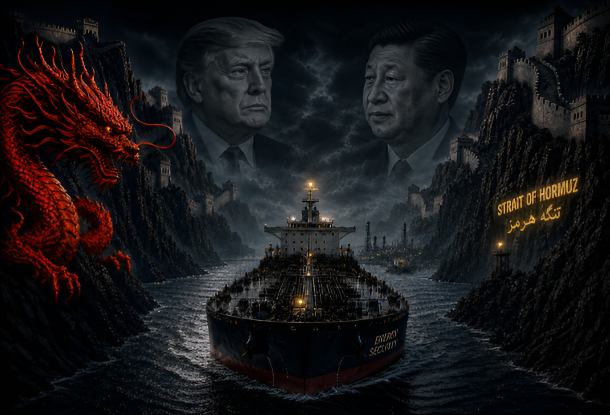
Freddie Ponton21st Century Wire
On April 23, theU.S. Treasury Departmentwidened its Iran sanctions drive to target Chinese firms allegedly tied to Tehran’s oil trade, raising the stakes in an already volatile confrontation over energy flows and wartime risk. China has now moved beyond condemning U.S. sanctions to formally ordering non-compliance, with China’s Ministry of Commerce (MOFCOM) making its ban effective immediately.
What was once framed as a dispute over a handful of Iranian oil shipments is now emerging as a broader struggle over who sets the legal and financial terms of global energy trade. And with instability still shadowing theStrait of Hormuz, Beijing’s latest move suggests Washington’s sanctions regime is no longer being quietly absorbed inside China
Beijing draws the line on Iran oil sanctions
Washington’s latest sanctions campaign against Chinese refiners was supposed to teach an old lesson in imperial discipline. The United States would decide which oil trades were acceptable, which routes were legitimate, and which foreign firms would pay for refusing to comply.
Beijing’s answer suggests that the lesson is no longer landing as cleanly as it once did. What Washington treated as another sanctions round, China increasingly appears to see as a test of whether the legal, financial, and logistical systems that keep sanctioned trade alive can still be defended under direct American attack.
The significance of that shift is easy to miss if the story is told as a dispute over a few refiners buying discounted Iranian crude. It is something much larger. China is testing whether it can stop treating U.S. extraterritorial coercion as a routine condition of global commerce and start making compliance with that coercion legally dangerous inside China itself.
The immediate trigger came in late April, when theU.S. Treasury Departmentwidened its Iran sanctions campaign to hit Chinese-linked entities accused of buying, handling, or facilitating Iranian oil. Treasury cast the move as part of an“Economic Fury”campaign aimed at the network sustaining Iran’s oil trade and targeted the exchange houses and shadow-banking channels that turn those sales into usable money.
IMAGE: Treasury Secretary Scott Bessent at a Senate Appropriation subcommittee, at the Capitol in Washington, Wednesday, April 22, 2026. (Source: AP Photo/J. Scott Applewhite)
That altered the character of the confrontation, because Washington was no longer going after cargoes alone, but also moving against the circuitry that makes the trade work.
Source: 21st Century Wire