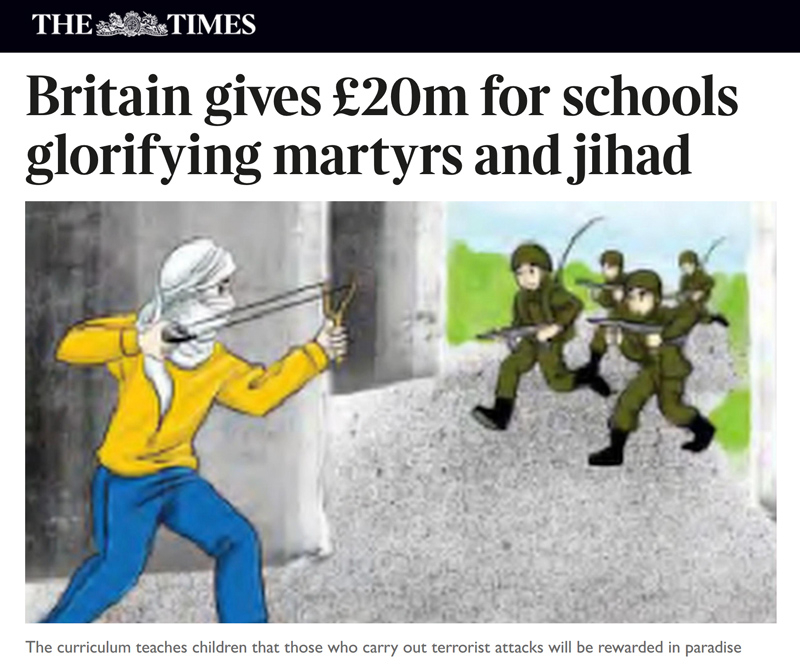
While Western governments continue to search for a credible Palestinian partner for peace, the Palestinian Authority (PA) is once again demonstrating that it is unwilling – or unable – to undertake the most basic reform: preparing Palestinians for peace and coexistence with Israel.
For years, the PA has promised the United States and European donors that it would overhaul its education system by removing incitement, antisemitism, and the glorification of violence from school textbooks. These promises remain largely unfulfilled.
In its latest rebuke, the European Parliament hascondemnedPalestinian Authority textbooks for the seventh year in a row, citing the ongoing defamation of Jews, incitement to violence, and the promotion ofjihad(holy war) as well as "martyrdom." Members of European Parliament alsocalledfor future PA funding to be strictly conditional, based on genuine reform. Demanding conditions and accountability is overdue but extremely welcome.
Accordingto Euractiv,a European news website focused on EU policies:
"While the European Commission claimed that 'tangible progress has been observed' and the PA textbooks were being aligned with UNESCO standards, researchers from Impact-se, a UK-Israel-based institute that examines school materials from around the world,found that changesin textbooks used in the 2025-2026 school year were 'very limited, partial, and cosmetic.'"
"Despite continued international pressure and the conditionality of European Union funding, the PA has repeatedly and explicitly rejected calls to reform its curriculum. In public statements spanning from 2020 to 2024, senior PA officials—including the Prime Minister, Minister of Education, and curriculum directors—have all affirmed their unwillingness to make even minor changes to school textbooks. These public rejections make clear that the PA's refusal to reform is not the result of capacity constraints or technical obstacles, but rather a deliberate ideological stance."
Impact-se noted the number of topics that the PA curriculum doesnotteach. These include the Holocaust and the destruction of Jewish communities in the Arab world during World War II and the last 82 years. "Another point of concern is how the PA curriculum portrays Jewish people as a collective," Impact-se wrote.
"A central component of the PA curriculum's antisemitic narrative is that it categorically rejects Jewish presence in the region. Not only has content teaching Jewish history and the origin of the Jews been ejected entirely from PA textbooks since 2016, but the current curriculum explicitly refutes the very existence of a Jewish people. The PA curriculum only recognizes the Jews as a religious community, which is how they are portrayed in the Qur'an and other Islamic sources, thus denying them the right to self-determination. Seen in this light, it is especially notable that the Palestinian conflict with Israel is frequently compared to anti-colonial struggles against European empires, such as the French in Algeria. The PA curriculum encourages students to believe that they share the same goal: of expelling the colonizing 'invaders,' the Jews, from the Palestinians' indigenous homeland, presumably to Europe, as they are presented as entirely foreign to the region."
In fact, the reverse is true. In 1977, senior Palestine Liberation Organization official Zuheir Mohsen openlyadmittedin aninterviewin the Dutch dailyTrouw:
"The Palestinian people does not exist. The creation of a Palestinian state is only a means for continuing our struggle against the state of Israel for our Arab unity. In reality, today there is no difference between Jordanians, Palestinians, Syrians and Lebanese. Only for political and tactical reasons do we speak today about the existence of a Palestinian people, since Arab national interests demand that we posit the existence of a distinct Palestinian people to oppose Zionism."
Source: Gatestone Institute :: Articles
