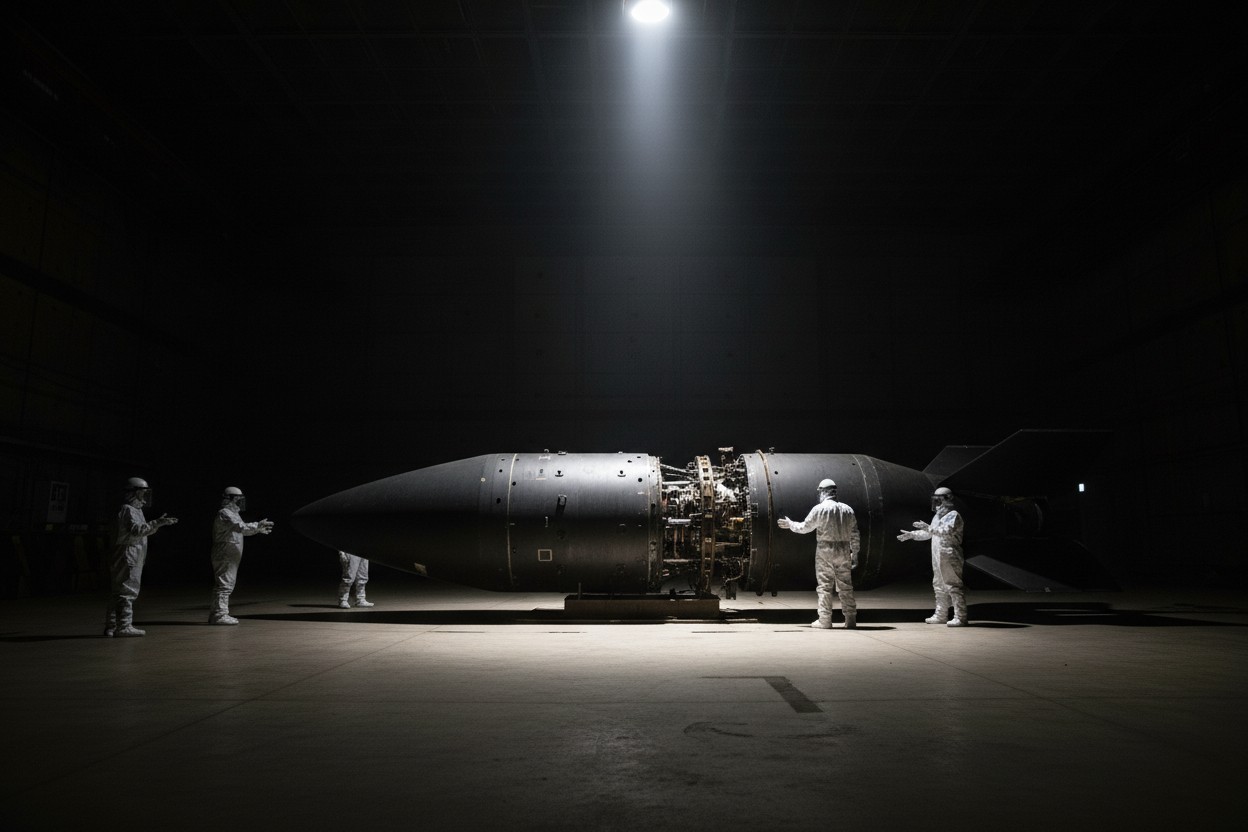
In the shadowed realms of modern warfare, a single unexploded U.S. bomb has emerged as a potential game-changer in the escalating shadow war between Israel and Iran. Dropped during a precision airstrike on suspected Iranian nuclear facilities last month, the 2,000-pound penetrator bomb—equipped with advanced GPS guidance and classified fusing mechanisms—failed to detonate upon impact. Recovered intact by Iranian forces in the remote deserts of central Iran, the device now holds secrets that could unlock the vulnerabilities of Israel's vast network of underground fortresses, from the heavily guarded Dimona nuclear complex to covert command bunkers beneath the Negev.
The bomb, a GBU-57 Massive Ordnance Penetrator variant supplied to Israel under a secretive U.S. military aid package, was intended to neutralize deeply buried targets hardened against conventional strikes. Military analysts believe its onboard inertial navigation system and digital altimeter retained telemetry data from pre-mission programming, including detailed topographic mappings of Israeli subterranean defenses. Iranian engineers, working in underground labs near Natanz, have reportedly begun reverse-engineering the dud, extracting firmware that reveals penetration algorithms calibrated specifically for Israel's Merkava-era bunkers—fortifications built to withstand nuclear blasts and housing everything from missile silos to elite IDF command centers.
This incident underscores a rare fumble in the otherwise airtight U.S.-Israel intelligence-sharing alliance. Sources within the Pentagon, speaking on condition of anonymity, confirmed the bomb's failure stemmed from a manufacturing defect in the proximity fuze, a component produced by a U.S. defense contractor now under federal investigation. The recovery operation was swift: Iranian Revolutionary Guard Corps (IRGC) teams, tipped off by local shepherds, airlifted the intact munition to Tehran under cover of night, evading Israeli drone surveillance. Experts warn that Iran's possession of this hardware could accelerate their development of countermeasures, such as reinforced concrete mixes or electronic jamming tailored to thwart future bunker-busters.
Geopolitically, the blunder amplifies Iran's propaganda victories while straining transatlantic ties. Tehran has already paraded grainy footage of the bomb on state media, dubbing it the "Gift from the Great Satan," and shared technical specs with proxies like Hezbollah and the Houthis. Israeli officials, tight-lipped as ever, have ramped up cyber operations against Iranian networks in retaliation, but the damage may be irreversible. As one former Mossad operative told The Culture War, "In the tunnel wars of the Middle East, knowledge is the ultimate explosive. This dud didn't just fail to boom—it handed our enemies the blueprint to our deepest secrets."
Looking ahead, the U.S. has halted shipments of similar penetrators pending a full audit, prompting questions about quality control in America's military-industrial complex. For Israel, the breach necessitates a costly overhaul of its underground infrastructure, potentially diverting billions from offensive capabilities. In a region where deterrence hinges on opacity, this strategic own-goal reminds all players that even the most sophisticated weapons can backfire—literally leaving the keys to the kingdom in enemy hands.
