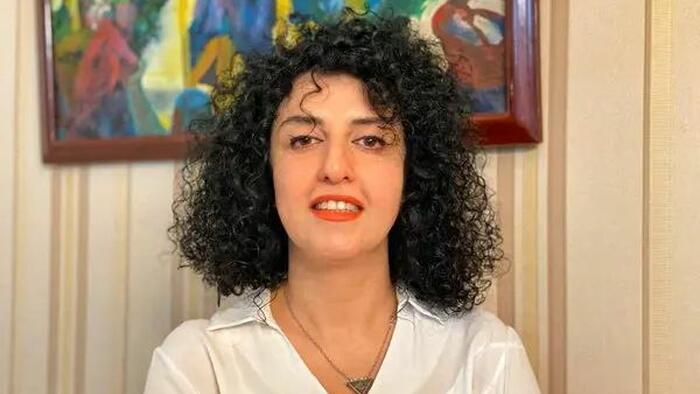
Narges Mohammadi, the 2023 Nobel Peace Prize laureate and prominent Iranian human rights activist, remains in critical condition in a hospital in Zanjan, northwestern Iran, after collapsing in prison last week with severe cardiac distress.She was transferred by ambulance to the local hospital’s coronary care unit on Friday, May 1, 2026, following repeated episodes of loss of consciousness, extreme chest pain, and blood pressure fluctuations, theNY Timesreports.
Her family and lawyer have urgently called for her transfer to a specialized facility in Tehran,where her longtime cardiologist could provide care, but Iranian judicial authorities have refused the requests. The Narges Foundation and her husband, Taghi Rahmani, who lives in exile in Paris with their children, stated thather life is in danger and described the move to the Zanjan hospital as a “last-minute” responseafter prison doctors determined her condition could no longer be managed on-site.
“We are extremely worried about her;she has collapsed and lost consciousness several times, and her life is in danger,” Rahmani said in an interview. “Our request is basic and urgent: send her to a hospital in Tehran immediately.” Her lawyer, Mostafa Nili, confirmed on social media that she had experienced acute cardiac crisis symptoms in recent days and was initially reluctant to go to the Zanjan facility due to her medical history, which includes multiple angiographies and stent placements.
Mohammadi, 54, has long suffered from chronic heart problems, a prior lung embolism (pulmonary embolism), and persistent headaches linked to ill-treatment in prison, including beatings by guards, according to her family and legal team. Prison authorities have repeatedly denied her adequate medical care in the past, opting instead for treatment in rudimentary prison clinics despite medical recommendations for specialized care.
This latest emergency follows a suspected heart attack in late March 2026, when she was found unconscious in her cell in Zanjan Prison on March 24. Fellow inmates reported she lay with her eyes rolled back for over an hour.Despite clear signs of cardiac distress, authorities refused hospital transfer or specialist evaluation at the time, according to reports from her legal team and visits documented by human rights groups.
She has spent much of her adult life imprisonedfor her pro-democracy and women’s rights activism in Iran’s theocratic system. She was previously serving a sentence that included approximately 10 years on national security charges. In February 2026, a court added seven and a half more years—six years for “assembly and collusion against national security” and one and a half years for “propaganda activities”—along with a two-year internal exile and travel ban, bringing her total sentence to around 17–18 years, according to her foundation and lawyers.
She had been granted a yearlong medical furlough in December 2024 due to her deteriorating health but was rearrested on December 12, 2025, while attending a memorial service in Mashhad for slain human rights lawyer Khosro Alikordi. She delivered a speech critical of the government and was violently detained along with other activists.She was subsequently transferred to the more restrictive Zanjan Prison, far from her family in Tehran.
In 2023, while imprisoned,she received the Nobel Peace Prize for “her fight against the oppression of women in Iran and her fight to promote human rights and freedom for all.”The award highlighted her decades of work documenting executions, advocating against compulsory hijab laws, and supporting political prisoners.
Her current hospitalization occurs against a backdrop of intensified repression in Iran. Following nationwide anti-government protests in January 2026 and the escalation of conflict involving the United States and Israel that began in late February 2026, authorities have ramped up arrests of activists, journalists, and students. Human rights monitors report that Iran has carried out at least 22 executions of political prisoners in the past six weeks (mid-March to late April 2026), with at least 10 linked to the January protests.Dozens more face imminent risk of execution.
On April 30, 2026 (Thursday), 21-year-old Sasan Azadvar Junaqani (also spelled Jonaghani or Joonqani), a karate athlete from Isfahan, was executed in Dastgerd Prison in Isfahan.Arrested during the January protests and accused of throwing a stone at security forces and other protest-related acts, he was convicted of “moharebeh” (enmity against God) in a swift Revolutionary Court proceeding widely criticized by rights groups as a sham trial lacking due process. Iran Human Rights (IHRNGO) and HRANA documented the case as one of at least 10 protester executions tied to the recent demonstrations.
Source: ZeroHedge News
