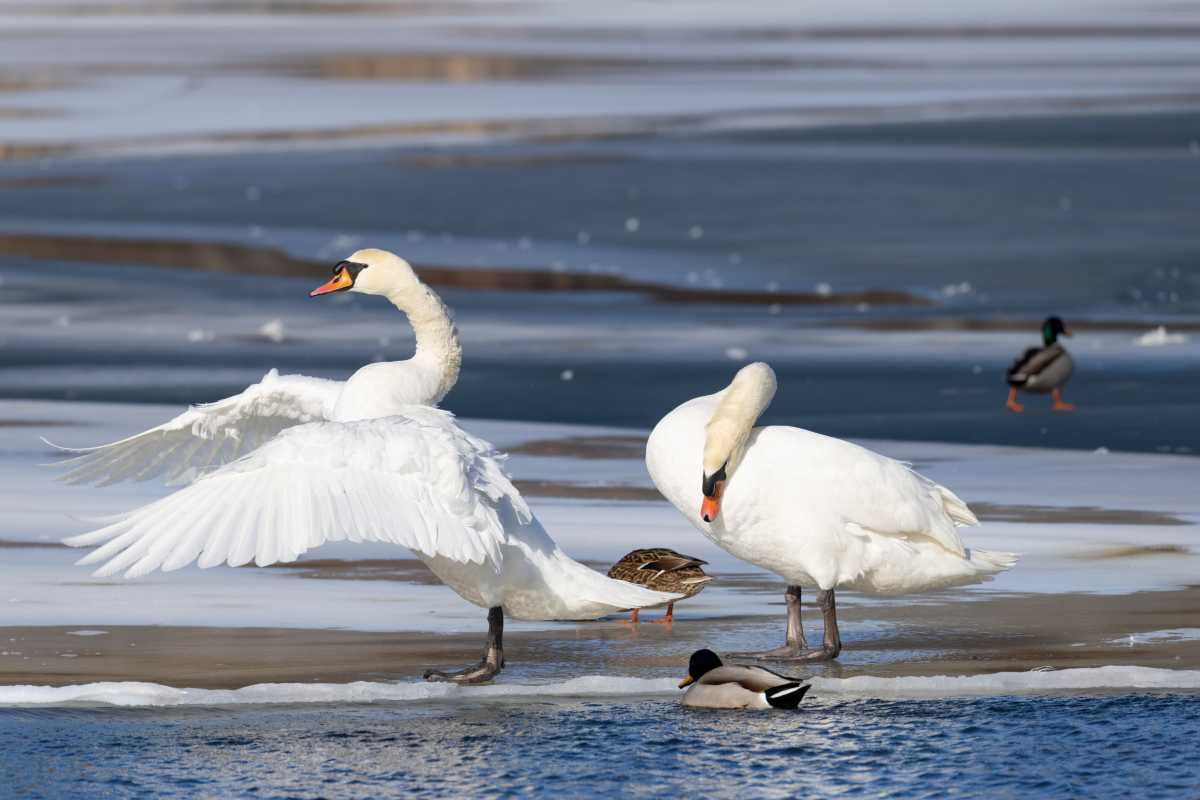
A walk past Argyle Lake in Babylon after the blizzards revealed themute swanswere not going anywhere—massive white birds, with their reddish-orange bills and black face patches, gliding through half-frozen water as if it was just another day at the park.
“This was the hardest winter for them,” says Nancy Viscardi-Ricigliano, an amateur wildlife photographer. In the Massapequa Preserve near her home, she estimates 30 swans huddled in small families. “I am amazed to watch their babies grow despite the cold.”
This kind of environmental detail flows through the Great South Bay the way tides move through inlets—constantly shifting, easy to miss if you’re not watching. And sometimes this means understanding the species we’ve come to see as fixtures of our downtowns.
“This beautiful swan was chilling on a little snowy beach. Turns out photographing white on white is harder than it looks,”Viscardi-Ricigliano laughs, as she shares a favorite moment captured in a Long Island wildlife photography Facebook group.
Swans’ ability to survive the coldest winters is a testament to their biology. Lauren Schulz, director of theWildlife Center of Long Island, explains that “swans are a non-migratory species. Like ducks and geese, they can survive our cold winters due to thousands of insulating feathers and feet that have a specialized countercurrent blood flow that keeps feet from freezing.”
To prepare, they build up fat reserves by consuming massive amounts of calories during summer and fall. A single adult swan needs four to eight pounds of submerged aquatic vegetation daily—an appetite that becomes problematic when waterways freeze over.
This past winter had been particularly brutal “due to a prolonged period of time with snow cover on the ground and frozen waterways,” Schulz says. When the ice locks them out of their feeding grounds, even their remarkable adaptations can’t compensate for the caloric deficit. So, despite their beauty, these non-native birds create environmental conflicts with native species that go beyond winter survival.
“While they are quite beautiful, they are large and quite territorial,” Schulz points out. “They are known for competing with our native waterfowl species, especially during the nesting season when swans will aggressively defend their nest sites.”
Quick history lesson: They’ve been part of New York’s waterways since the late 1800s, when wealthy estate owners imported them from Europe as living ornaments for their manicured ponds. The feral populations we see today are descendants of birds that escaped or werereleased, particularly from a mass release of 500 birds between 1910 and 1912. What started as Gilded Age decoration became a self-sustaining population.In 2023, the latest biennial mid-summer swan survey counted a bit more than 1,330 birds in the downstate region. Although that’s almost certainly an undercount, because the state’s approach to managing this non-native species has evolved considerably.
The New York State Department of Environmental Conservation (DEC) initially proposed total elimination, which triggered visceral public backlash on Long Island. After multiple gubernatorial vetoes and intense community opposition, the agency pivoted to a population-control policy focused on non-lethal methods. The current strategy uses egg-addling—coating eggs with food-grade corn oil to prevent hatching—to stabilize populations rather than eliminate them.
Source: Fire Island News & Great South Bay News
