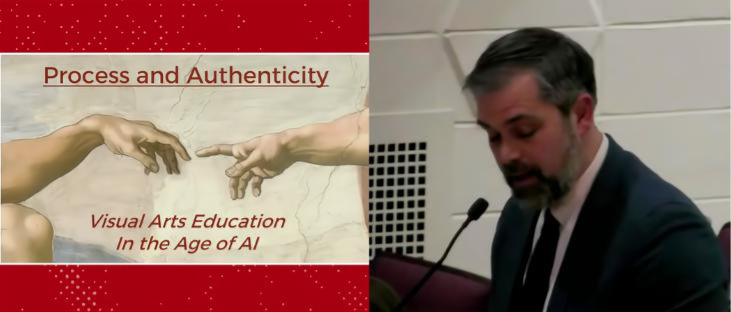
“What do the rapid changes wrought by AI mean for our art students?” inquired Christopher Hale, Syosset High School’s director of fine & performing arts, in his introduction to the presentation of “Process and Authenticity” by four Syosset visual arts educators at the board of education’s meeting on Monday, Feb. 9.
The educators framed their discussion around the way these “two pillars of the visual arts experience” shape their approach to art education in Syosset. The presentation offered a timely, humane and reflective response to the encroachment of artificial intelligence in the arts, particularly AI’s ability to create images and graphic designs in seconds.
“When we look back in 20 years, what skills, competencies, and habits will truly matter for our students?” Hale said.
The goal of the process and authenticity approach, Hale said, is to help students “develop habits of mind, develop their voice, go deep into sustained investigations and in a truly authentic way examine the human experience.”
Mariana Beach from Walt Whitman Elementary School opened the presentation with “Process: The Habits of Mind.”
She described how primary school students develop foundational skills, focusing on materials and how they work. Students establish routines and gain experience in as many artistic disciplines as possible. As they grow into the middle grades, the emphasis shifts into understanding their authentic selves as artists, Beach explained. Students are discovering their personal styles and preferences, and begin focusing on process and exploration of ideas.
“By providing our students with an arsenal of choices, we are allowing for more agency on their part,” Beach said. “The work created becomes more authentic to who they become as artists.”
Amanda O’Rourke, an arts educator at Syosset Middle School, followed with a discussion of “Developing Voice and Social Awareness.” As middle school students transition from concrete to abstract thinking, and begin to question their identities, the art world offers a unique opportunity for exploration, she said.
“Art becomes a tool for advocacy, empathy, and community-building,” O’Rourke said. “Students have agency over their artistic creations, and in turn, discover how their artistic process gives them a voice.”
O’Rourke described how she drew inspiration for a student project from the NFL’s “My Cause My Cleats” annual campaign, which raises awareness for various charities. Students have full agency to select a cause that resonates personally, leading to higher engagement and emotional investment in the artwork, she said.
Source: LI Press
