Freddie Ponton21st Century Wire
The lights are going out in Cuba again, but this time, the blackout is by design. With a stroke of his pen, a US president declared a “national emergency,” ordered an oil blockade, and warned every shipowner and government on earth that helping an island of eleven million keep the lights on could now invite punishment from Washington.
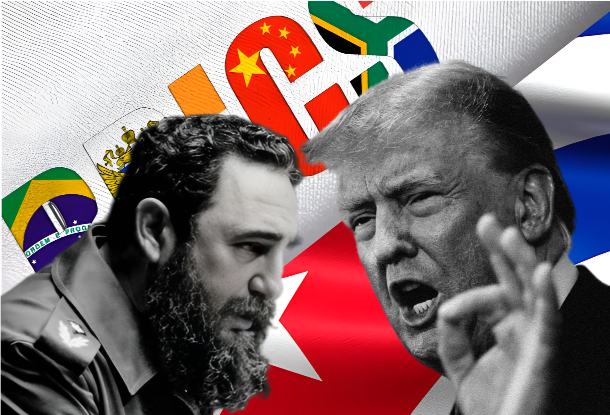
What is unfolding in Havana is not just another tightening of a Cold War‑era embargo; it is a live stress test of the emergingBRICS‑centred orderand its promise that small countries can survive outside the US orbit. On one side is Donald Trump, wielding tariffs, sanctions and a naval grip on the Caribbean; on the other is a battered socialist state betting its future onRussian tankers,Chinese diplomacy,Mexican defiance, and the still‑nascent machinery of theNew Development Bank.
On 29 January 2026, Trump signed an executive order that does something the euphemism “sanctions” can no longer hide: it threatens punitive tariffs on any country or company that supplies oil to Cuba, turning the entire global fuel market into a battlefield.UN expertshave called this an “extreme” form of unilateral coercion and agrave violation of international law, stressing that it has no UN Security Council mandate and is incompatible with the Charter and the basic rules of the WTO. In plain language, Washington is asserting the right to decide who can sell fuel to Havana, and at what political price, far beyond its own borders.
Inside the Trump administration, the goal is not a secret. In private discussions reported byPolitico, one person familiar with the plan summarised the strategy bluntly: “Energy is the chokehold to kill the regime.” Deposing Cuba’s communist government is described as “100% a 2026 event” in the administration’s eyes, justified under the Helms‑Burton Act that codifies the embargo. Cuba imports roughly 60% of its oil, according to theInternational Energy Agency; for years, most of that came from Venezuela, until the Trump team beganseizing sanctioned cargoeson the high seas and then turned its sights on the Mexican tankers that replaced them.
The impact is measurable in barrels and hours. By 3 December 2025, Cuba had already stopped receiving Venezuelan crude under US pressure; by January 2026, its crude imports hadfallen to zerofor the first time in a decade, leaving domestic heavy oil, about 40% of demand, to carry a collapsing system. Shipping trackers cited in Russian and Chinese reports estimate that without new imports, the island had perhaps15–20 days of usable fuel; the last recorded external shipment, roughly 85,000 barrels from Mexico, docked on 9 January before Pemex froze exports to avoid Trump’s tariffs. Since then, petrol stations have run dry, public transport has stalled, and blackouts of 10, 15, even 18 hours a day have become routine in some provinces.
UN human‑rights officialsnow link the fuel shortage directly to food access, warning that it is disrupting Cuba’s rationing system and access to regulated basic staples, not just dimming the lights. Alena Douhan, the UN Special Rapporteur who studied the wider sanctions regime, had already recorded 70–80 percent shortages in some food items and a chronic lack of medicines; the fuel siege is pushing that fragile equilibrium towards a precipice. In New York, theUN Newsservice has warned that the humanitarian situation “will worsen, and if not collapse, if [Cuba’s] oil needs go unmet,” a statement that explicitly ties Washington’s attempt to block oil supplies to the risk of humanitarian breakdown. The UN’s most senior official in Havana describes a country living through a mix of resilience, grief, sorrow and indignation, confronting rolling blackouts and surging food prices while still trying to defend its social model under “severe economic, financial and trade sanctions.”
The legal verdict is equally stark. TheUN General Assembly, by 165 votes to 7, with 12 abstentions, has for the 33rd consecutive year demanded an end to the US economic, commercial and financial embargo. UN and expert language suggest these latest measures risk amounting tocollective punishment, given their foreseeable impact on civilians. Even mainstream outlets have begun to ask whether a policy that predictably shuts down power plants, hospitals, and schools to “pressure” a government meets the definition of collective punishment under international humanitarian law—the same term that has been deployed, and then ignored, over Israel’s siege of Gaza.
In the skies, the crisis now has a timetable. On 9 February, the Cuban aviation authority quietlytold airlinesthat from 10 February it could no longer guaranteejet fuel at nine airports, including Havana, at least until March 11. Carriers were forced toreroute flightsto refuel in Santo Domingo or elsewhere;Air Canadasuspended its Cuba routes outright, organising the repatriation of roughly3,000 stranded passengers, while others began tankering fuel in and hopping the island like a refuelling desert.
On the ground, hotels are shuttering, tourist areas stand half‑empty, and the sector that once brought vital hard currency into Cuban households has joined the electrical grid in freefall. Local reporting gathered by international andindependent outletspaints a harsh picture: families with power only a few hours a day, single mothers cooking with wood because bottled gas has run out, students trying to study by candlelight, and workers who can no longer afford the informal taxi rides that replaced paralysed buses. For ordinary Cubans, this is not an abstract debate about sanctions; it is the moment when the bus stops coming, the fridge warms up, the ATM line doubles, and survival becomes a full‑time job once more.
Source: 21st Century Wire