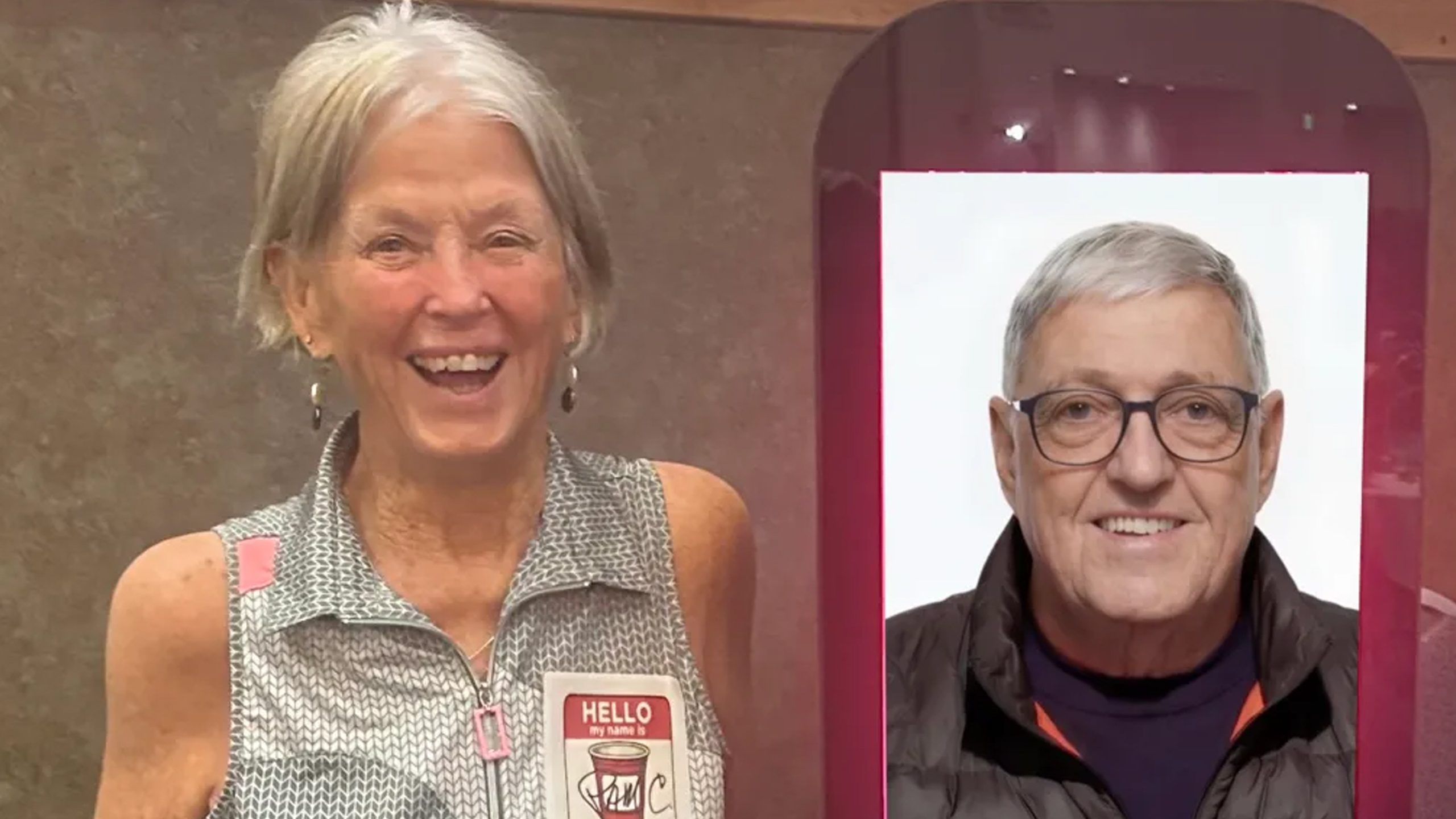
A grieving widow in Washington has turned to cutting-edge technology to give her late husband a voice at his own memorial service. By utilising a sophisticated digital platform, she allowed mourners to interact with the deceased in a way that was previously impossible.
After nearly 60 years of marriage, which came to an end with Bill's death last year, Pam Cronrath was certain about the kind of farewell she wanted to host, though she hadn't quite figured out how to make it happen. 'I promised him a super wake,' she told the BBC.
Little did she imagine that fulfilling that vow would involve delving into holographic technology, a field usually reserved for famous stars rather than funeral services in small-town America.
At 78, Pam resides in Wenatchee, Washington, a farming town tucked away on the eastern side of the Cascade Mountains. A lifelong fan of gadgetry and innovation, she credits her forward-thinking attitude to a career that evolved right alongside the internet from its very beginning.
A few years back, her interest was piqued at a medical conference when she witnessed a doctor being beamed across the country as a life-sized, live hologram. 'I was completely impressed. It stayed with me,' she said.
The memory of that experience resurfaced after Bill passed away, leaving Pam to wonder if that same tech could be applied to a memorial. However, tracking down the right support proved difficult, as she was working against the clock while many firms she approached were either priced out of reach or simply uninterested.
She eventually connected withProto Hologramand Hyperreal, a pair of firms specialising in hologram and avatar tech. Pam was open about her hesitations, admitting, 'When you hear they're working with Michael Jackson's estate, and then it's me—Pam from Wenatchee—you do wonder how it's going to work.'
Although she had initially vowed to Bill that she would cap the spending for his 'super wake' at $2,000 (£1,480), the costs spiralled as the project grew in scale. Pam admitted the total eventually reached roughly 10 to 15 times her starting budget, yet she remained certain that Bill would have been moved by the effort and glad it took place.
The last few years have seen the rise of various technologies that let people seemingly speak from beyond the grave by filming answers to questions ahead of time, which software then sifts through to find the right response. Remington Scott, who founded Hyperreal, claims his firm takes a different path, noting, 'Those systems are meaningful, but they're constructed; they're selecting from pre-recorded material or generating an approximation.'
Scott explained that his firm focuses on a 'comprehensive capture' of a person's appearance, voice, and movements to produce something that those close to the individual can identify at once. However, because Bill had already passed away, Pam's project could not rely on any live recordings.
Source: International Business Times UK
