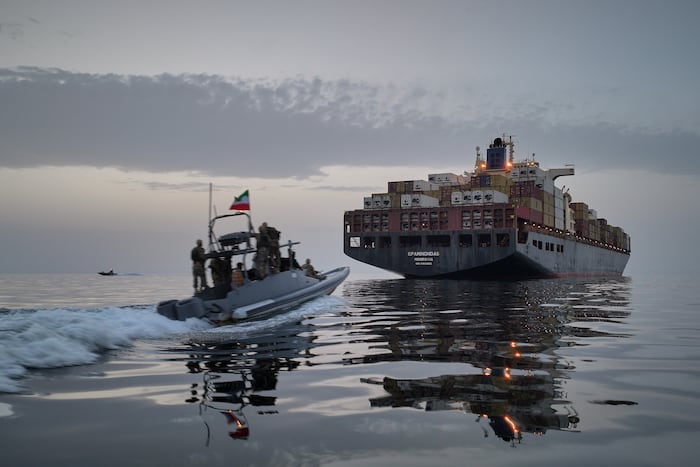
The United Arab Emirates announced Tuesday that it will leave OPEC effective May 1, stripping the oil cartel of one of its largest producers. While the announcement doesn’t change anything regarding the blockage of the Strait of Hormuz, it could help lower oil prices after the war if the UAE increases its production capacity. On Tuesday, Brent crude oil traded above $111 a barrel, over 50% higher than its prewar price.
Iran offered to end its chokehold on the Strait of Hormuz if the U.S. lifts its blockade on the country and ends the war in a proposal that would postpone discussions on the Islamic Republic’s nuclear program, two regional officials said Monday. U.S. President Donald Trump seems unlikely to accept the offer, and U.S. Secretary of State Marco Rubio appeared to rule out any deal that excludes Iran’s nuclear program.
Dozens of nations repeated calls to open the critical waterway in a joint statement led by Bahrain. German Chancellor Friedrich Merz criticized the U.S. for going into the war with what he said was no strategy.
Israeli strike in northern Gaza kills 4 Palestinians
Shifa Hospital said the Israeli airstrike hit a car in Gaza City on Tuesday, killing four men, about 6 kilometers (3.7 miles) from the so-called Yellow Line separating Israeli-controlled areas from the rest of Gaza. The Israeli military said it struck “a terrorist” but provided no further details.
Although a fragile ceasefire between Israel and Hamas in October eased large-scale fighting after two years of war, Israeli forces still carry out near-daily strikes and fire around military-held zones of the tiny Palestinian territory. Since the ceasefire, Israel has killed at least 818 people in Gaza, including 226 children and 179 women, according to health officials there.
Away from the spotlight, the situation in Gaza and the West Bank is ‘steadily worsening,’ UN official says
U.N. Assistant Secretary-General Khaled Khiari said Gaza is facing “ongoing and deadly Israeli strikes and dire humanitarian conditions,” with 1.8 million people — nearly its entire population — living in camps and dependent on aid.
He told a U.N. Security Council ministerial meeting Tuesday that in the West Bank, “violence, including rampant settler attacks, displacement and accelerating settlement activity, is threatening entire communities and further eroding prospects for a political process” toward a two-state solution.
In Gaza, he said, “the ceasefire is increasingly fragile as Israeli strikes and armed activity by Hamas and other groups continue.”
Source: WPLG
