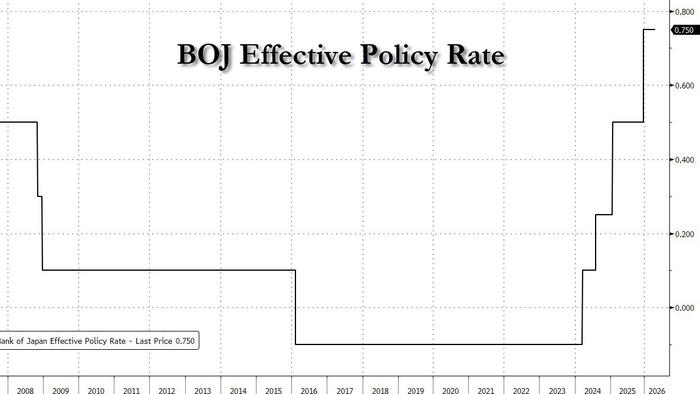
In the first G5 central bank announcement of the week, overnight the Bank of Japan held its benchmark interest rate in a 6-3 vote, despite forecasting a sharp rise in inflation as the war in the Middle East sends commodity prices higher and clouds the global economic outlook while testing Japan's given its exposure to rising energy prices.
While the decision on Tuesday to keep rates at about 0.75% was in line with market expectations,it came via a rare six-to-three vote split of the Monetary Policy Committee,the biggest divergence of opinion under governor Kazuo Ueda, and since the launch of the bank’s negative interest rate policy in 2016.
The three dissenterscalled for an immediate rate increase to 1%,reflecting fears that the BoJ is at risk of falling even further behind the curve by postponing rate increases as it seeks to “normalise” monetary policy at a time when Japan's inflation is dangerously overheating due to sharp wage increases in recent years.
After the BOJ announcement, traders were convinced that rates will rise after the next meeting in June.
Speaking at a press conference later on Tuesday that was widely interpreted as hawkish, Ueda said the central bank would make appropriate decisions “so that we do not fall behind the curve”, yet even now he refused to outline a formal timeframe for the BoJ to decide whether conditions were right to raise rates.
“Given the high level of uncertainty around the conflict in the Middle East, the likelihood of achieving our forecasts has declined,” said Ueda.
He added that the central bank “wants to spend a little more time scrutinizing how the Middle East conflict affects the economy and prices, and whether the risk to growth and inflation could change”.
While two of the three dissenters, Naoki Tamura and Hajime Takata, are known hawks who have voted against the governor at previous meetings,analysts noted the addition of the more dovish Junko Nakagawa.
“Three dissenting votes is not a huge surprise, but Nakagawa being one of them is,”said JPMorgan senior Japan economist Benjamin Shatil. “The Board is sending a clear signal that it is ready for a June rate hike. Whether global conditions have settled sufficiently and tacit government approval is in place by then is another question.”
In the BoJ’s stagflationary outlook statement, the bankwarned that Japan’s economic growth was likely to slow in the current fiscal year;at the same time it also significantly raised its inflation forecast over the same period.
Source: ZeroHedge News
