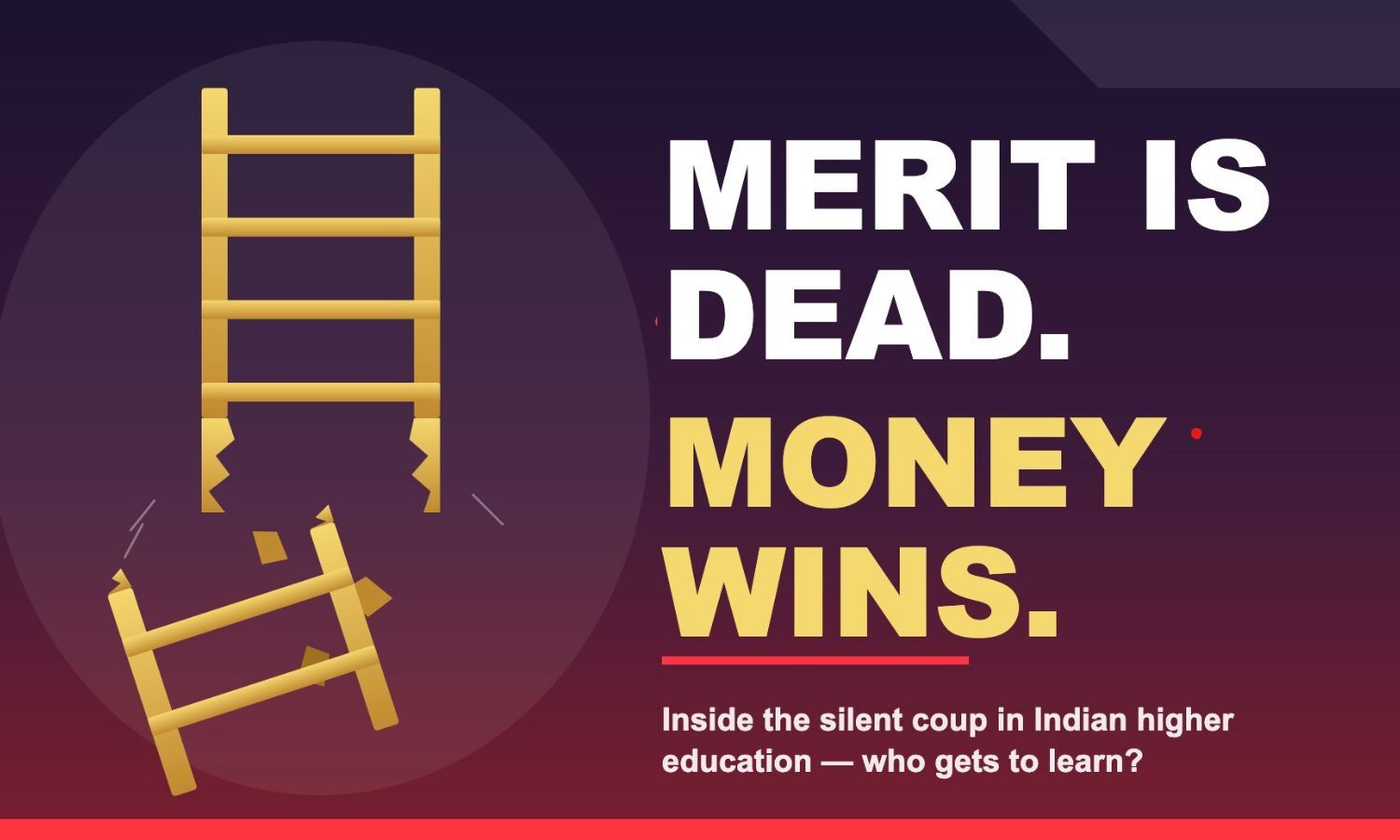
In The Tyranny of Merit, Harvard philosopher Michael Sandel observes that even the most egalitarian education system cannot neutralise the vast differences between a child born into privilege and a child born into deprivation. The former grows up surrounded by resources, networks, personalised attention, and cultural capital; the latter must fight simply to reach the starting line. "Even the best, most inclusive educational system would be hard pressed to equip students from poor backgrounds to compete on equal terms with children from families that bestow copious amounts of attention, resources, and connections," he writes.
Daniel Markovits, in The Meritocracy Trap, deepens the argument by showing how modern meritocracy, far from dismantling privilege, quietly entrenches it. "The new elite receives a meritocratic inheritance that transmits privilege, and excludes the middle class from opportunity, as effectively as the old elite's birthright used to do." These observations, drawn from Western contexts, apply to India — except that our inequalities are older, deeper and far more structured, rooted in centuries of caste, class, gender and religion-based hierarchies.
At a time when India boasts of becoming the world's third-largest economy, a technology hub, and a global education market, the privatisation ofhigher educationin India is quietly restructuring the very foundation of its knowledge ecosystem in favour of a narrow elite.
Also Read:Higher Education: Students Expose Caste Bias in Top Institutions
Wealth inequality and the cost of private coaching
The roots of elite capture lie in the economic and caste structure of the country, and they shape every downstream stage of the privatisation of higher education in India. Data from the World Inequality Database and the India Human Development Survey (IHDS) show that caste and religious groups in India have sharply different economic positions.
Wealth correlates almost perfectly with caste and religion, with upper-caste groups holding far more assets on average. According to the paper Wealth Inequality, Class and Caste in India, 1961–2012, Brahmins earn about 48% more than the national average household income and non-Brahmin forward castes 45% more, while Other Backward Classes (OBCs) earn 8% less, Scheduled Castes (SCs) 21% less, and Scheduled Tribes (STs) 34% less than the national average.
Among religious groups, Muslims earn about 7% below the national average — broadly comparable to OBC households — while non-Hindu, non-Muslim groups outside the SC/ST/OBC categories earn well above the national average.
Under Article 21A, inserted by the 86th Constitutional Amendment in 2002, the Constitution of India guarantees the right to free and compulsory education for children aged 6 to 14. The Right of Children to Free and Compulsory Education (RTE) Act, 2009, which came into force on 1 April 2010, gives effect to this right and lays down the responsibilities of the State and local authorities in providing free elementary education. However, this principle has been consistently undermined by successive governments through sustained withdrawal from public investment inschool education. As a result, rising private school fees and declining investment in government schools have meant that children from historically marginalised communities start their educational trajectory in a structurally disadvantaged position.
India's Gross Enrolment Ratio (GER) shows this story clearly: per UDISE+ 2021–22, while enrolment exceeds 100 per cent in primary school, it drops to 94 per cent in upper primary, 80 per cent in secondary, 58 per cent in higher secondary, and a mere 28 per cent in higher education. The "pipeline" narrows not because children lose merit as they grow older, but because the system becomes more expensive and exclusionary.
Source: The Probe: Investigative Journalism & In-Depth News Analysis
