By Dhaval Joshi of BCA Research
The Fed will run the US economy hot – because, with labour demand and supply now in balance, both demand and supply must expand to keep output expanding.
Short-term US real rates will come down further because the Fed will continue to cut even with inflation in the 2.5-3.5 percent range.
The US dollar will continue to weaken, given the currency’s dependence on real interest rate differentials.
The US yield curve will undergo a ‘bear steepening’ as US inflation expectations ratchet higher. Meaning, T-bonds will underperform cash, as well as other major sovereign bonds.
Stocks will continue to outperform bonds.
New tactical trade: Overweight MSCI ACW Consumer Discretionary versus Industrials.
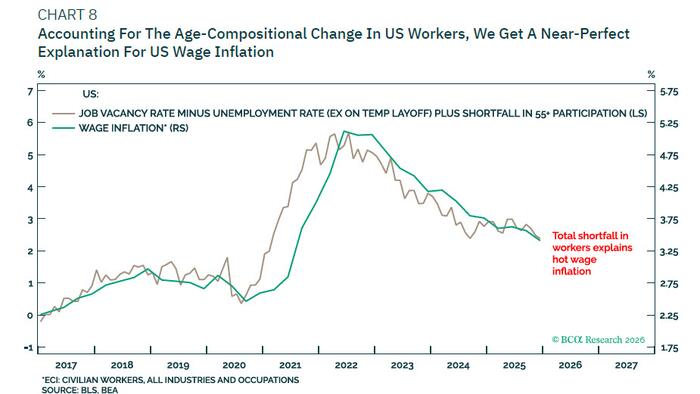
The US economy has reached a watershed. For the first time since the pandemic, labor demand and labor supply are in perfect balance, with both now standing at 172 million workers.
Labor supply equals the number of available workers: those with jobs plus those without jobs. Labor demand equals the number of people in work plus job vacancies plus workers on temporary layoff. Many people miss this last component of labor demand. Labor demand must include workers on temporary layoff because there is demand for these workers, albeit they are on temporary layoff for idiosyncratic reasons (such as a government shutdown).
Put a different but equivalent way, the labor market is balanced when the number of ‘jobs looking for workers’ (job vacancies) equals the number of ‘workers looking for jobs.’ The latter means the unemployed. But given that those on temporary layoff are not looking for jobs, it more correctly means the unemployed that are not on temporary layoff.
Source: ZeroHedge News