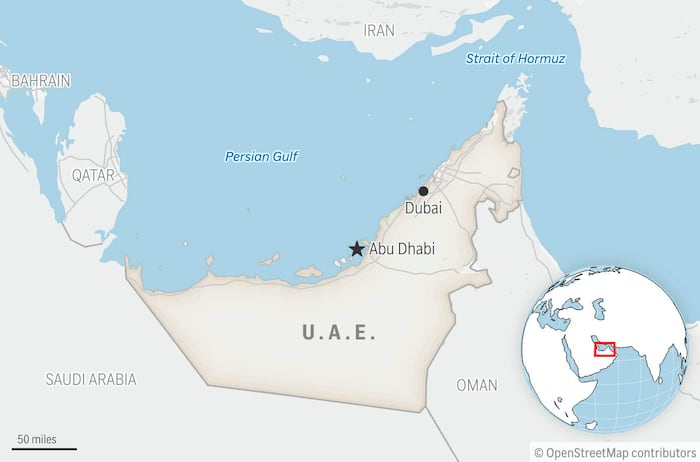
DUBAI, United Arab Emirates (AP) — The United Arab Emirates announced Tuesday that it will leave OPEC effective May 1, stripping the oil cartel of one of its largest producers and further weakening its leverage over global oil supplies and prices.
The UAE's decision had been rumored as a possibility for some time, as it pushed back in recent years against OPEC production quotas it felt had been too low — meaning it wasn't able to sell as much oil to the world as it had wanted.
“Having invested heavily in expanding energy production capacity in recent years, the bigger picture is that the UAE has been itching to pump more oil,” Capital Economics wrote in an analysis. “The ties binding OPEC members together have loosened,” it said, particularly after Qatar withdrew from the cartel in 2019.
Regional politics are also likely at play. The UAE has had increasingly frosty relations with Saudi Arabia, OPEC's largest producer, over political and economic matters in the Mideast, even after both came under attack by fellow OPEC member Iran during the war.
The UAE’s withdrawal from OPEC won’t necessarily have any immediate effects in markets. That’s because world oil supplies are sharply constrained by the war in Iran, which has closed off the Strait of Hormuz, a waterway through which one-fifth of global oil supplies — including much of the UAE's — is transported. On Tuesday, Brent crude, the international benchmark, traded above $111 a barrel, or more than 50% above its prewar price.
OPEC's market power had already been waning in recent years as the United States ramped up its production of crude oil. U.S. President Donald Trump has been a steady critic of the cartel during his two terms in the White House.
The UAE had been a longtime member of OPEC, first through its emirate of Abu Dhabi in 1967 and later when the UAE became its own country in 1971. It had been producing around 3.4 million barrels of crude a day just before the United States and Israel launched a war on Iran on Feb. 28.
The UAE made the announcement via its state-run WAM news agency, saying it also would be leaving the wider OPEC+ group as well, which Russia had led in order to try to stabilize oil prices.
“This decision reflects the UAE’s long-term strategic and economic vision and evolving energy profile, including accelerated investment in domestic energy production, and reinforces its commitment to a responsible, reliable, and forward-looking role in global energy markets,” the UAE said.
“Following its exit, the UAE will continue to act responsibly, bringing additional production to market in a gradual and measured manner, aligned with demand and market conditions,” the country added.
Source: WPLG
