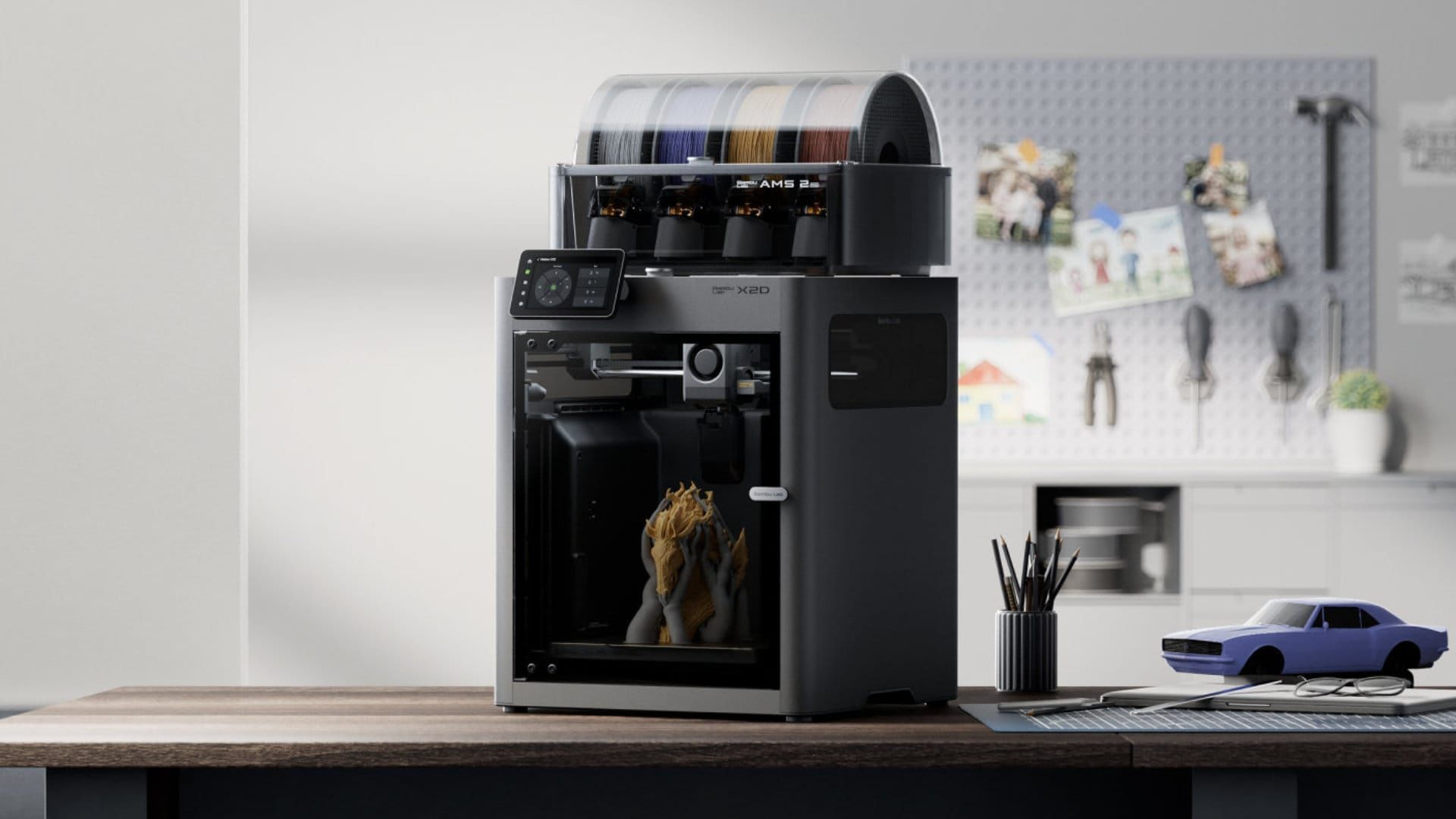
Home-Bambu Lab launches X2D dual-nozzle 3D printer targeting reduced post-processing and material waste
Bambu Labhas introduced the X2D, the second-generation system in its flagship X Series of desktop 3D printers. The new machine features a dual-nozzle extrusion system with mechanical switching, designed to simplify support removal, reduce material waste, and maintain consistent print quality over time. The system is positioned as a workflow-focused upgrade rather than a speed-driven iteration, with pricing starting at $649.
Building on the automated calibration and enclosed architecture introduced with theX1 Carbon,the X2D targets remaining constraints in desktop 3D printing workflows. These include post-processing effort and material inefficiencies during multi-material printing.
Dual-nozzle system targets support removal and material efficiency
At the core of the X2D is a dual-nozzle extrusion system with mechanical switching. One nozzle is dedicated to printing the model, while the second handles support material. This allows the use of materials optimized for clean removal, reducing the need for manual finishing and minimizing surface damage.
Switching between nozzles is achieved through a gear- and trigger-based mechanism, eliminating the need for an additional motor on the toolhead. According to the company, this reduces moving mass and vibration, improving motion control and print stability. The mechanism has undergone life-cycle testing exceeding one million switching operations without loss of performance.
The same approach is applied to multi-color printing. By switching nozzles instead of purging filament, the system reduces transition time and material waste, addressing a common limitation in multi-material desktop printing.
Hybrid extrusion and real-time calibration
The X2D integrates two extrusion approaches within a single toolhead. The primary nozzle uses a direct drive extruder, providing precise filament control and compatibility with a wide range of materials. The auxiliary nozzle is connected to a rear-mounted Bowden extruder, enabling higher feeding force over longer filament paths.
To maintain consistent output over time, the system includes Dynamic Flow Calibration. This feature monitors the extrusion motor, nozzle condition, and filament behavior, automatically compensating for wear and environmental variation before each print. The calibration process is performed without user input.
Source: 3D Printing Industry
