Consider the change remarkable in its own fashion. The “President of PEACE” in his first term in office has distinctly become the President of WAR the second time around, whether in theCaribbean Sea and the eastern Pacific Ocean,inVenezuela, inNigeria, inSomalia,or now in Iran. And it was indeed true that, though in his first term he tookludicrous creditfor bringing peace to the planet by stopping wars that he generally didn’t halt, Donald Trump did not launch any significant wars himself. The second time around, however, the Peace President of increasingly “Epic Fury” simply can’t seem to stop doing so. And he’s been using language in the process that no American president has ever publicly used before. As hepostedon Truth Social recently about his plans for Iran (no matter that purposely targeting civilian infrastructure is a war crime): “Tuesday will be Power Plant Day, and Bridge Day, all wrapped up in one, in Iran. There will be nothing like it!!! Open the Fuckin’ Strait, you crazy bastards, or you’ll be living in Hell — JUST WATCH! Praise be to Allah.”
Yep, and with that “Fuckin’ Strait” (the Strait of Hormuz, of course), he’s piling presidential firsts one on top of another, even as, in a big-time fashion, he joins all the previous American presidents since World War II who have launched or been involved in staggeringly unsuccessful wars from Korea and Vietnam to Afghanistan and Iraq. (Mind you, when it comes to Donald J. Trump and crew, “Fuckin’ Crooked” would be a significantly more accurate phrase.) Explain it as you will, in his second term as president, he has indeed been in a mood of — to steal hiscode namefor his war on Iran — epic fury and seemingly all too ready to take the world that refused to give him a Nobel Prize down with him.
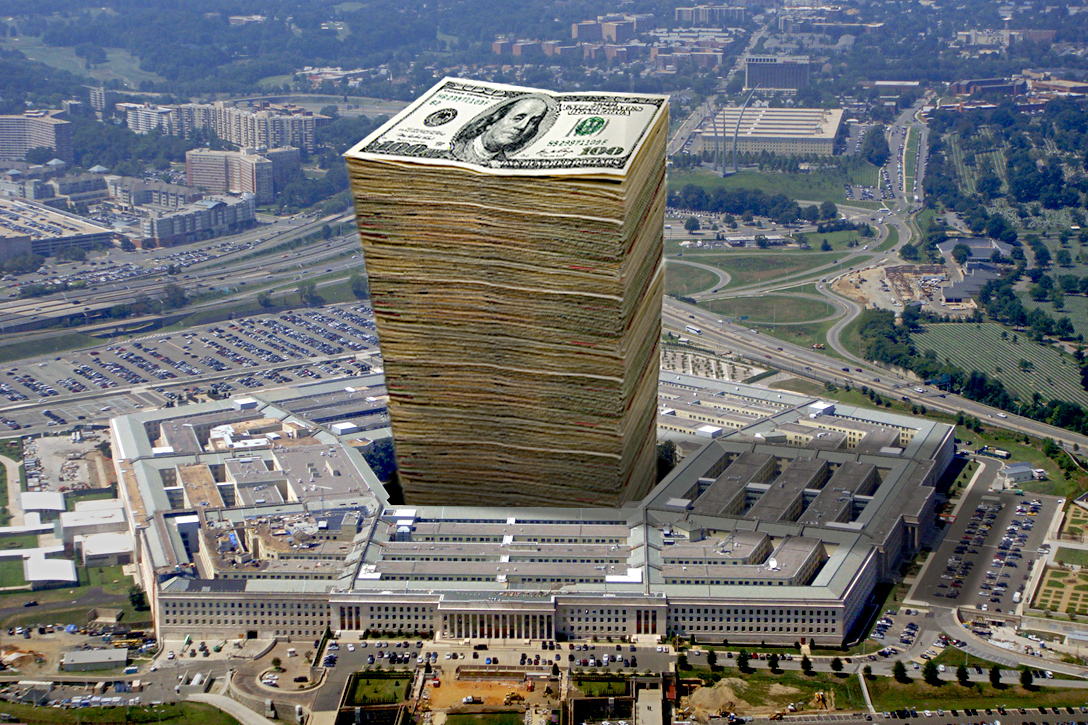
So, there should be little surprise that, this time around, the President of Peace is also remarkably eager to raise an already astronomical Pentagon budget by a mere $500 billion more dollars to a genuinely unprecedented$1.5 trillionand, if that doesn’t get him a Nobel Prize, maybe he’ll have to try raising it to two trillion dollars while cutting every civilian program in sight (as he’s already beginning to try to do). Now, with all of that in mind, take a deep breath and letTomDispatchregularWilliam Hartung, co-author ofThe Trillion Dollar War Machine(though, of course, any future edition may have to be retitledThe Trillion and a Half Dollar War Machine), escort you into the Trumpian version of the military-industrial complex. (If President Dwight D. Eisenhower, who gave the MIC its name in hisfarewell addressin 1961, could be brought back today, he simply wouldn’t believe his eyes!)~ Tom Engelhardt
Right at this moment, we are witnessing an unprecedented shift of resources from domestic investments in the United States to the military-industrial complex (aka the war machine). The only comparable period in our history was the buildup to World War II, when the United States confronted a powerful adversary in Nazi Germany with designs to control not just Europe, but the world. The current buildup is breathtaking in scope and will certainly prove devastating in its impact — not just on this country’s foreign and domestic policies but also on the economic prospects of average Americans.
When, in 2023, my colleague Ben Freeman and I first conceived of our book,The Trillion Dollar War Machine,we viewed it in part as a cautionary tale about just how high the Pentagon budget might rise in the years to come (absent pushback from Congress and the taxpaying public). By the time our book came out in November 2025, however, the Pentagon budget had already topped the $1 trillion mark and, only recently, President Trump has proposed to instantly add another$500 billionto that already staggering figure and to do so in a single year’s time. And imagine this: such a proposed increase alone ishigherthan the total military budget of any other nation on Earth. Mind you, the current high levels of spending have already underwritten a provocative, unnecessary intervention in Venezuela and a region-wide war in the Middle East, and the larger costs of all this in human lives and damage to the global economy are guaranteed to shape the lives of the rest of us globally for years to come.
To add insult to injury, the Pentagon announced that it would seek a$200 billion supplementalappropriation to pay for its war on Iran, which has spread across the Middle East. That $200 billion would have beenin addition tothe $1.5 billion proposed for the Pentagon’s future budget. According to ananalysisby Pentagon budget expert Stephen Semler, the Iran war, which started on February 28th with Israeli and U.S. air strikes on that country, cost the United States more than $28 billion just in its first two weeks. And to put that in perspective, $28 billion is more thanthree timesthe Trump administration’s proposed annual budgets for theCenters for Disease Control and Preventionand theEnvironmental Protection Agency(at a time when the climate crisis and the need to head off future pandemics are essential to the health and security of all Americans). Worse yet, it’s all for a completely senseless war that should never have been started.
As President Trump alternates between engaging in negotiations to end the war and threatening to wipe Iran off the map — or even just walking away to bomb another day — there are reports that the supplemental budget request to pay for the war on Iran willshrinkfrom the proposed $200 billion to $98 billion. And that $98 billion will include other things in addition to war costs, including disaster relief and aviation modernization.
The Garrison State and the Reign of the War Profiteers
On the campaign trail in 2024, Donald Trumppledgedto drive the “war profiteers” and “war mongers” from Washington, suggesting that they like wars because “missiles cost $2 million each,” while bragging that, in his first term in office, “I had no wars.”
And his rhetoric as the ultimate champion of peace has continued during his second term, even as he has indeed launched reckless wars guaranteed to fill the coffers of the “war profiteers” he railed against on the campaign trail. He has, however, also pledged to help the weapons industryquadrupleproduction of the same sort of “$2 million bombs” he decried during the campaign, plus — even better for the arms makers — missile interceptors that cost up to $12 million each. Worse yet, the demands of the current war on Iran, coupled with support for Israel’s war on Gaza and Ukraine’s efforts to defend itself from Russia, have left the Pentagon and the giant weapons corporations complaining that, if the U.S. doesn’t radically increase its production of artillery shells, bombs, and missiles, the cupboard could soon be bare.
Source: Antiwar.com
