This article wasfirst published by Al Jazeerain Arabic.
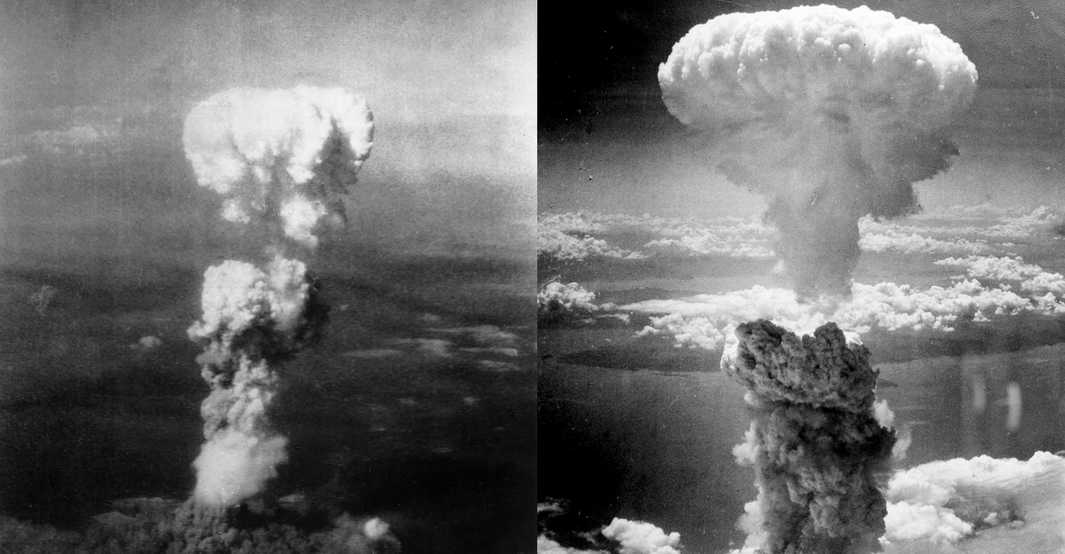
False historical narratives abound in our contentious and divided world, as leaders and complicit historians endeavor to use public understanding of the past to push policies and gain control in the present. One of the most egregious cases is the widely accepted account of the decision by U.S. leaders to drop the atomic bombs on the Japanese cities of Hiroshima and Nagasaki on August 6 and 9 of 1945, respectively.
The generally held view, which is frequently taught in schools across the U.S. and beyond, is that the bombings werenecessary to save lives, both American and Japanese; just how many lives were saved has itself been subject to debate, though President Harry Truman claimed half a million U.S. lives in his1955 memoirs. This assessment is not only disputed by the facts, but it ignores the realities of what the bombings meant for the initiation of the Cold War and the future of humanity, in a world long awash with civilization-ending weapons.
Most importantly, the bombings quite simplywere unnecessary. There were at least three ways that Japanese surrender could have been induced without the instantaneous killing of more than a hundred thousand civilians and another several hundred thousand men, women, and children being subjected to third-degree burns, injuries, and radiation exposure that would either end their lives shortly thereafter, or cause health problems in the years and decades following the fateful attacks.
One option was that the U.S. could have altered the surrender terms to make them acceptable to the Japanese. What most Japanese leaders wanted in early August of 1945 was to keep their Emperor and the kokutai or emperor system. The Americans, who knew this from intercepted cables, should have accepted this term;they would eventually agreeanyway out of self-interest. Sadly, most of Truman’s top military and political advisors urged this course of action, but Truman, with the support of Secretary of State Jimmy Byrnes, refused.
Another possibility was to allow the Soviet Union to proceed with itsground invasionupon declaring a war on Japan at midnight on August 8. The Joint Intelligence Staff of the Joint Chiefs of Staffpredicted on April 11, “If at any time the USSR should enter the war, all Japanese will realize that absolute defeat is inevitable.” As Japan’s Supreme War Councilstated in May, “At the present moment when Japan is waging a life-or-death struggle against the U.S. and Britain, Soviet entry into the war will deal a death blow to the Empire.” Japan would have surrendered once it saw that it would be fighting both the U.S. and the Soviet Union. Moreover, President Truman knew that the Soviets were about to invade, and wrote at least twice that that would end the war.
The last, albeit arguably the weakest, alternative was to demonstrate the enormous power of the atomic bomb by exploding it, as was done on July 16 in New Mexico, in the presence of foreign leaders, and as was recommended by a group of scientists in theFranck Report. Such a display could have exerted sufficient pressure on the Japanese government, especially in conjunction with the changed surrender terms and a warning about Soviet entry, to precipitate Japanese surrender. In fact, seven of America’s eight five-star admirals and generalsin 1945 saidthe bombs were either militarily unnecessary, morally reprehensible, or both. Truman’s personal chief of staff Admiral William Leahy, who also chaired the meetings of the Joint Chiefs of Staff, said the use of the atomic bombs put us on the moral level of the ”barbarians of the dark ages.” General Douglas MacArthur wrote that the Japanese would have “gladly” surrendered months earlier if we’d told them they could keep the emperor.
Beyond the fact that there were multiple ways to ensure the end of the war without committing the gravest nuclear crimes, the atomic bombings of Hiroshima and Nagasaki represent a violent entry into the nuclear age, with historians and scientists arguing that they mark the beginning of the Cold War, rather than the end of the hot one. By fancifully hoping that the bombs would force Japanese surrender before the Soviets made too much ground, the U.S. sought to diminish the Soviet contribution to the final outcome of the war that consumed Europe and much of Asia. At the same time, the U.S. leaders also managed to demonstrate to the Soviets their possession of a “new weapon,” failing to recognize, as many of the scientists did at the time, the near certainty of a nuclear arms race that indeed came to pass and haunts us to this day. And the Soviets, who knew clearly that the Japanese were defeated and desperate to surrender because the Japanese had sought Soviet assistance in securing better surrender terms, saw themselves as the real target and not Japan – a view that was shared and stated explicitly by Manhattan Project head General Leslie Groves.Groves admitted, “There was never from about two weeks from the time I took charge of this Project any illusion on my part that Russia was our enemy, and the Project was conducted on that basis.”
Furthermore, the bombings didn’t just set up a decades-long rivalry between the two states that stood diametrically opposed to each other in their ideologies and economic systems at that very moment, it also set the world on a path toward nuclear weapons possession by many more states,nine at the latest count. Although nuclear weapons have not been used in a time of war ever since, their development and testing have leftdeep scars and much devastationaround the world. And they have continued to threaten the world ever since.
Perhaps most shockingly, the U.S. used these unnecessary weapons knowing full well that it was opening up the door to ending life on our planet.Robert Oppenheimer warnedthe top political and military officials on May 31 that within three years we’d probably have weapons between 700 and 7000 times as powerful as the bomb that destroyed Hiroshima. Upon receiving the report at Potsdam of how powerful the Alamagordo bomb test was,Truman wrote in his diary, “We have discovered the most terrible bomb in the history of the world. It may be the fire destruction prophesied in the Euphrates Valley Ear, after Noah and his fabulous Ark.”
Source: Antiwar.com
