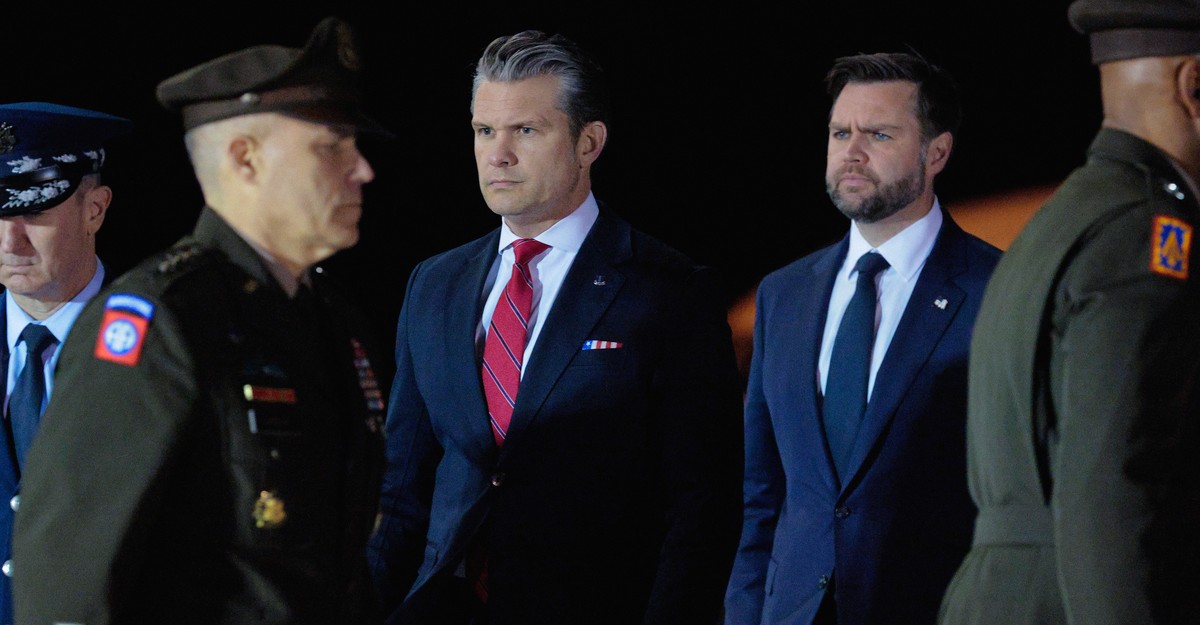
In closed-door meetings, J. D. Vance has repeatedly questioned the Defense Department’s depiction of the war in Iran and whether the Pentagon has understated what appears to be the drastic depletion of U.S. missile stockpiles.
Two senior administration officials told us that the vice president has queried the accuracy of the information the Pentagon has provided about the war. He has also expressed his concerns about the availability of certain missile systems in discussions with President Trump, several people familiar with the situation told us. The consequences of a dramatic drawdown in munitions reserves are potentially dire: U.S. forces would need to draw from these same stockpiles to defend Taiwan against China, South Korea against North Korea, and Europe against Russia.
Both Pete Hegseth, the secretary of defense, and General Dan Caine, who chairs the Joint Chiefs of Staff, have publicly said that U.S. weapons stockpiles are robust, and portrayed the damage to Iranian forces after eight weeks of fighting as drastic. Vance’s advisers, who spoke with us on the condition of anonymity, told us that the vice president has presented his concerns as his own rather than accusing Hegseth or Caine of misleading the president.
Vance is trying, the advisers suggested, to avoid making this personal, or to create divisions in Trump’s war Cabinet. Some of Vance’s confidantes, however, believe that Hegseth’s portrayal has been so positive as to be misleading. In a statement, Vance said that the Pentagon chief “is doing a great job,” and cited Hegseth’s work with Trump to ensure a “warrior ethos” in the military’s top ranks. A White House official told us that Vance “asks a lot of probing questions about our strategic planning, as do all of the members of the president’s national-security team.”
Trump has echoed many of Hegseth and Caine’s positive statements about the war, declaring weeks ago that the damage wrought by U.S. forces already constituted victory and that U.S. stockpiles of key weapons are “virtually unlimited.” Some advisers suggested that Hegseth’s sanguine portrayals and at times combative approach with the press appear designed to give the president what he wants to hear; the Pentagon’s 8 a.m. press briefings take place when Trump is known to watch Fox News. “Pete’s TV experience has made him really skilled at knowing how to talk to Trump, how Trump thinks,” one former Trump official told us.
Pentagon leaders’ positive portrayals present an incomplete picture at best, people familiar with intelligence assessments told us. According to those internal estimates, Iran retains two-thirds of its air force, the bulk of its missile-launching capability, and most of its small, fast boats, which can lay mines and harass traffic in the Strait of Hormuz. At least in terms of resuming stalled maritime commerce, “those are the real threat,” one person told us.
In March, Hegseth boasted about the military’s “complete control” of Iranian skies. But in April, Iranian forces downed an American fighter jet, setting off an intensive rescue operation—one that Hegseth compared to the Resurrection of Jesus Christ. And Tehran brings more missile launchers back online every day; roughly half are accessible again after an initial two-week cease-fire that was scheduled to expire last Tuesday, according to people familiar with the assessments. Trump extended that cease-fire indefinitely but then called off planned trips last week to Pakistan for peace talks by Vance and, later, special envoys Steve Witkoff and Jared Kushner as Iran demurred from entering negotiations.
Officials and outside advisers told us that the use of key weapons—including interceptors that defend against Iranian missiles, and offensive weapons such as Tomahawk and Joint Air-to-Surface Standoff missiles—has produced a serious shortage that erodes America’s ability to fight future wars, despite an effort to quickly manufacture replacements. Vance has raised concern about munitions shortages in meetings with the president and other national-security officials. Already, the United States may have gone through more than half of its prewar supply of four key munitions, the Center for Strategic and International Studies, a Washington, D.C., think tank,saidthis week. Even before the Iran war, stockpiles had been drained by lethargic manufacturing and munitions donations to Ukraine and Israel. Pentagon officials have warned that the deficits jeopardized the military’s ability to prevail in a hypothetical conflict against Russia or China.
Sean Parnell, a Pentagon spokesperson, told us in a statement that Hegseth and other Pentagon leaders “consistently provide the president with the complete, unvarnished picture.” A senior official told us that Caine, meanwhile, was “precise, exact, and comprehensive” in assessing the effectiveness of military operations.
The vice president was skeptical about the merits of attacking Iran before the war started; Trump has acknowledged that Vance was “maybe less enthusiastic” about a conflict that has proved deeply unpopular among American voters. But the vice president has multiple factors to balance: his desire to work smoothly with other senior officials, his track record of opposing “forever wars,” and his prospects should he mount a presidential run in 2028.
Source: Drudge Report
