German Chancellor Friedrich Merz has delivered one of the most pointed European rebukes of Donald Trump's Iran campaign to date, declaring that the United States entered the conflict without a strategy and is now paying the price.
Speaking to students in the German town of Marsberg on Monday, Merz said the situation had grown worse than he had anticipated since the US and Israel launched Operation Epic Fury against Iran on 28 February. 'The Iranians are obviously very skilled at negotiating, or rather, very skilful at not negotiating, letting the Americans travel to Islamabad and then leave again without any result,'he said. The German chancellor did not mince words about what he sees as a humiliation playing out in real time. 'A whole nation is being humiliated by the Iranian leadership, especially by these so-called Revolutionary Guards,' Merztoldthe audience.
Merz, long regarded as one of Trump's more sympathetic European counterparts,saidhe could not identify any coherent endgame for Washington. He drew comparisons with past American military failures, saying: 'The problem with conflicts like this is always you don't just have to get in — you have to get out again. We saw that very painfully in Afghanistan for 20 years. We saw it in Iraq.'
Merz reiterated that Germans and Europeans were not consulted before the US and Israel began attacking Iran on 28 February, and that he had conveyed his scepticism directly to Trump afterwards. 'If I had known that it would continue like this for five or six weeks and get progressively worse, I would have told him even more emphatically,' he said. Germany has stopped short of overt opposition, however. Merz said Berlin had offered to send German minesweepers to clear the Strait of Hormuz, which he said had 'obviously been mined in part.'
Merz's remarks come amid a broader collapse of European military solidarity with Washington. Spain's Prime Minister Pedro Sánchez closed his country's airspace to US warplanes and barred operations from the jointly run Morón and Rota bases. Italyrefusedto allow US bombers to land at the Sigonella base in Sicily. The United Kingdom initiallyblockedthe Pentagon from launching strikes out of the joint base at Diego Garcia, drawing a sharp rebuke from Trump directed at Prime Minister Keir Starmer.
Trump has harshly criticised NATO allies for not sending their navies to help open the Strait of Hormuz, which has remained virtually shut, causing market turmoil and major disruption to energy supplies. Peace efforts have also stalled. Hopes of reviving talks receded after Trump cancelled a visit by his envoys Steve Witkoff and Jared Kushner to Islamabad, the Pakistani capital. Iranian Foreign Minister Abbas Araqchi subsequently travelled to Russia following failed talks in both Pakistan and Oman.
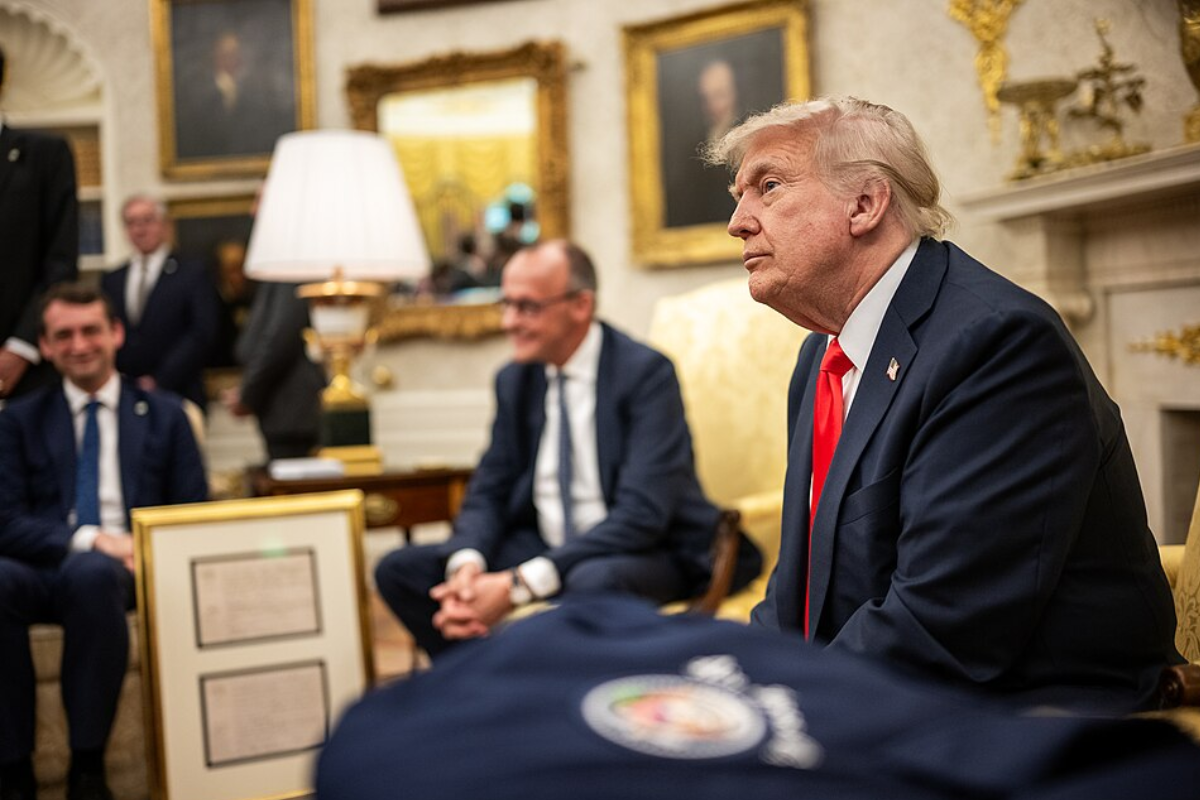
Merz's public criticism carries particular weight given his historically warm relationship with Trump, as the two met in the Oval Office as recently as March. That a leader seen as Washington's closest European ally is now openly questioning the war's direction signals a deepening fracture within NATO at a moment when the conflict shows no signs of resolution. With the Strait of Hormuz still effectively closed and European economies already feeling the strain, the political cost of the war is climbing on both sides of the Atlantic.
Source: International Business Times UK
