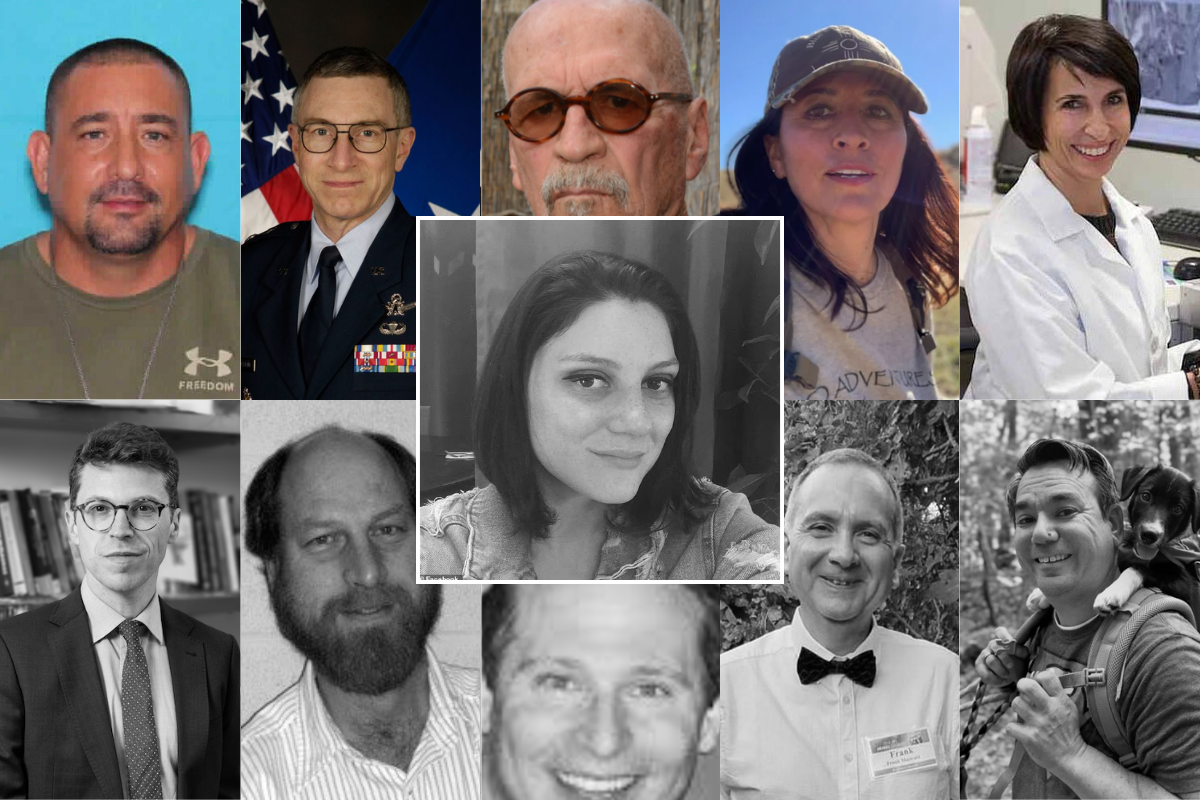
The US House Oversight Committee's deadline for four federal agencies to brief lawmakers on a string of missing and dead scientists falls today, setting up a key test of how seriously the executive branch is taking the inquiry.
Letters dated 20 April 2026from Committee Chairman James Comer and Subcommittee Chairman Eric Burlison gave the Federal Bureau of Investigation (FBI), the National Aeronautics and Space Administration (NASA), the Department of Energy, and the Department of War (DoW) until 27 April to deliver staff-level briefings on at least 11 individuals tied to nuclear, rocket, and aerospace research who have died or disappeared since 2023.
The DoW has already responded, telling the committee there are 'no active national security investigations' of any missing person who was a current or former clearance holder involved in special access programs. Comer and Burlison wrote back that the answer 'leaves the Committee with many unanswered questions.'
That early refusal to confirm any active probe could shape what unfolds today. If the FBI, NASA, and the Energy Department offer similarly thin briefings, Congress may push for compelled testimony. If they reveal coordinated work, the inquiry escalates from a public-attention exercise to a formal national security review.
The FBI said it 'is spearheading the effort to look for connections into the missing and deceased scientists,' working with the Department of Energy and the Department of War. NASA spokesperson Bethany Stevens said the agency is 'coordinating and cooperating with the relevant agencies' but added that 'nothing related to NASA indicates a national security threat.'
NASA is coordinating and cooperating with the relevant agencies in relation to the missing scientists. At this time, nothing related to NASA indicates a national security threat. The agency is committed to transparency and will provide more information as able.https://t.co/92dTXGAxQn
Cases on the committee's radar span Caltech, NASA's Jet Propulsion Laboratory (JPL) in California, Los Alamos National Laboratory, MIT, and the Kansas City National Security Campus. Three former JPL researchers, Michael David Hicks, Frank Maiwald, and Monica Reza, are among the dead or missing. Astrophysicist Carl Grillmair was shot dead at his home outside Los Angeles in February.
The most recent and politically charged case involves retired Air Force Major General William Neil McCasland, the seventh Commander of the Air Force Research Laboratory, who walked out of his Albuquerque home on 27 February and remains missing. He left behind his phone, prescription glasses, and wearable devices, taking only a wallet and a .38 calibre revolver, according to his wife.
Several of those listed held high-level security clearances tied to advanced materials, planetary defence, and nuclear weapons infrastructure. Reza, who patented a nickel super-alloy used in rocket programmes including New Glenn and Starship, was last seen on Angeles Crest Highway in June 2025.
However, experts question whether a pattern even exists. Medical sociologist Robert Bartholomew said the public response shows classic 'apophenia', or the human tendency to see meaningful links in unrelated events. Writing forPsychology Today,he warnedthat authority figures suggesting foul play activate the brain's pattern-seeking instinct, which 'renders us vulnerable to conspiracy theories.'
Source: International Business Times UK
