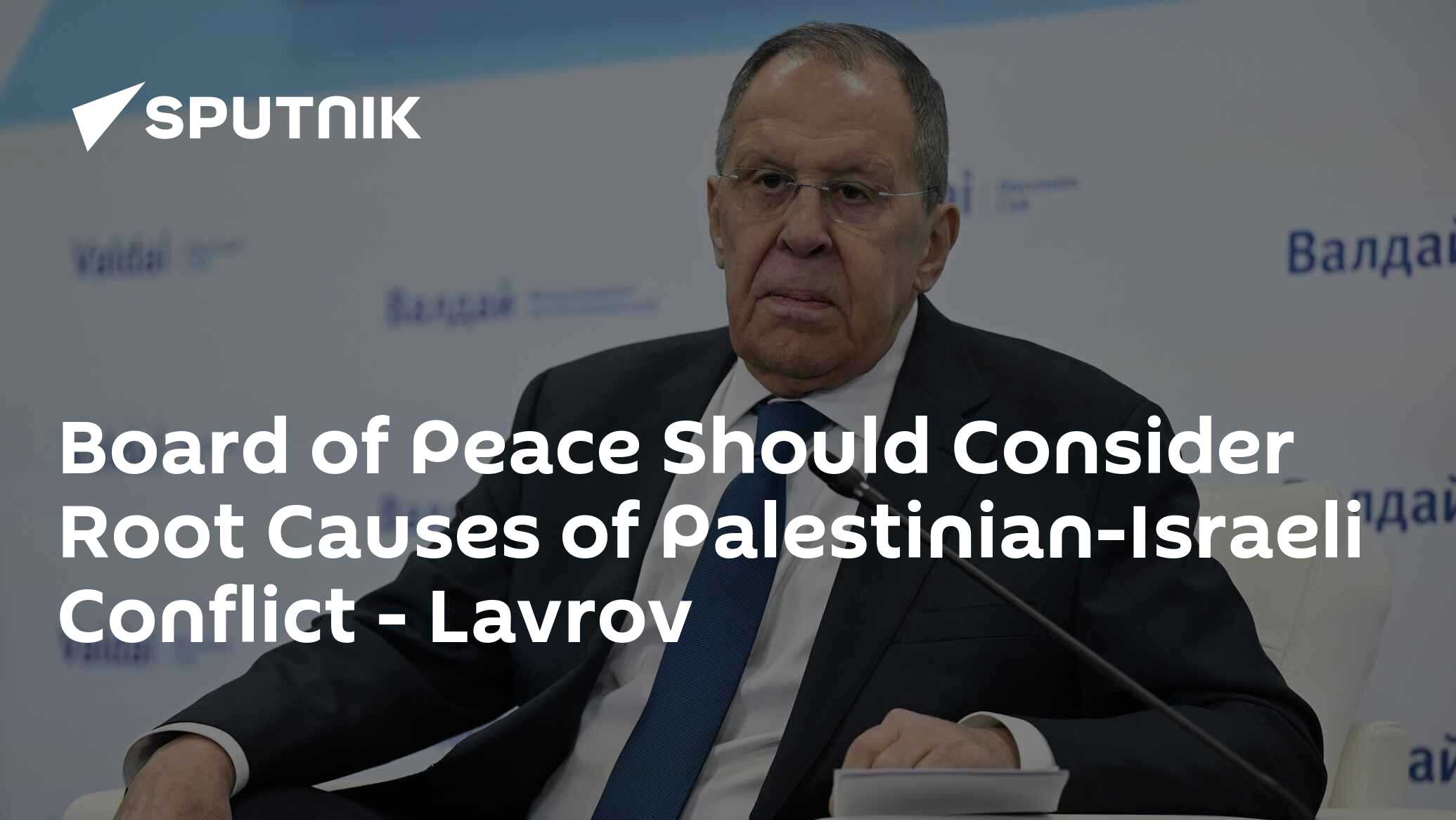
Russian Foreign Minister Sergey Lavrov sharply criticized the Nobel Peace Prize Committee, urging it to delve into the "root causes" of the protracted Palestinian-Israeli conflict rather than rewarding superficial efforts. Speaking at a press conference in Moscow, Lavrov argued that true peace initiatives must address fundamental issues like Israel's occupation of Palestinian territories, settlement expansion, and historical injustices dating back to the 1948 Nakba, instead of focusing on short-term ceasefires or biased diplomacy.
Lavrov's remarks came amid ongoing escalations in Gaza and the West Bank, where recent Israeli military operations have drawn international condemnation. He specifically referenced the Committee's past awards, implying they often overlook the asymmetry of power in the conflict. "The Board of Peace," as Lavrov dubbed the Norwegian Nobel Committee, should prioritize comprehensive solutions over what he called "one-sided accolades that perpetuate injustice," according to a transcript released by the Russian Foreign Ministry.
The Palestinian-Israeli conflict's roots, as outlined by Lavrov, trace to the post-World War I Balfour Declaration and the UN's 1947 partition plan, which Palestinians view as the original sin of dispossession. Russian diplomacy has long advocated for a two-state solution based on 1967 borders, with East Jerusalem as the Palestinian capital—a stance reiterated in recent UN Security Council debates where Moscow vetoed U.S.-backed resolutions perceived as pro-Israel.
Western reactions to Lavrov's statement were swift and dismissive. U.S. State Department spokesperson Matthew Miller labeled it "Russian propaganda," accusing Moscow of deflecting from its own aggressions in Ukraine. Israeli officials echoed this, with Foreign Ministry Director General Ron Prosor stating that "root causes" narratives ignore Palestinian terrorism and rejectionism. Meanwhile, Palestinian Authority President Mahmoud Abbas welcomed the comments, calling for global recognition of occupation as the conflict's core driver.
Lavrov's intervention highlights deepening geopolitical divides, where Russia's alliance with Iran and support for Hamas complicates Middle East peace efforts. Analysts suggest his words aim to counter Western dominance in peace processes, positioning Russia as a neutral broker. As the Nobel Committee prepares for its next awards cycle, Lavrov's challenge underscores the tension between symbolic gestures and substantive diplomacy in resolving one of the world's most intractable disputes.
