[Author’s Note:The article below, first published by GR in August 2022, focuses mainly on the fighting in western Europe during the opening weeks of World War I. The Belgian Army, seriously outnumbered, put up some staunch resistance against the German Army but Belgium, among the smallest nations in Europe, could not expect to hold out for long against the bulk of the German invasion force. I’ve mentionedGeneral Ludendorffand his courageous storming of the Citadel of Liège in early August 1914, along with the deployment by the Germans that same month of the 40-ton plus Big Bertha siege gun which was used to deadly effect, for example, in eastern Belgium. German soldiers lined up more giant siege guns on the battlefield late in the war in order to bombard Paris from dozens of miles away which further damaged the already fragile morale of the Parisians. —Shane Quinn, February 12, 2026]
Nineteen fourteen was a terrible year, much worse than the most pessimistic imaginings at the time had forecast, and it was perhaps among the worst years in human history.
During late July and early August 1914, in Paris, Berlin, London and Saint Petersburg, crowds lined the streets during the last days of the crisis leading up to the First World War, which officially began on 28 July 1914. Some among the marchers sang patriotic songs, demonstrated in front of enemy embassies, and committed random acts of violence.
Those who had desired the conflict, and those who had dreaded it, found their tensions released with the declarations of war. Some wept to see the lamps going out across Europe heralding the imminent approach of fighting, though these were not in a majority. In all of the warring powers many of the young men especially, oblivious of the carnage lying in store for them on the battlefields, celebrated the dawning of a new world with a sense of awe. Yet it soon became clear to everyone, politicians, the public and to a lesser extent military commanders, that the nature of modern, industrialised warfare had been sorely misunderstood.
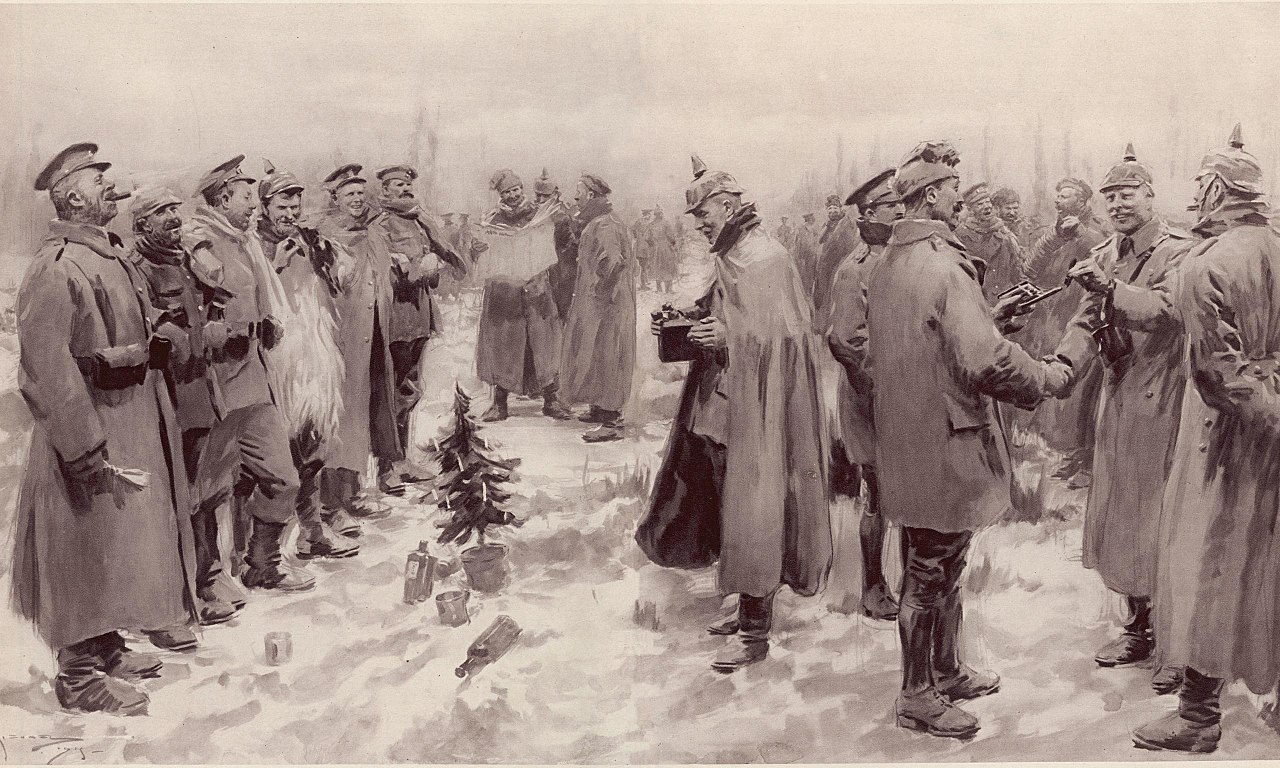
It was thought by most that the war would be decided within a few months, before Christmas 1914 even, and that no nation’s economy could handle the strain of a prolonged war. There were other fanciful beliefs that combat was to be conducted in the classical sense, with cavalry screens and wide-wheeling masses of manoeuvre. Such were the technological advances that mankind had made by the early 20th century, many decades into the industrial age, that the old-style forms of war were primarily defunct, and the new form was infinitely more deadly.
In 1915 for example, the French Army would suffer 1,624,000 casualties. By comparison in 1915 the German Army had incurred 873,200 casualties, amounting to less than 54% of French casualties; which gives an indication of the superiority of the Germans over the French, and during a period when German forces were simultaneously fighting against the massive Russian Army in the East.
That was into the future. In the early morning of 4 August 1914, the Germans invaded neutral Belgium. They attacked towards the city of Liège in eastern Belgium, located less than 25 miles from the German border. Germany’s invasion of Belgium, a lawless and aggressive action, drew much condemnation from the French and British among others. Not mentioned was that France had until 1912 been planning an attack on Belgium at the outbreak of hostilities, and only that year the French had abandoned the notion out of consideration for England’s attitude, and not out of consideration for the Belgians.
Furthermore, on 5 October 1915 France and Britain invaded neutral Greece, which was of course against the wishes of the Greeks who wanted to stay out of the war, as had the Belgians. The Anglo-French invasion of Greece was a very similar example of unlawful aggression to the German invasion of Belgium. Yet the reactions in Paris and London to the attack on Greece a year later were quite different.
Greece was not pivotal to Anglo-French war aims, whereas the German advance into Belgium, a strategically placed country which borders Germany to the west, was viewed with good reason by Berlin’s militarists as crucial to a German victory in the war. On 4 August 1914 the German chancellor, Theobald von Bethmann Hollweg, publicly acknowledged his country’s guilt in assaulting Belgium. Addressing the Reichstag (parliament) he called it “a breach of international law” and continued “The wrong – I speak openly – the wrong we hereby commit we will try to make good as soon as our military aims have been attained”.
An invasion of Belgium was formulated almost a decade prior to 1914 by the German field marshal, Alfred Graf von Schlieffen, as part of his strategy known as the Schlieffen Plan. Field Marshal von Schlieffen, who died aged 79 in January 1913, had planned another illegal offensive against the neutral Netherlands, through Maastricht in the far south of the Netherlands, but Germany spared the Dutch such a fate in 1914.
Source: Global Research
