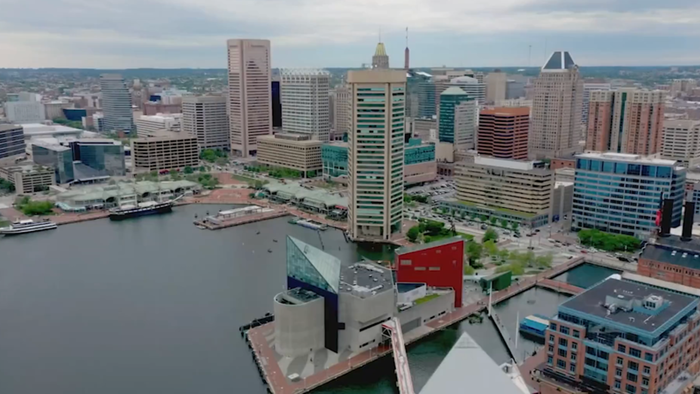
A localized commercial real estate crash has been spreading through downtown Baltimore City's office market like cancer, with more than $1 billion in property value erased since 2020. The rapid decline of the commercial tax base in the downtown area is colliding with deep structural crises, including violent crime, a continued population collapse (now at a 100-year low), fiscal mess, and the increasing risk that theunhinged left-wing politicians in City Hallwill hike taxes on working poor households to offset the shortfall. What you're seeing in Baltimore is a death spiral: capital leaves, residents follow, the tax burden shifts onto those who stay, and the cycle feeds on itself with no clear bottom in sight.
The Baltimore Sun, now owned by conservative David Smith (who also owns Sinclair Broadcasting), and Democrats in the state have becomevisibly angeredthat the paper is not producing left-wing propaganda as leftist Gov. Wes Moore's polling data slides. Reports from the paper indicate that between 2020 and fiscal 2026,more than $1 billion in commercial property value has been erased, or about 29% of the city's commercial properties - 4,085 out of 14,027 - saw their assessed values slashed on average by 28.7%.
"The pace of losses has been so sharp that officials have repeatedly issued out-of-cycle reassessments, rather than waiting for Maryland's standard three-year review," The Sun wrote in the report.
Downtown Baltimore is witnessing a troubling trend as businesses continue to close, leaving employees without jobs and residents without essential services.The latest casualty is the Sheraton Hotel, a key fixture of the Inner Harbor, which has left 69 employees jobless.…pic.twitter.com/PagIL8uW9J
The steepest losses have been concentrated in Downtown, the Inner Harbor, and Downtown West:
Commercial property values in Downtown alone fell $496.3 million in assessed value over the last six years, while the Inner Harbor dropped $363.4 million and Downtown West lost $214.6 million — a combined decline of more than $1.07 billion across those three districts.
Some of the city's most recognizable properties saw steep reductions: 100 Pratt Street E in the Inner Harbor lost $138.9 million in assessed value during that period, while 1 Light Street in Downtown dropped $87.3 million. Several other high-profile properties posted losses exceeding $40 million.
David Bramble, managing partner at MCB Real Estate, told the local paper that the downtown area ofBaltimore is "experiencing massive value loss," adding, "If this trend continues unabated, Baltimore will face even more serious financial hardship, impacting all its residents and businesses, from neighborhoods to the waterfront."
The paper noted that city officials and business leaders said downtown's commercial struggles stem not only from crime but also from the era of remote work.
"A lot of these workers are still working from home, at least a few days a week. T. Rowe Price might have a trader who, in 2018, went to the office five days a week. Now he's coming in two or three days a week. As a result, the needed downtown office space is being downsized," said Richard Clinch, executive director for the University of Baltimore's Jacob France Institute.
Source: ZeroHedge News
