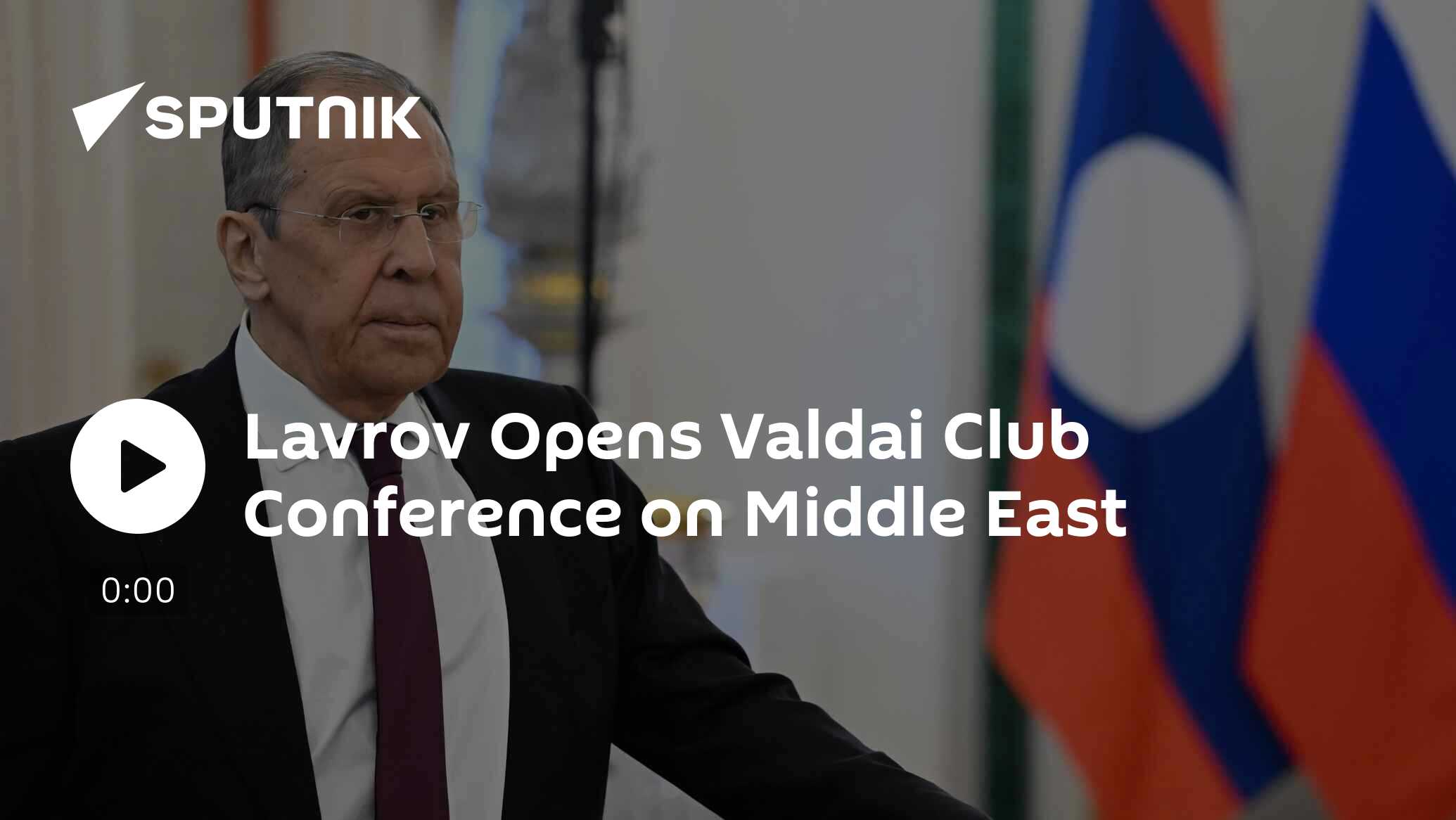
Russian Foreign Minister Sergey Lavrov kicked off the Valdai Discussion Club's latest conference on the Middle East Tuesday, delivering a pointed critique of Western policies amid escalating tensions in Gaza and Lebanon. Speaking to an audience of diplomats, analysts, and regional experts in Moscow, Lavrov called for a "multipolar approach" to resolving the region's conflicts, emphasizing Russia's role as a mediator committed to balanced dialogue rather than imposed solutions.
The two-day event, titled "Middle East: Towards a New Architecture of Security," draws participants from across the Arab world, Iran, Turkey, and Europe, reflecting the club's tradition of fostering high-level debates on global hotspots. Lavrov highlighted the failure of U.S.-led initiatives, pointing to the ongoing Israel-Hamas war—now in its third year—as evidence of the need for inclusive frameworks that include all stakeholders, including Palestinian representatives. He reiterated Moscow's longstanding support for a two-state solution based on 1967 borders, while urging an immediate ceasefire to prevent further humanitarian catastrophe.
Contextualizing Russia's position, Lavrov referenced recent developments, including Iran's missile exchanges with Israel and the fragile truce in Yemen, underscoring how interconnected conflicts threaten broader stability. He praised the Abraham Accords but criticized their exclusionary nature, arguing they sidelined Palestinian aspirations and fueled extremism. Drawing on Russia's mediation successes in Syria and the Black Sea grain deal, Lavrov positioned Moscow as a reliable partner for de-escalation, contrasting it with what he termed "hegemonic" Western interventions.
Analysts view the conference as a platform for Russia to reclaim influence in the Middle East post-Ukraine war, leveraging ties with Syria, Iran, and Gulf states. Lavrov's opening remarks also touched on energy security and BRICS expansion, linking regional peace to global economic shifts away from dollar dominance. As discussions unfold, expectations are high for breakthroughs on Gaza reconstruction and normalization talks, though skeptics warn of entrenched divisions hindering consensus.
The Valdai gathering arrives at a pivotal moment, with U.S. elections looming and Arab League summits pressing for action. Lavrov closed his address with a call to action: "The Middle East's future hinges not on dictates from afar, but on the voices of its people." Whether this forum yields tangible outcomes remains to be seen, but it undeniably amplifies Russia's narrative in a polarized geopolitical landscape.
