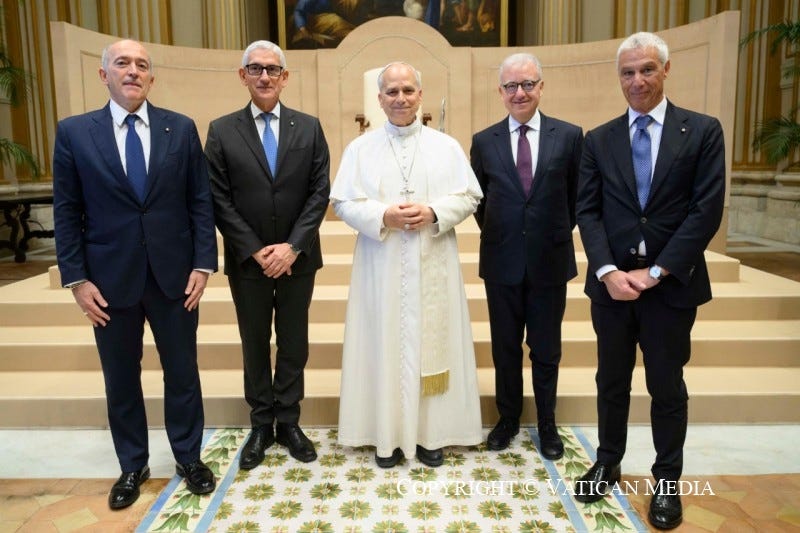
When Trump declared Pope Leo “terrible for foreign policy,” the U.S. intelligence community took the president’s remarks as a directive to prioritize spying on the Vatican.
It has for years, sources tell me. The CIA has human spies working inside the Holy See bureaucracy. The NSA and CIA seek to intercept telecommunications, emails, and texts. The FBI investigates crimes committed against and by the Vatican. The State Department closely follows the ins and outs of Papal diplomacy and politics. All of these agencies liaise with the Vatican’s own foreign policy, intelligence and law enforcement agencies.
“Pope Leo is WEAK on Crime, and terrible for Foreign Policy,” Trump said in an April 12 social media post. Trump went on to cite several specific foreign policy grievances, including the Pope’s criticism of the Iran War and the abduction of Venezuelan ruler Nicolas Maduro. Trump said:
“I don’t want a Pope who thinks it’s OK for Iran to have a Nuclear Weapon. I don’t want a Pope who thinks it’s terrible that America attacked Venezuela, a Country that was sending massive amounts of Drugs into the United States and, even worse, emptying their prisons, including murderers, drug dealers, and killers, into our Country. And I don’t want a Pope who criticizes the President of the United States …”
Tension between the Vatican and the White House is nothing new, but historically it has taken place through surrogates, policy statements, or pointed silence. Trump’s very public swipe against Pope Leo cast the American-born head of the Roman Catholic church as a threat to U.S. interests. It is an unprecedented label.
My first hint of the government’s interest in this subject was a recent job posting by SOS International, a major national security contractor headquartered in Reston, Virginia. It is looking for an Italian speaker to work for an unnamed “U.S. Government Client” to “provide social media monitoring, translation, and current event awareness” on subject matters including “religion.”
It is a pretty innocuous contractor job, and though it does not require a security clearance, it lists as a preferred qualification “experience supporting the Intelligence Community.”
But it got me thinking: Just what does the U.S. do to spy on the Pope and the Vatican? What I found, after some reporting, was a portrait of a longstanding — and quietly extensive — relationship between the U.S. national security apparatus and the Vatican. It involves genuine diplomatic, law enforcement, and even cyber security cooperation, all of which serves as both genuine cooperation and convenient cover for collecting intelligence.
FBI documents I obtained show that the first Trump administration sought to beef up its coordination with Italian intelligence agencies and Vatican officials on things like cyber security, white collar crime, human trafficking, art theft and other issues. One particular project was to help the Vatican actively thwart, cyber intrusions into its networks. The FBI also regularly provides threat intelligence to the Pope during his travels (though it’s unclear whether that cooperation still exists).
The CIA is represented in the U.S. Embassy to the Vatican and the Agency has been penetrating (or attempting to penetrate) the Vatican government and diplomatic corps for years. The NSA intercepts Vatican communications, working independently and through a joint NSA/CIA “Special Collection Service.”
Source: Drudge Report
