There is a number that circulates quietly among producers who have been in this business long enough to remember when original films got made: 18 percent. That is Hollywood's current share of qualified film and television projects, down from 23 percent just three years ago. A contraction that doesn't make many headlines but defines nearly everything about what is and isn't getting greenlit right now.
The mechanics are straightforward, if painful. Studios retreated into franchise territory because the margin of error on a $60 million original is unforgiving in a way that a $200 million IP extension, paradoxically, is not. The streamers, who absorbed a decade's worth of independent creative energy, have since pivoted toward profitability, which translates operationally to smaller orders, narrower bets, and a preference for data-validated demand over creative instinct. The foreign presales market, historically the financial oxygen that kept mid-budget films alive, has tightened further still. International buyers want recognisable IP. They are not writing seven-figure commitments for an original thriller from a first-time director, regardless of the script's quality.
The economic architecture that once made a $40 million original pencil out, with presales covering a meaningful chunk of budget, domestic theatrical providing upside, and home video and international filling gaps, barely exists in its prior form. Entertainment industry layoffs topped 17,000 in 2025 alone. Filming activity in Los Angeles dropped 40 percent from 2022 levels before falling another 13 percent in a single summer. The industry is not experiencing a correction. It is experiencing structural failure.
For nearly two years, Acme AI & FX has operated without a public website, without a PR operation, and without a single press announcement. That is not an oversight. It is a strategy.
What the company has been building in that time is something the industry has discussed in theory but never seen executed at scale: a production infrastructure that uses proprietary AI technology to dramatically reduce the physical cost of filmmaking without eliminating actors or department heads, but rather empowers them further. Actors perform. Directors direct. Writers write. Department heads run their departments. What Acme eliminates is the industrial-era apparatus surrounding those creative acts, including location scouts, set construction, travel, permits, and the logistical sprawl that routinely consumes 20 to 30 percent of a feature budget before a single frame of story is captured.
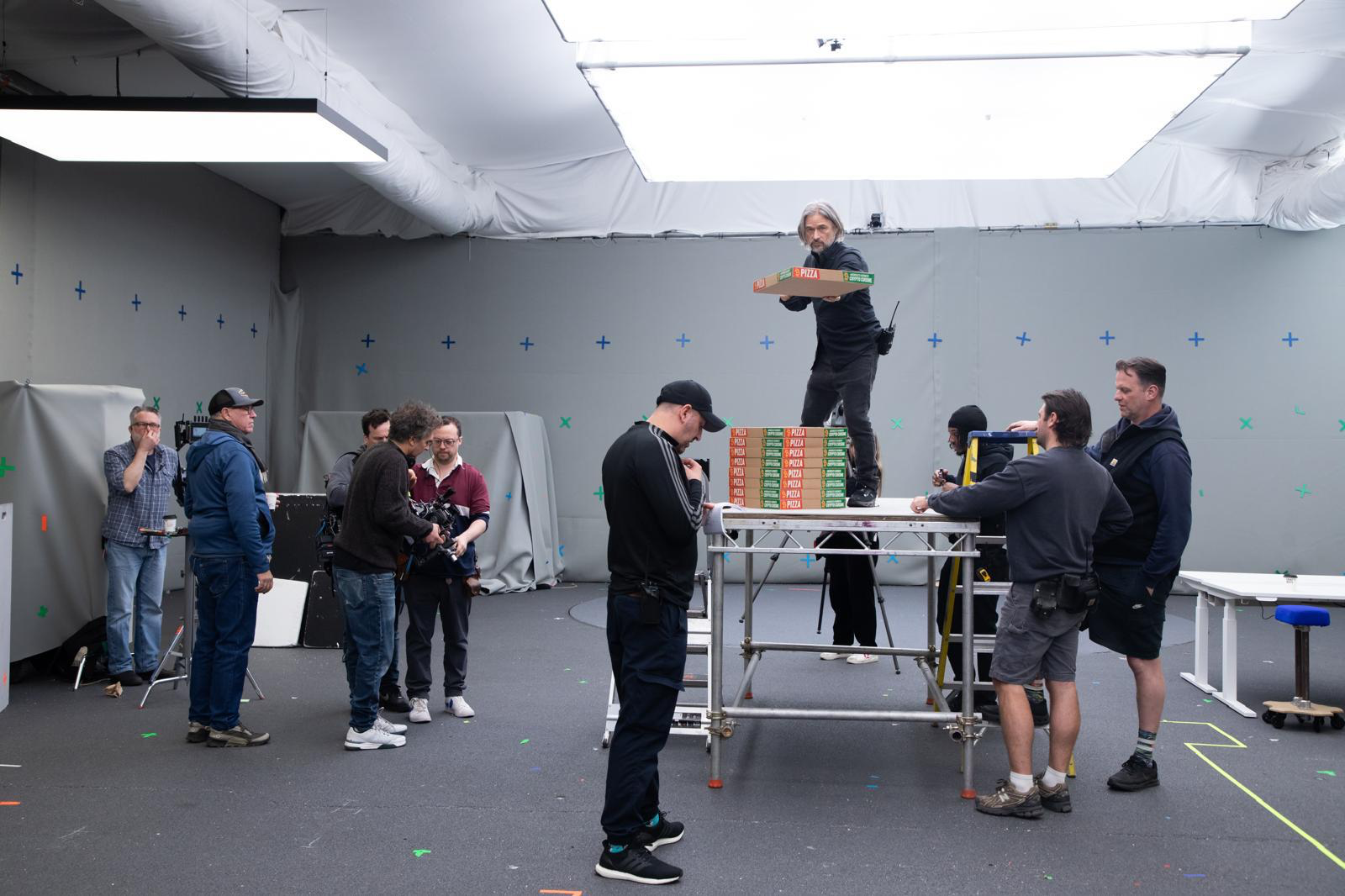
The technical centerpiece is performance capture shot on Acme's proprietary grey stage, with AI-generated environments built to full photorealism around the actors. Not impressive-for-AI photorealistic, but photorealistic by the standards of a 60-foot theatrical screen, according to those who have seen it. Every exterior, interior, and landscape that would traditionally require a location and a construction budget is instead built digitally. The performances remain entirely actor-driven. This is not digital puppetry. Nobody is being replaced or replicated. The actors act. The world around them is rendered. As important is Acme's proprietary pre-production and production software, a technology that has been making waves through Hollywood. We requested a demo but were told it was not for the press to see. We have been told that it makes pre-production seamless, organised and efficient for AI production. That it saves $15 million or more dollars on a big production and that there is nothing close to it in the industry. Our patent research shows over 40 patents or patents pending, and a source close to them has confirmed they have fielded offers, but apparently are not ready to sell.
The other unique piece is their proprietary grey stage setup. One individual who spent time at Acme's London facility and declined to be named due to NDA obligations described what they observed: 'You've got to see it. Over a one-week period, I watched numerous studio heads come through. Most of them arrived ready to dismiss the whole concept. Every single one left asking some version of 'how quickly can we start'.
Acme's cost structure, as described by those familiar with the company's operations, delivers a film at roughly 20 percent of traditional below-the-line cost while compressing shoot schedules by 60 to 70 percent. The implications for the greenlight problem are significant. A $50 million film that a studio won't touch because the downside risk exceeds its risk appetite becomes, at Acme's cost structure, a substantially similar film made for a fraction of that number. The risk-reward math changes, not just for sequels and franchise extensions, but for original stories, character-driven dramas, and the ambitious genre films that have been economically priced out of the conversation.
Garrett Grant, who joined Acme as a partner after a 25-year production career, described the practical experience on set: 'My entire department is intact. My crew is working. The difference is I'm not spending three weeks in prep dealing with location permits and weather covers and travel logistics. We're just making the movie. I've never had a shoot move this fast without something falling apart.'
The flagship production that brings Acme's model out of the abstract isKilling Satoshi, a $70 million conspiracy thriller directed by Doug Liman and starring Casey Affleck, Pete Davidson, Gal Gadot, and Isla Fisher. The film was shot entirely on Acme's grey stage with AI-generated environments, in partnership with 30 Ninjas. Nick Schenk, who wrote Gran Torino for Clint Eastwood, penned the original screenplay.
Source: International Business Times UK
