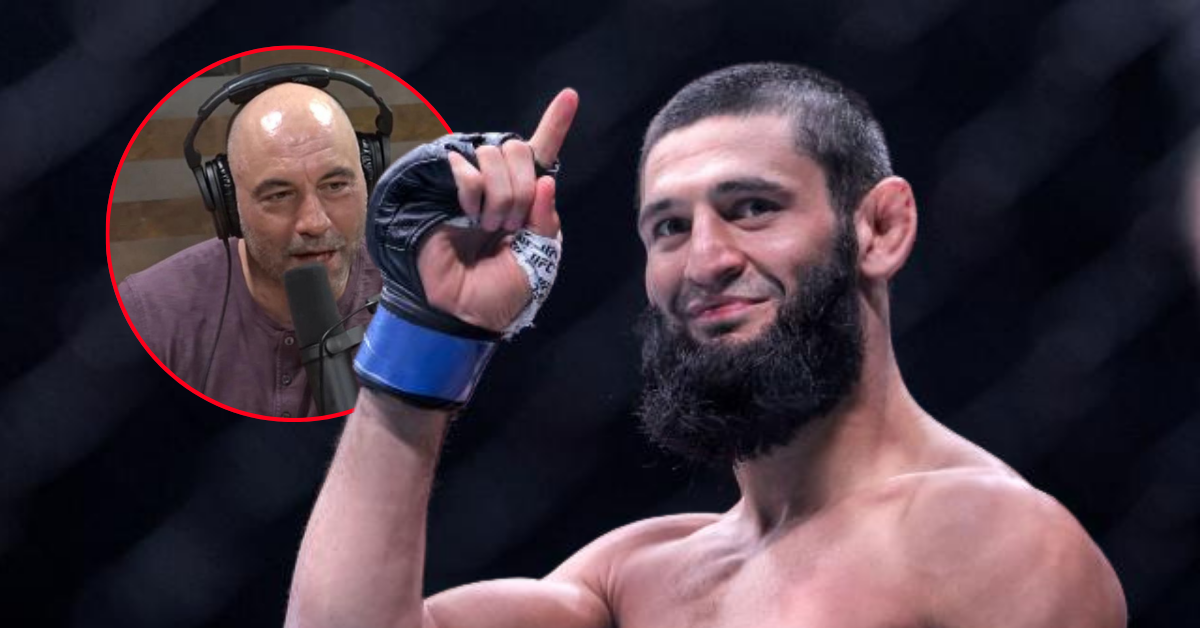
Joe Rogan has added a fresh layer to the conversation aroundKhamzat Chimaevbefore UFC 328, where the unbeaten middleweight champion is scheduled to defend his title against former champ Sean Strickland on May 9 at Prudential Center in Newark. The matchup is already easy to sell on names alone, but Rogan’s recent take shifts the focus to a more specific question: how much of Chimaev’s dominance has come against men who were never built to stop elite wrestling in the first place?
“Khamzat is handling guys that don’t have a big background in elite wrestling; they’re not elite wrestlers. The guy that he fought who was an elite grappler and gave him problems wasKamaru Usman. Usman took the fight on short notice at 185 lbs, and in the third round Kamaru was winning. That would have been a very interesting fight if it was a 5-round fight and if Kamaru had a full camp.”
Rogan’s argument centers on the idea that Chimaev has often been able to impose his game on opponents who were dangerous in other areas but did not bring a topwrestlingbase into the cage. Chimaev’s rise has been tied to his ability to close distance fast, force takedowns, build control, and either pile up damage or threaten submissions. His combat style has long been rooted in freestyle wrestling, and his credentials outside the UFC support that, including national titles in Sweden.
Joe Rogan says Khamzat Chimaev has been handling opponents without elite wrestling backgrounds 👀🤯“Khamzat is handling guys that don’t have a big background in elite wrestling; they’re not elite wrestlers. The guy that he fought who was an elite grappler and gave him problems…pic.twitter.com/CFQpNI1wXN
The fight Rogan used to make his case was Chimaev’s October 2023 meeting with Kamaru Usman at UFC 294. Usman took that bout on around 10 days’ notice afterPaulo Costawithdrew, and he accepted it at middleweight rather than his usual welterweight class. Chimaev won by majority decision, but the result did not feel like one-way traffic by the time the third round closed.
Chimaev controlled Usman for 4:35 in the first round and finished the night with 7:16 of total control time, landing four takedowns in 12 attempts. Even so, Usman had the better third round on the feet in stretches, and the official scores came back 29-27, 28-28, and 29-27, which showed a much tighter contest than many of Chimaev’s earlier UFC performances.
That is the opening Rogan is pointing to. His view is that Usman, an accomplished wrestler with years of championship experience, was able to giveChimaevproblems even without a full training camp and while fighting up a division. If that version of Usman could make the fight competitive late, Rogan’s suggestion is simple: a full camp and a five-round format could have told a different story.
This does not erase what Chimaev has done at 185 pounds. He remains undefeated, he submittedRobert Whittakerin the first round at UFC 308, and he later won the middleweight belt before booking this first defense against Strickland. Still, Rogan’s comments land because they target an ongoing debate in Chimaev’s career: whether overwhelming early control looks the same once the opponent can wrestle, defend, and drag him deeper into a fight.
That makes Strickland an interesting next chapter, even if he is not entering this fight with Usman’s wrestling résumé. Strickland is a former champion, hard to move backward, disciplined with his jab, and known for forcing opponents into uncomfortable rounds rather than chaotic minutes. Ahead of UFC 328, Rogan’s criticism does not rewrite Chimaev’s record, but it does sharpen the key question over this title defense: can Chimaev dominate another top middleweight, or will this become another fight where resistance changes the picture?
Source: LowKickMMA.com
