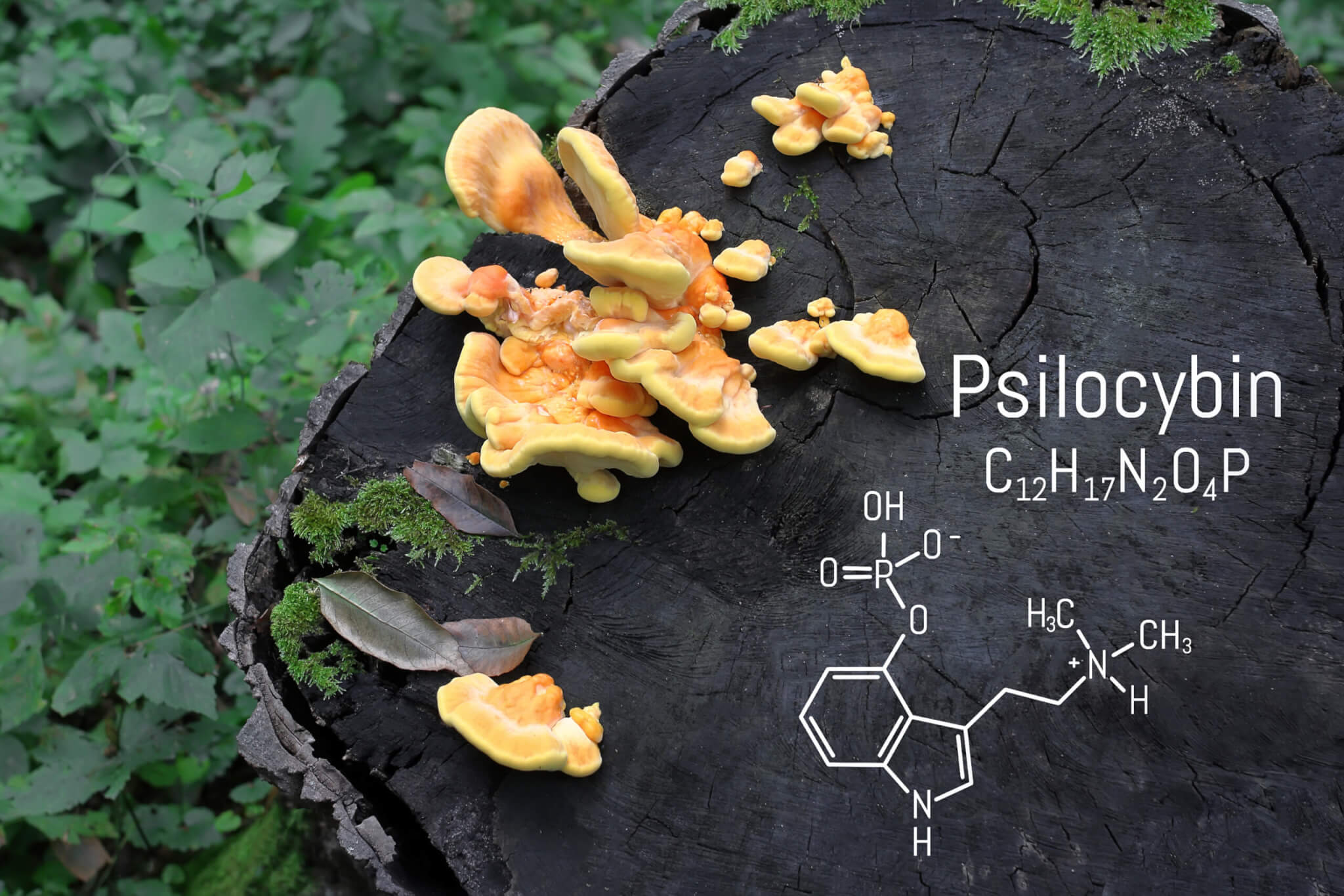
Chemical formula of psilocybin found in magic mushrooms. (© Aleksandr - stock.adobe.com)
Interest in magic mushrooms has surged in recent years, and new federal data put a number on just how widespread use has become. A federal survey found that roughly 8 million Americans used psilocybin, the active compound in magic mushrooms, last year.
Buried inside that figure is a pattern researchers say doctors need to pay attention to: people who had recently experienced amajor depressive episodewere more likely to be among those using it.
As psilocybin inches closer to mainstream medicine, the question of who is using it outside of controlled settings, and why, is becoming harder to ignore.
For the first time, the 2024 National Survey on Drug Use and Health included questions specifically about psilocybin. Run annually and designed to reflect the broader U.S. population, previous versions of the survey either grouped psilocybin with other hallucinogens or only asked whether someone had ever tried it in their lifetime. By asking instead about use within the past year, researchers got a much sharper picture of who is actually using it now.
Led by Kevin H. Yang of UC San Diego and Joseph J. Palamar of NYU Grossman School of Medicine, the study was published inThe American Journal of Psychiatryand analyzed responses from 58,633 participants. An estimated 8 million people ages 12 and older, about 2.8% of the U.S. population, reported past-year use. Because the survey captures a single point in time and relies on self-reported data, the findings describe associations rather than cause-and-effect relationships.
Who is using it? Mostly younger, college-educated, higher-income men. Young adults ages 18 to 25 had higher odds of past-year use than the 35-to-49 age group, while people 50 and older had much lower odds. Black individuals had about 60% lower odds and Hispanic individuals about 31% lower odds compared to White individuals, and people with a college degree had more than two and a half times the odds of those without a high school diploma. Throughout the study, “odds” refers to how common something was in one group relative to another, not the likelihood that any one person would usepsilocybin.
Other drug use showed the tightest connections. People who had used cannabis in the past year had more than 13 times the odds of also having used psilocybin, making it the most strongly associated factor by a wide margin. Past-year LSD use carried nearly eight times the odds,ketamineabout six times, and MDMA roughly three and a half times. Cocaine was linked to about twice the odds, and misuse of prescription stimulants showed a similar association.
Researchers noted that psilocybin use “commonly co-occurs with other substance use within the same year, consistent with a shared experimentation pattern among individuals who usepsychedelics.” For clinicians, that clustering is a practical signal: when a patient mentions using one psychedelic, a broader conversation about substance use is probably warranted, including a look at potential interactions with antidepressants.
Among past-year psilocybin users, 23.1% had experienced a major depressive episode in the past year, compared to 8.4% of non-users. These figures reflect differences between groups, not a change in individual risk caused by psilocybin. After adjusting for demographics, income, education, and other substance use, people with a recent depressive episode still had 37% higher odds of having used psilocybin.
Source: Drudge Report
