The loss of Europe’s geopolitical power is the defining decline narrative of our time.As Europeans, we are condemned to become unwilling witnesses of continental decay. And in no field of politics does the toxic amalgam of eco-socialism, elite arrogance, and rampant infantilism become more visible than at the level of the European Union.
What we are witnessing in Brussels and the leading capitals of the EU are desperate attempts at coordinated foreign policy – and the realization that the cooperation of powerless individual entities does not necessarily lead to better outcomes than bilateral cooperation.
That this realization must have reached the highest circles of European politics could be observed at the end of this week. The four “big ones” – Germany, the United Kingdom, France, and Italy – called for a maritime alliance and the protection of the Strait of Hormuz.
Fifty additional states – according to the initiators of this rather peculiar political camouflage – are expected to join the European alliance. Leadership claims are naturally being made by the former maritime powers Britain and France, above all France, whose aircraft carrier Charles de Gaulle may stand as the last remaining symbol of Europe’s great naval tradition at the center of these activities – if one can even approach the Persian Gulf at all.
The situation remains fragile: the currently stable ceasefire ends on Wednesday. And negotiations between the United States, Israel, and Iran are entering their final phase. From a European perspective, our assumptions are once again confirmed: the EU and its slowly re-approaching partner the United Kingdom are staging a political cabaret. First came the wait-and-see approach until Americans and Israel had militarily decided the situation. Meanwhile, some NATO members refused cooperation with the United States, only to now, after everything has been decided, attempt to place themselves at the forefront of political forces seeking to guarantee the security of the Strait of Hormuz.
Through constant media overdrive, Starmer, Macron, Meloni, and Merz present themselves as the decision-makers of the moment – it is their harvest time, collecting cheap public dividends. But is that really the case? Do they seriously believe that the majority of Europeans are not fully aware of what is happening? That European power is essentially the product of media magic – permanent propaganda wrapped in moral excess? A shadow of past greatness, reduced to virtual impotence, ultimately dissolving into the very media theatre that we, as embarrassed Europeans, are forced to endure every day.
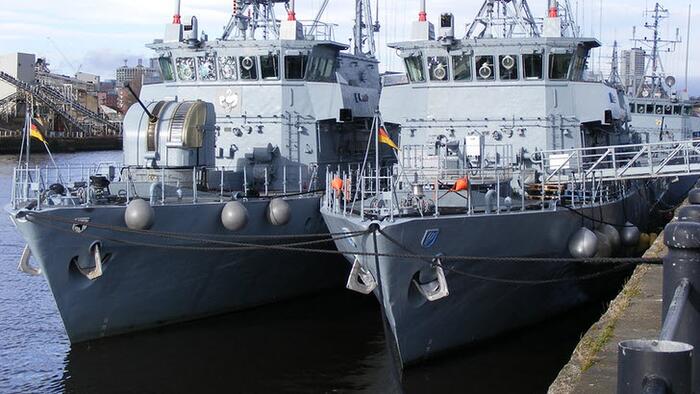
TheGerman contributionto the mission, as announced by Chancellor Friedrich Merz, is predictably modest:mine countermeasure vessels (eight available), one supply ship, and two P-8 Poseidon reconnaissance aircraft. No frigates – they are tied up in a NATO deployment in the North Atlantic. Germany does have a defense budget that exceeds all other Europeans by billions, yet even this money appears to vanish into the nirvana of bureaucracy and into the coffers of defense contractors, who are popping champagne corks thanks to the government’s debt-driven spending spree amid multiple conflict scenarios.
As for the possible German contribution. But as said: whether a military deployment will actually take place remains uncertain. Europe is already feeling the consequences of its energy dependency and its eco-socialist policy course, which hit like an icy wind. Yet this does not change the fact that policymakers continue to refuse to acknowledge the geopolitical vacuum, and instead begin trying to piece together diplomatically what they have shattered in recent years – especially in relations with the United States and Russia.
From poker we know: those who repeatedly bluff at the same table with empty hands and are exposed will be dismantled in future rounds. AUS withdrawal from NATOwould likely also mean a full retreat from the Ukraine conflict. This move would expose both Europe’s fragile finances and its non-existent security infrastructure. The EU faces economic and geopolitical problems it cannot manage alone.
From a European perspective, not many options remain. To those advocating closer alignment with China: China sees Europe primarily as a dumping ground for surplus production from its politically driven export sector. Europe could be pressured at any time via export restrictions on rare earths or microchips. This is not a viable option.
Source: ZeroHedge News
