Freddie Ponton21st Century Wire
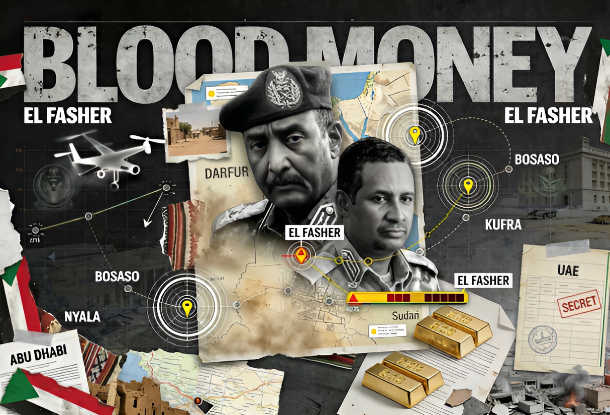
El Fasher, the capital of North Darfur in Sudan, and the last major city in Darfur outside paramilitary control, did not fall to theRSF, or Rapid Support Forces, alone. According toBlood Money, a new investigation byConflict Insights Group (CIG), the October 2025 capture of the city was enabled by a UAE-backed network that moved Colombian mercenaries through Somalia, Abu Dhabi, Libya, and South Darfur, where they flew drones, trained fighters, and were present during the final takeover.
What followed was slaughter. After the RSF, a powerful Sudanese paramilitary force led byMohamed Hamdan Dagalo,better known as Hemedti, seized El Fasher on 26 October 2025, fighters carried out executions, civilians were killed inside theSaudi Maternity Hospital, and the Prosecutor of theInternational Criminal Courtlater concluded that war crimes and crimes against humanity had been committed in the city. CIG references reports indicating that over 460 patients lost their lives at the Saudi Maternity Hospital alone, and argues that without this foreign support, the siege, the takeover, and the atrocities that followed would likely not have occurred. The report indicates that its analysis underwent multiple levels of verification, eliminating questionable data and ensuring that significant findings were validated against external sources, which included confirmation from theU.S. Treasuryregarding devices linked to Colombia in El Fasher.
That finding belongs to a longer history of foreign power in Sudan. The UAE and Saudi Arabia did not enter Sudan as neutral brokers. They helped entrench military actors after former President of Sudan,Omar al-Bashir’s fall, while deepening their ties to the RSF through Yemen and post 2019 power politics, before binding Sudan ever more tightly to a regional economy of gold, coercion, and foreign dependency.
Sudan’s current war erupted on 15 April 2023, when the power struggle between the SAF, or Sudanese Armed Forces, the country’s regular army led byGeneral Abdel Fattah al-Burhan, and the RSF exploded into open conflict and pushed the country into disintegration. What began as a contest between rival armed centers hardened into a national catastrophe shaped by outside patrons, war profiteers, and regional states that treated Sudan as a zone of leverage rather than a sovereign country.
IMAGE: The Rapid Support Forces (RSF) paramilitary group, active in Sudan since 2013, has its roots in the Janjaweed
The RSF did not emerge from nowhere. It grew out of theJanjaweed militiasused during the Darfur war and was later formalized as a paramilitary force under Hemedti, whose rise turned a militia commander into one of Sudan’s most powerful warlords. By May 2024, the RSF and its allies had laid siege to El Fasher, while local forces aligned with the SAF tried to hold the city against an increasingly brutal encirclement.
Around 260,000 civilians, including 130,000 children, were still living in El Fasher as of late August 2025, trapped inside a city that had become both a strategic prize and a chamber of hunger, terror, and exhaustion. On 12 September 2025, theUN Security Councilrenewed the Darfur sanctions regime and arms embargo, and on that same day,the Quadof Egypt, Saudi Arabia, the UAE, and the United States called for an end to external military support, even as CIG says UAE support to the RSF continued. The road to El Fasher was paved not only by Sudan’s internal fracture, but by the systems that kept the war supplied and profitable.
According toReutersand the Washington Post, foreign backing has intensified the conflict on multiple fronts, including Iranian drone support to the Sudanese army and documented Turkish weapons transfers to the SAF, whileChatham Houseargues that competition over gold was not a byproduct of the war but one of the forces driving it. Darfur, Sudan’s vast western region long scarred by mass violence and displacement, was never just a battlefield. It was a war economy.
Gold is the clearest motive, but not the only one. Sudan offers Abu Dhabi access to one of Africa’s richest gold zones, leverage on the Red Sea, influence across the Horn of Africa and the Sahel, and a political arena where power can be projected through armed clients and commercial networks rather than direct occupation. Saudi Arabia has pursued its own version of that logic, treating Sudan as a strategic hinterland and a reservoir of military manpower, especially during the Yemen war.
Source: 21st Century Wire
