Home-DTU uses Lithoz ceramic 3D printing to build gyroid fuel cells
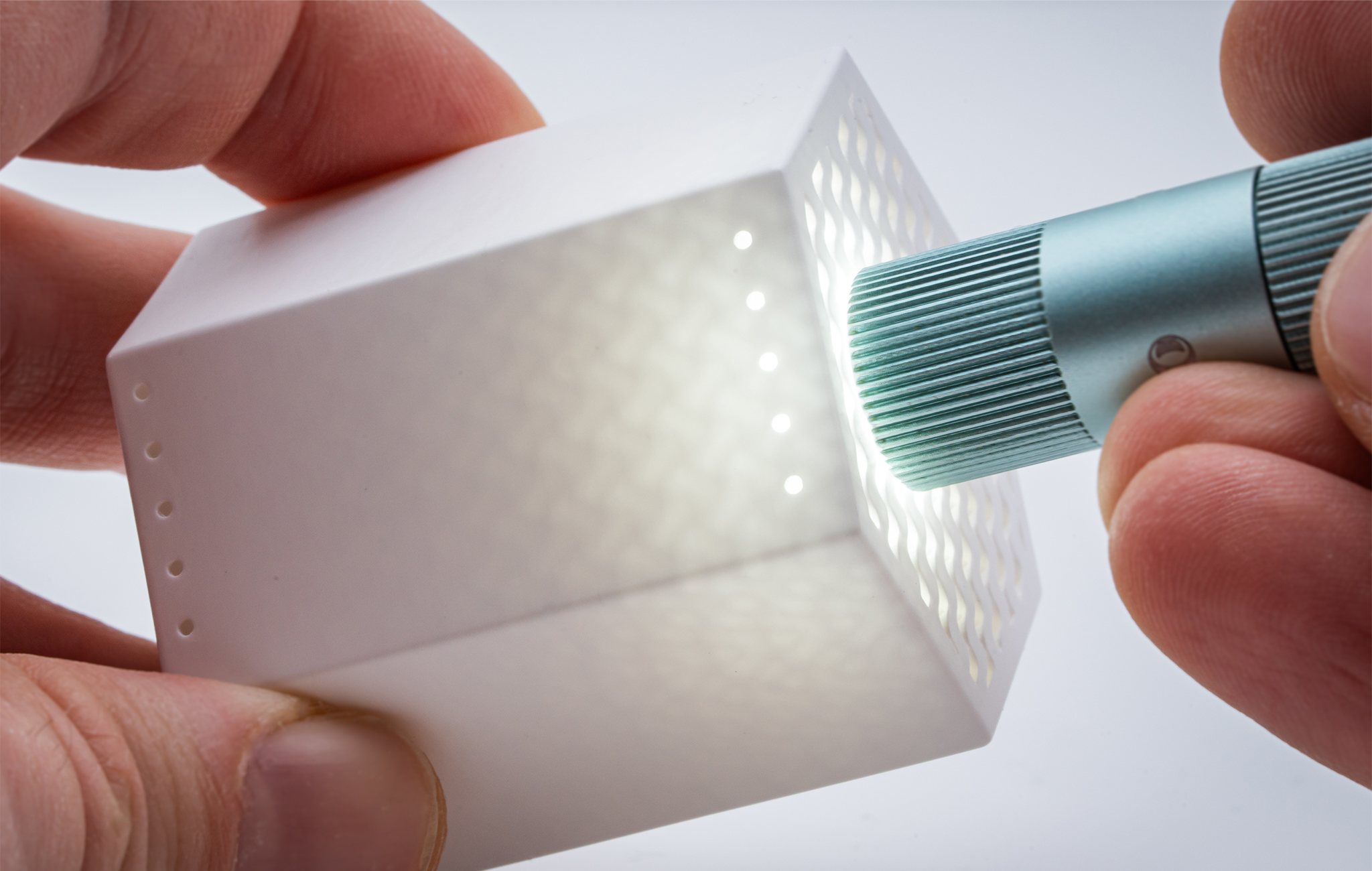
Researchers at theTechnical University of Denmark(DTU) have developed monolithic solid oxide fuel cells with 3D printed gyroid architectures made from 8YSZ, reporting power-to-weight ratios of about 1 W g⁻¹. According to the team, conventional planar SOFC architectures typically deliver around 0.2 W g⁻¹, making the new design roughly five times higher on that metric. Led by Professor Vincenzo Esposito atDTU Energy, the project used a recently acquiredLithoz CeraFabunit from Austrian ceramic 3D printer manufacturerLithozto produce a lighter fuel cell architecture aimed at hydrogen-powered transportation.
The cells were printed in 8 mol% yttria-stabilized zirconia, one of the most widely used electrolyte materials for SOFCs. Instead of building stacked flat cells, the researchers designed a monolithic ceramic structure with thin internal walls arranged in gyroid geometries. According to the university, removing conventional interconnects and sealants cuts weight, reduces thermal mismatch and mechanical stress, and improves use of the available volume. That compact configuration is intended to support lighter fuel cell systems for transportation applications on water, land, and in the air.
Researchers fromDTU Constructalso contributed to the project. Associate Professor Venkata Karthik Nadimpalli provided expertise in the mechanical behaviour and structural optimization of architected ceramic materials. That collaboration helped assess the structural stability of the thin-walled gyroid architecture under thermal and operational conditions. To create a working device, the team combined repeated gyroid units with a sealed shell frame that maintained gastight conditions.
Esposito described the result as a break from established SOFC design. “This innovation is a real paradigm shift from planar stacking to monolithic architectures,” he said. He added that the concept had long been out of reach because of the complexity required in the arrangement of materials and microstructures. “Our motto, ‘Escaping Flatland,’ sounds like a logical step, but it has long been impossible to achieve,” Vincenzo Esposito said. “The particular arrangement of materials and microstructures requires a significantly elevated level of complexity – but until recently, we simply lacked the tool to make this concept a reality.” He said Lithoz LCM technology delivered the repeatability needed to fabricate the bio-inspired TPMS geometries with very thin inner walls and to add the sealed shell required for gastight operation.
Johannes Homa, CEO of Lithoz, said the project reduced dependence on interconnect and sealing architectures used in stacked flat fuel cells. “By realizing 8YSZ monolithic fuel cells with intricate gyroid geometries on their Lithoz CeraFab printer, DTU was able to reduce the dependence on conventional interconnect and sealing architectures inherent to stacked flat items,” he said. With design and testing now completed, the DTU Energy team plans to scale the project to an industrial level. According to the university, the lighter ceramic architecture opens the way to rethinking both long-range and ultra-compact hydrogen engine designs.
Ceramic AM pushes solid oxide cell design beyond flat architectures
Earlier work had already shown that ceramic 3D printingcould improve solid oxide cell performanceby changing geometry rather than chemistry alone. In 2020, researchers at theCatalonia Institute for Energy Researchand theCatalan Institution for Research and Advanced Studiesused SLA ceramic 3D printing to produce electrolyte-supported solid oxide fuel and electrolysis cells in both planar and corrugated forms. Using 8YSZ, the team reported that the corrugated design increased active surface area from 2.00 cm² to 3.15 cm², a 57% rise, and delivered a 60% performance increase over conventional cells. That result mattered because it demonstrated that ceramic AM could produce gas-tight, crack-free YSZ electrolytes with enhanced-area architectures, showing that cell shape itself could be used to raise performance.
More recent work has pushed that logic further intohydrogen production systems with higher operating demands. The Horizon Europe-fundedHyP3D projecthas been developing 3D printed high-pressure solid oxide electrolysis cells designed to convert electricity into compressed hydrogen. Those cells were reported with a 70 cm² active area, operation above 0.90 A/cm² at about 1.3 V under 850°C and pressures above 5 bar, alongside projected gains in specific power per unit volume and mass. The project also highlighted the manufacturing side of the challenge, with 3DCeram working on printable YSZ-based slurries, process parameters, thermal treatment, and production workflows for complex ceramic parts. In that context, the DTU result stands out not simply as another printed solid oxide cell, but as a further step away from flat ceramic architectures toward lightweight monolithic designs built around geometric complexity.
3D Printing Industry is inviting speakers for its 2026 Additive Manufacturing Applications (AMA) series, covering Energy, Healthcare, Automotive and Mobility, Aerospace, Space and Defense, and Software. Each online event focuses on real production deployments, qualification, and supply chain integration. Practitioners interested in contributing cancomplete the call for speakers form here.
Source: 3D Printing Industry
