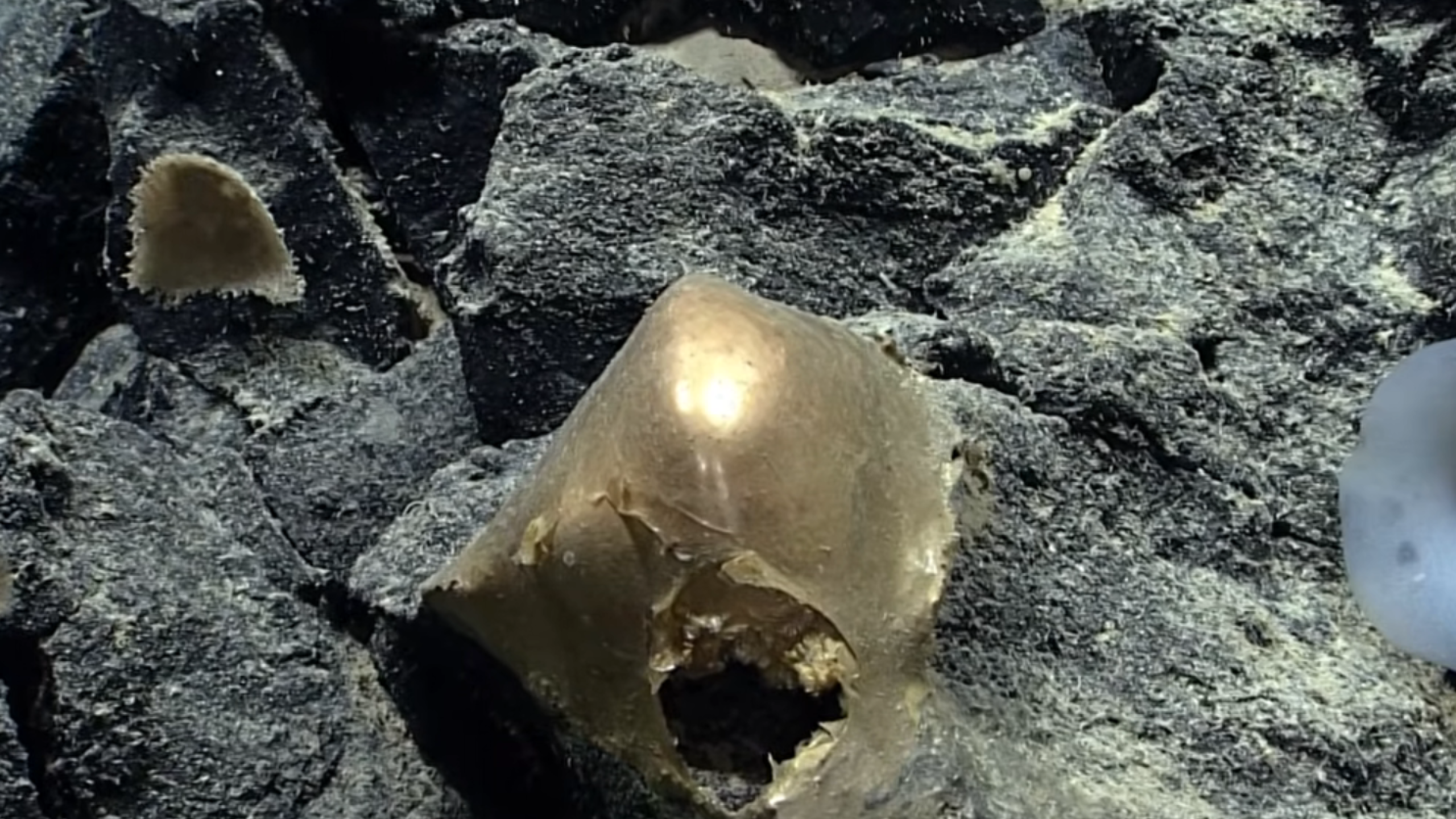
A small golden structure recovered from the deep North Pacific has been identified after several years of analysis, resolving its biological origin while leaving key questions about its formation and ecological role unanswered.
The National Oceanic and Atmospheric Administration (NOAA), in collaboration with the Smithsonian Institution, has confirmed that the so-called 'golden orb' is biological material linked to a deep-sea sea anemone. However, the complete organism was not observed at the site of discovery.
The golden orb was first observed in 2023 during aNOAA expeditionaboard the Okeanos Explorer in the Gulf of Alaska. The object was found at a depth of around 3,300 metres and appeared as a smooth, dome-shaped golden structure roughly 10 centimetres wide, firmly attached to a rocky seabed.
At the time of discovery, scientists aboard the expedition were unable to identify it beyond confirming its biological origin. The unusual appearance led to immediate uncertainty, with early assessments considering possibilities such as a marine egg case, a sponge, or a coral-related structure.
A small opening or tear was also visible near its base, exposing internal tissue and complicating classification. Researchers noted that its intact, rounded form and unusual composition made it unlike commonly documented deep-sea specimens observed during remotely operated vehicle surveys.
After several years of laboratory analysis, including morphological examination and DNA sequencing, scientists from the NOAA, working in collaboration with the Smithsonian Institution, identified the 'golden orb' as biological material linked to thedeep-sea sea anemone, Relicanthus daphneae.
Researchers determined that the sample contains cellular structures consistent with cnidarians, the group of marine animals that includes anemones and corals. These included specialised stinging cells known as cnidocytes, including spirocysts, which are characteristic of this animal group. Genetic analysis further supported the classification, matching the material to Relicanthus daphneae, a rare deep-sea species.
The findings indicate that the golden orb is not a separate organism, but rather a remnant of the anemone's basal attachment structure, which anchors the animal to the seafloor. Scientists interpret this structure as part of its anchoring system, adapted to extreme deep-ocean conditions where stable surfaces are limited and environmental pressures are high.
While the analysis has resolved the structure's origin, it has raised further scientific questions. The complete organism associated with the formation was not observed during the expedition dive, and researchers only recovered the detached structure from the seafloor.
This has prompted renewed discussion about the species' behaviour and life cycle. One hypothesis is that the structure may be linked to growth or reproductive processes in deep-sea anemones, although this has not been confirmed.
Source: International Business Times UK
