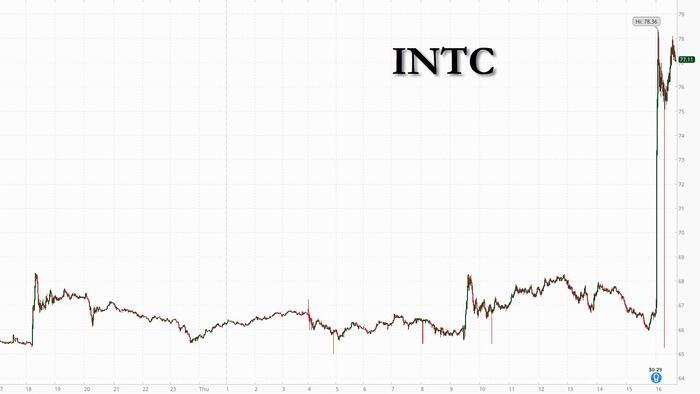
Chipmaker Intel, which less than a year ago was trading like a distressed company, and required a capital infusion from the US government, and earlier today hit a 90x forward PE...
... soared after hours after giving a strong sales forecast for the current period, signaling that the recently struggling chipmaker is finally beginning to benefit from the giant build-out of artificial intelligence infrastructure. But before we get there, here is a quick look at what the company reported for the first quarter:
The Intel Foundry Services division - the company’s factory unit - generated revenue of $5.4 billion, up 16%. That unit currently relies almost exclusively on Intel product divisions for orders, though it is seeking outside customers. Its PC chip division had revenue of $7.7 billion, and the data center unit posted sales of $5.1 billion. All of those totals topped Wall Street estimates. Gross margin was 41% on an adjusted basis. When Intel was at the height of its powers, it regularly reported margins north of 60%. It predicted a margin of 39% in the current period.
Commenting on the results, CFO David Zinsner said that “we remain focused on maximizing our factory network to improve available supply and meet our customers’ needs throughout the year.“
CEO Lip-Bu Tan chimed in: “The next wave of AI will bring intelligence closer to the end user, moving from foundational models to inference to agentic. This shift is significantly increasing the need for Intel’s CPUs and wafer and advanced packaging offerings."
While Q1 results were solid, especially at the data center level, it was the Q2 forecast that caught the market's attention:
The upbeat outlook suggests that CEO Lip-Bu Tan is making progress on a challenging comeback plan. After lining up major investments in Intel last year which helped to strengthen the company’s balance sheet - Thursday’s results suggest he’s now delivering on a promise to improve its operations.
The earnings report shows that the need for data center chips to power the massive AI expansion is lifting demand for Intel’s flagship Xeon server processors. That type of generalist semiconductor is a renewed focus for companies trying to turn their AI software into services that bring in revenue.
In an interview with Bloomberg, Tan said Intel delivered a “solid result” that was ahead of its projections. He expects the strong demand for processors used in AI systems to expand and said the company is “laser-focused” on increasing output from Intel’s factories, which still can’t produce enough to fill all its orders.
“There is huge demand,” Tan said. “We are working very hard with our team to make sure we deliver, that we meet that demand but we are still short because the demand keeps increasing from the customers.
Source: ZeroHedge News
