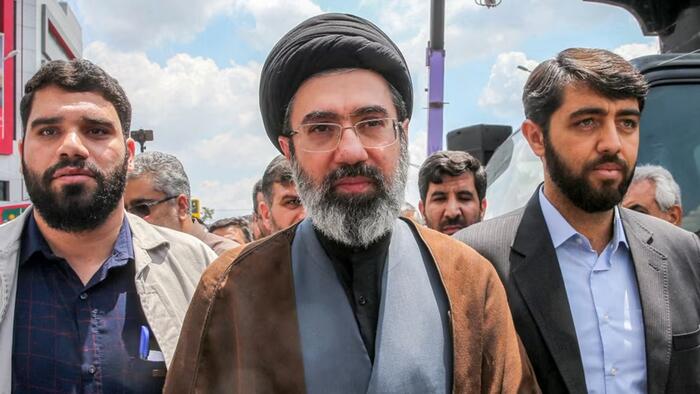
The NY Times in a new deep dive of what governing structures now look like inside Iran says what's already long been obvious to many in the wake of longtime Ayatollah Ali Khamenei's death: "When Ayatollah Ali Khamenei ruled Iran as the supreme leader, he exerted absolute power over all decisions about war, peace and negotiations with the United States.His son and successor does not play the same role."
The publication says it was able to interview at least half-a-dozen Iranian insiders, including IRGC officials, and individuals who know the younger Khamenei "well". TheNY Timesdescribes of Mojtaba Khamenei: "His father, wife and son were all killed.Access to him is extremely difficult and limited now. He issurrounded mostly by a team of doctors and medical staff who are treating the injuries he sustained in the airstrikes."
Apparently even top'trusted' generals and IRGC commanders do visit him for fear of being surveilled and trackedto his location by Israel and the United States.
Per the sources cited in theTimes, "Though Mr. Khamenei wasgravely wounded,he is mentally sharp and engaged, according to four senior Iranian officials familiar with his health."
And more: "One leg was operated on three times, and he is awaiting a prosthetic. He had surgery on one hand and is slowly regaining function.His face and lips have been burned severely, making it difficult for him to speak, the officials said, adding that, eventually, hewill need plastic surgery."
All of this provides an explanation as to why he hasnever been seen or heard from in publicsince Trump's Operation Epic Fury began on February 28. He has not so much as been photographed, and when state media has issued a few prior statements, it does so via text or what appears to be AI-configured audio over state media airwaves.
This fact has unleashed an avalanche of speculation as to his fate over the course of the war, and who is "really in charge". And yet it's also well-known that Iran is able to function militarily based onautonomy and dispersion of command among units, with the IRGC given more independence to act.
The White House has alleged there are essentially two factions vying for power and direction over the war - the civilian leadership and the IRGC command sides.
"Mojtaba is not yet in full command or control,"Sanam Vakil, the director of the Middle East and North Africa for Chatham House,claimedin the NYT report. But as expected the situation is nuanced: "There is, perhaps, deference to him," he continued. "He signs off or he is part of the decision-making structure in a formal way. But he is presented with fait accompli presentations right now."
As we and other have pointed out, in public at least the de facto day-to-day leader of the country remains speaker of the Iranian Parliament Mohammad Bagher Ghalibaf. He has taken point as lead negotiator with the United States in Pakistan, and has been the public face of updating his country and the world on both the status of the war and the now stalled negotiations.
Source: ZeroHedge News
