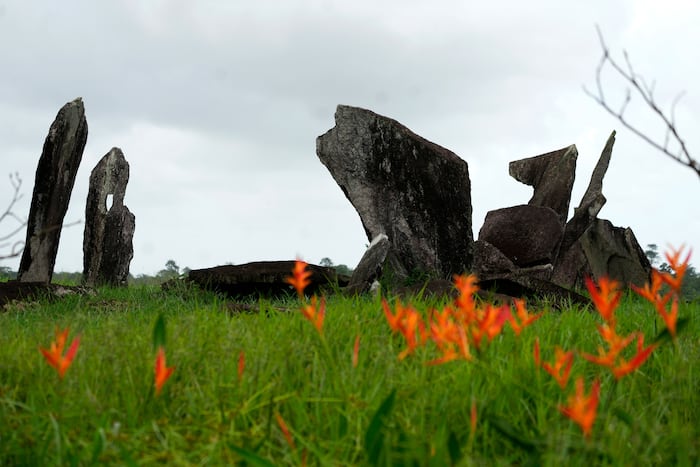
MACAPA, Brazil (AP) — Paving roads in the Amazon rainforest has long brought deforestation that threatens the people who live there. The same roadwork, however, has also allowed archaeologists to get glimpses of the region’s past long before Europeans arrived to reshape it.
The construction often requires archaeological surveys before the paving starts, and some of the latest discoveries have emerged along the BR-156 highway in Brazil's northern state of Amapa. Among the findings so far from nine dig sites: pottery vases that may be funerary urns, as well as small artifacts that resemble human faces.
“What we now about the region’s past is also tied to the opening created by these projects, which gives our relationship with them a somewhat ambivalent character,” said Lúcio Flávio Costa Leite, who manages the Archaeological Research Center at Amapa’s Institute for Scientific and Technological Research. “At the same time, the knowledge we gain about these sites leads us to pay closer attention to these regions, including by adopting permanent protection measures.”
Scientists say recent research has reinforced understanding of the region's past not as a human desert, but rather as a landscape shaped by interconnected societies long before Columbus arrived. The material found along BR-156, for example, included pottery in multiple styles and techniques that reflected influences from communities ranging from Brazil’s Para state to the Caribbean.
It's been cleaned and analyzed by a team working for the National Department of Transport Infrastructure. One of the archaeologists, Manoel Fabiano da Silva Santos, said the layers of the Amazon soil he excavated are a historic timeline.
In the upper layers, he found items such as Portuguese porcelain and nails linked to European occupation.
“Digging deeper, we uncovered pottery and ceramics associated with earlier Indigenous presence, marking the site’s transition before and after the arrival of colonizers,” Santos said.
The artifacts will eventually go to Amapa's state collection, overseen by Costa Leite, which includes about 530,000 pieces. The oldest piece is around 6,140 years old, confirming a long human presence across Amapa, he said.
The artifacts offer insight into how ancient Indigenous societies lived, died and interacted with the rainforest.
“Here is something I often debate with my students -- we usually think of technology as computers and microchips,” Costa Leite said, walking through shelves of ancient pottery. “But all of this required careful reading of the landscape and deliberate choices of materials.”
Source: WPLG
