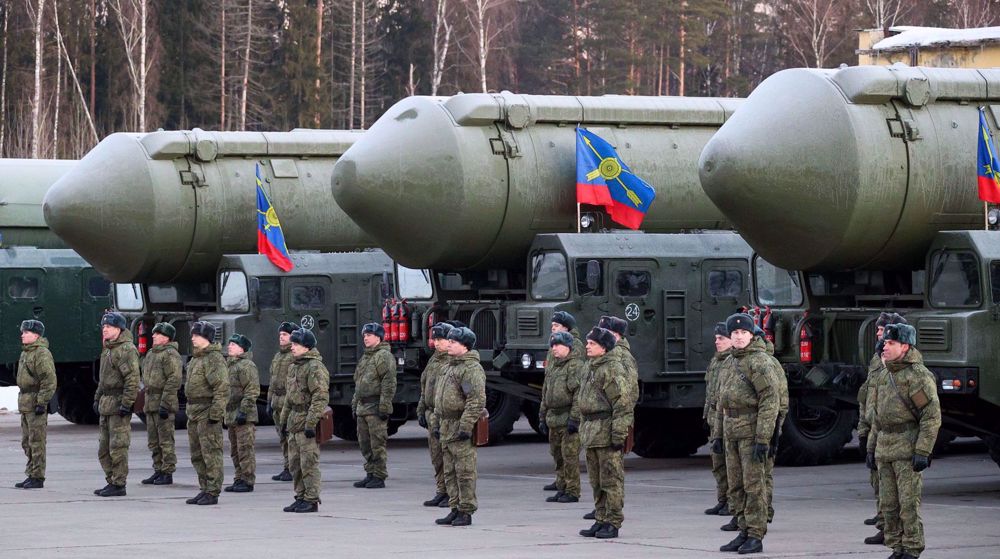
The two major ongoing military conflicts, between the United States and Israel on one side and Iran on the other, and the Russia–Ukraine war, both involve nuclear-armed powers.
This raises the question of what level of escalation would be required to push the world toward nuclear war.
The nine nuclear-armed states are the United States,Russia, China, the United Kingdom, France, India, Pakistan, North Korea, and Israel. Iran is not yet anuclear-armed statebut is widely regarded as a nuclear threshold state, possessing enough enriched uranium for multiple weapons and the delivery systems to deploy them, pending only the weaponization step.
The nine nuclear-armed countries possessed roughly 12,187 warheads as of the beginning of 2026. The overall inventory continues to decline due to U.S. and Russian dismantlement of retired warheads, but the pace of reductions is slowing and is likely to be outpaced by new warhead production in the coming years.
The crucial elements of a nuclear posture review include the number and types of weapons each country possesses and what their nuclear threshold is, meaning, do they have a no-first-use rule and if not what level of provocation would be necessary to trigger a nuclear response.
With the expiration of the NewStrategic Arms Reduction Treaty(START) in February 2026, we are now operating in an era of potentially unconstrained nuclear buildup between the two largest nuclear powers, as both the United States and Russia have discussed resuming nuclear testing.
Across the globe, the convergence of multiplemodernizing arsenals, the collapse of arms control architecture, and the first-use doctrines across several states represents the most complex nuclear environment since the Cold War.
UNITED STATES –The United States maintains a stockpile of approximately 3,700 warheads and has embarked on an ambitious plan to overhaul its nuclear weapons arsenal and command and control systems.
The fundamental role ofU.S. nuclear weaponsis to deter nuclear attack on the United States or its allies and partners, with secondary roles including deterring strategic attack, assuring allies, and enabling achievement ofnational objectivesin extreme circumstances if deterrence fails.
The U.S. retains afirst-use option: declaratory policy allows for the first use of nuclear weapons against non-nuclear threats under “extreme” circumstances, and maintains a launch-under-attack posture.
Source: The Gateway Pundit
