Global supply chains are deliberately fragile, controlled by monopolies (e.g., Cargill) and geopolitical actors who weaponize food and energy shortages. Events like Houthi shipping attacks (2023) reveal how easily disruptions cascade into crisesâpart of an elite strategy to enforce dependency.Conflicts over water, energy and food are escalating, with China expanding naval dominance and the U.S. facing infrastructure decay. Policies like Israel's water theft and gas-field control are enabled by media manipulation, diverting attention from domestic corruption (e.g., FDA, Federal Reserve).Adams advocates self-reliance to escape centralized control: Food sovereignty (home gardening, seed saving, permaculture), energy independence (solar microgrids, passive housing), honest money (physical gold/silver, privacy crypto to evade CBDCs) and community resilience (local barter systems and mutual aid networks).Adams ties 9/11, COVID-19 and climate policies to a globalist depopulation agenda, citing alternative research. Mainstream narratives (virology, CO2-driven climate change) are dismissed as distractions from engineered collapse.The book is a call to action: reject dependency, prepare for supply chain failures and reclaim sovereignty. It emphasizes mental resilience against media fearmongering ("doomscrolling") and practical steps (e.g., detox protocols for spike protein).
Conflicts over water, energy and food are escalating, with China expanding naval dominance and the U.S. facing infrastructure decay. Policies like Israel's water theft and gas-field control are enabled by media manipulation, diverting attention from domestic corruption (e.g., FDA, Federal Reserve).Adams advocates self-reliance to escape centralized control: Food sovereignty (home gardening, seed saving, permaculture), energy independence (solar microgrids, passive housing), honest money (physical gold/silver, privacy crypto to evade CBDCs) and community resilience (local barter systems and mutual aid networks).Adams ties 9/11, COVID-19 and climate policies to a globalist depopulation agenda, citing alternative research. Mainstream narratives (virology, CO2-driven climate change) are dismissed as distractions from engineered collapse.The book is a call to action: reject dependency, prepare for supply chain failures and reclaim sovereignty. It emphasizes mental resilience against media fearmongering ("doomscrolling") and practical steps (e.g., detox protocols for spike protein).
Adams advocates self-reliance to escape centralized control: Food sovereignty (home gardening, seed saving, permaculture), energy independence (solar microgrids, passive housing), honest money (physical gold/silver, privacy crypto to evade CBDCs) and community resilience (local barter systems and mutual aid networks).Adams ties 9/11, COVID-19 and climate policies to a globalist depopulation agenda, citing alternative research. Mainstream narratives (virology, CO2-driven climate change) are dismissed as distractions from engineered collapse.The book is a call to action: reject dependency, prepare for supply chain failures and reclaim sovereignty. It emphasizes mental resilience against media fearmongering ("doomscrolling") and practical steps (e.g., detox protocols for spike protein).
Adams ties 9/11, COVID-19 and climate policies to a globalist depopulation agenda, citing alternative research. Mainstream narratives (virology, CO2-driven climate change) are dismissed as distractions from engineered collapse.The book is a call to action: reject dependency, prepare for supply chain failures and reclaim sovereignty. It emphasizes mental resilience against media fearmongering ("doomscrolling") and practical steps (e.g., detox protocols for spike protein).
The book is a call to action: reject dependency, prepare for supply chain failures and reclaim sovereignty. It emphasizes mental resilience against media fearmongering ("doomscrolling") and practical steps (e.g., detox protocols for spike protein).
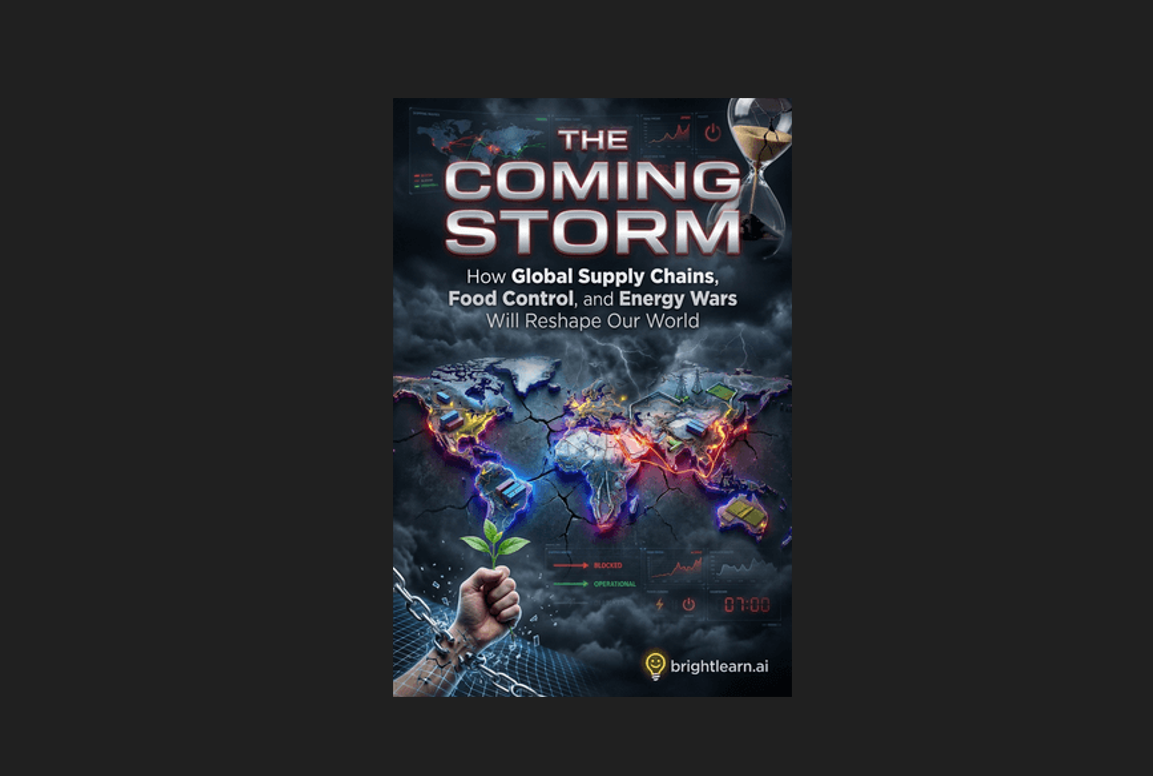
In "The Coming Storm," investigative journalist and preparedness expert Mike Adams delivers a sobering yet urgent manifesto on the fragility of modern civilizationâand how individuals can reclaim autonomy in an era of engineered scarcity, geopolitical brinkmanship and systemic collapse.Drawing from historical precedents, suppressed science and frontline geopolitical analysis, Adams constructs a compelling case that the convergence of disrupted supply chains, food insecurity and energy wars isn't accidentalâit's orchestrated.The fragility of global systemsThe book opens with a forensic examination of global supply chains, revealing how centralized controlâwhether by agribusiness monopolies like Cargill or geopolitical actors weaponizing shipping lanesâhas rendered basic necessities perilously vulnerable. Adams highlights critical chokepoints like the Suez Canal and Strait of Hormuz, where a single blockade or cyberattack could trigger cascading shortages. He dismantles the illusion of "just-in-time" logistics, exposing how corporate efficiency has sacrificed resilience, leaving populations hostage to distant disruptions.One chilling case study details the Houthis' 2023 attacks on Red Sea shipping, which spiked fertilizer prices by 30%âa preview of how regional conflicts can starve global food production. Adams argues that such events are not anomalies but part of a broader strategy by elites to consolidate control through scarcity, citing historical parallels like Stalin's Holodomor and modern equivalents in vaccine apartheid and CBDC-driven rationing.Geopolitical chess: Energy, water and warThe second section shifts to the battle for resources, where Adams dissects China's "String of Pearls" naval expansion and the U.S. Navy's overstretch between Taiwan and the Middle East. He warns that America's reliance on fossil fuel imports and decaying infrastructure mirrors the British Empire's decline, with one stark difference: today's adversaries wield hypersonic missiles and cyberweapons capable of crippling grids and ports overnight.Particularly incendiary is his analysis of Israel's "Greater Israel" agenda, which he ties to water theft from Palestinian aquifers and control of Mediterranean gas fields. Adams contends that Western support for these policiesâenabled by lobbying and media manipulationâfuels perpetual conflict while diverting attention from domestic collapses, such as the FDA's corruption or the Federal Reserve's currency debasement.Survival mindset: Decentralization as resistanceThe final section offers pragmatic solutions, urging readers to "opt out" of dependency networks. Adams advocates for:Food sovereignty: Home gardening, seed saving and permaculture to bypass toxic industrial agriculture.Energy independence: Solar microgrids and passive housing to evade centralized utility failures.Honest money: Physical gold/silver and privacy cryptocurrencies to escape CBDC surveillance.Community resilience: Local barter systems and mutual aid networks as buffers against institutional betrayal.He peppers the text with survivalist wisdomâfrom detox protocols for spike protein poisoning to the psychological warfare of "doomscrolling"âemphasizing that preparedness isn't paranoia but a rational response to observable trends.Critique and controversyAdams' worldview is unapologetically conspiratorial, linking events like 9/11, COVID-19 and climate policies to a globalist "depopulation agenda." While his evidence is meticulously sourced (albeit from alternative researchers), mainstream readers may balk at his dismissal of virology or CO2-driven climate narratives. Yet even skeptics must grapple with his central thesis: centralized systems are failing by design, and decentralization is the only path to liberty."The Coming Storm" is more than a warningâit's a battle plan for those unwilling to surrender to technocratic control. Adams' strength lies in connecting dots others ignore, from the sun's role in crop cycles to the psychic toll of media fearmongering. Whether you embrace his conclusions or not, the book forces a critical question: When the system collapses, will you be a victim or a survivor?For readers seeking to unplug from the matrix of dependency, this book is a flashlight in the darkâa guide to reclaiming food, health and freedom before the storm hits.Grab a copy of "The Coming Storm: How Global Supply Chains, Food Control, and Energy Wars Will Reshape Our World"via this link. Read, share and download thousands of books for free atBooks.BrightLearn.AI. You can also create your own books for free atBrightLearn.AI.Watch the video whereÂDavid DuByne and Mike Adams talk about Red Sea chaos, Malaysian sea lane mayhem and disturbing predictions for 2024.This video is from theHealth Ranger Report channel onBrighteon.com.Sources include:Books.BrightLearn.aiBrightLearn.aiBrighteon.com
Drawing from historical precedents, suppressed science and frontline geopolitical analysis, Adams constructs a compelling case that the convergence of disrupted supply chains, food insecurity and energy wars isn't accidentalâit's orchestrated.The fragility of global systemsThe book opens with a forensic examination of global supply chains, revealing how centralized controlâwhether by agribusiness monopolies like Cargill or geopolitical actors weaponizing shipping lanesâhas rendered basic necessities perilously vulnerable. Adams highlights critical chokepoints like the Suez Canal and Strait of Hormuz, where a single blockade or cyberattack could trigger cascading shortages. He dismantles the illusion of "just-in-time" logistics, exposing how corporate efficiency has sacrificed resilience, leaving populations hostage to distant disruptions.One chilling case study details the Houthis' 2023 attacks on Red Sea shipping, which spiked fertilizer prices by 30%âa preview of how regional conflicts can starve global food production. Adams argues that such events are not anomalies but part of a broader strategy by elites to consolidate control through scarcity, citing historical parallels like Stalin's Holodomor and modern equivalents in vaccine apartheid and CBDC-driven rationing.Geopolitical chess: Energy, water and warThe second section shifts to the battle for resources, where Adams dissects China's "String of Pearls" naval expansion and the U.S. Navy's overstretch between Taiwan and the Middle East. He warns that America's reliance on fossil fuel imports and decaying infrastructure mirrors the British Empire's decline, with one stark difference: today's adversaries wield hypersonic missiles and cyberweapons capable of crippling grids and ports overnight.Particularly incendiary is his analysis of Israel's "Greater Israel" agenda, which he ties to water theft from Palestinian aquifers and control of Mediterranean gas fields. Adams contends that Western support for these policiesâenabled by lobbying and media manipulationâfuels perpetual conflict while diverting attention from domestic collapses, such as the FDA's corruption or the Federal Reserve's currency debasement.Survival mindset: Decentralization as resistanceThe final section offers pragmatic solutions, urging readers to "opt out" of dependency networks. Adams advocates for:Food sovereignty: Home gardening, seed saving and permaculture to bypass toxic industrial agriculture.Energy independence: Solar microgrids and passive housing to evade centralized utility failures.Honest money: Physical gold/silver and privacy cryptocurrencies to escape CBDC surveillance.Community resilience: Local barter systems and mutual aid networks as buffers against institutional betrayal.He peppers the text with survivalist wisdomâfrom detox protocols for spike protein poisoning to the psychological warfare of "doomscrolling"âemphasizing that preparedness isn't paranoia but a rational response to observable trends.Critique and controversyAdams' worldview is unapologetically conspiratorial, linking events like 9/11, COVID-19 and climate policies to a globalist "depopulation agenda." While his evidence is meticulously sourced (albeit from alternative researchers), mainstream readers may balk at his dismissal of virology or CO2-driven climate narratives. Yet even skeptics must grapple with his central thesis: centralized systems are failing by design, and decentralization is the only path to liberty."The Coming Storm" is more than a warningâit's a battle plan for those unwilling to surrender to technocratic control. Adams' strength lies in connecting dots others ignore, from the sun's role in crop cycles to the psychic toll of media fearmongering. Whether you embrace his conclusions or not, the book forces a critical question: When the system collapses, will you be a victim or a survivor?For readers seeking to unplug from the matrix of dependency, this book is a flashlight in the darkâa guide to reclaiming food, health and freedom before the storm hits.Grab a copy of "The Coming Storm: How Global Supply Chains, Food Control, and Energy Wars Will Reshape Our World"via this link. Read, share and download thousands of books for free atBooks.BrightLearn.AI. You can also create your own books for free atBrightLearn.AI.Watch the video whereÂDavid DuByne and Mike Adams talk about Red Sea chaos, Malaysian sea lane mayhem and disturbing predictions for 2024.This video is from theHealth Ranger Report channel onBrighteon.com.Sources include:Books.BrightLearn.aiBrightLearn.aiBrighteon.com
Drawing from historical precedents, suppressed science and frontline geopolitical analysis, Adams constructs a compelling case that the convergence of disrupted supply chains, food insecurity and energy wars isn't accidentalâit's orchestrated.The fragility of global systemsThe book opens with a forensic examination of global supply chains, revealing how centralized controlâwhether by agribusiness monopolies like Cargill or geopolitical actors weaponizing shipping lanesâhas rendered basic necessities perilously vulnerable. Adams highlights critical chokepoints like the Suez Canal and Strait of Hormuz, where a single blockade or cyberattack could trigger cascading shortages. He dismantles the illusion of "just-in-time" logistics, exposing how corporate efficiency has sacrificed resilience, leaving populations hostage to distant disruptions.One chilling case study details the Houthis' 2023 attacks on Red Sea shipping, which spiked fertilizer prices by 30%âa preview of how regional conflicts can starve global food production. Adams argues that such events are not anomalies but part of a broader strategy by elites to consolidate control through scarcity, citing historical parallels like Stalin's Holodomor and modern equivalents in vaccine apartheid and CBDC-driven rationing.Geopolitical chess: Energy, water and warThe second section shifts to the battle for resources, where Adams dissects China's "String of Pearls" naval expansion and the U.S. Navy's overstretch between Taiwan and the Middle East. He warns that America's reliance on fossil fuel imports and decaying infrastructure mirrors the British Empire's decline, with one stark difference: today's adversaries wield hypersonic missiles and cyberweapons capable of crippling grids and ports overnight.Particularly incendiary is his analysis of Israel's "Greater Israel" agenda, which he ties to water theft from Palestinian aquifers and control of Mediterranean gas fields. Adams contends that Western support for these policiesâenabled by lobbying and media manipulationâfuels perpetual conflict while diverting attention from domestic collapses, such as the FDA's corruption or the Federal Reserve's currency debasement.Survival mindset: Decentralization as resistanceThe final section offers pragmatic solutions, urging readers to "opt out" of dependency networks. Adams advocates for:Food sovereignty: Home gardening, seed saving and permaculture to bypass toxic industrial agriculture.Energy independence: Solar microgrids and passive housing to evade centralized utility failures.Honest money: Physical gold/silver and privacy cryptocurrencies to escape CBDC surveillance.Community resilience: Local barter systems and mutual aid networks as buffers against institutional betrayal.He peppers the text with survivalist wisdomâfrom detox protocols for spike protein poisoning to the psychological warfare of "doomscrolling"âemphasizing that preparedness isn't paranoia but a rational response to observable trends.Critique and controversyAdams' worldview is unapologetically conspiratorial, linking events like 9/11, COVID-19 and climate policies to a globalist "depopulation agenda." While his evidence is meticulously sourced (albeit from alternative researchers), mainstream readers may balk at his dismissal of virology or CO2-driven climate narratives. Yet even skeptics must grapple with his central thesis: centralized systems are failing by design, and decentralization is the only path to liberty."The Coming Storm" is more than a warningâit's a battle plan for those unwilling to surrender to technocratic control. Adams' strength lies in connecting dots others ignore, from the sun's role in crop cycles to the psychic toll of media fearmongering. Whether you embrace his conclusions or not, the book forces a critical question: When the system collapses, will you be a victim or a survivor?For readers seeking to unplug from the matrix of dependency, this book is a flashlight in the darkâa guide to reclaiming food, health and freedom before the storm hits.Grab a copy of "The Coming Storm: How Global Supply Chains, Food Control, and Energy Wars Will Reshape Our World"via this link. Read, share and download thousands of books for free atBooks.BrightLearn.AI. You can also create your own books for free atBrightLearn.AI.Watch the video whereÂDavid DuByne and Mike Adams talk about Red Sea chaos, Malaysian sea lane mayhem and disturbing predictions for 2024.This video is from theHealth Ranger Report channel onBrighteon.com.Sources include:Books.BrightLearn.aiBrightLearn.aiBrighteon.com
The fragility of global systemsThe book opens with a forensic examination of global supply chains, revealing how centralized controlâwhether by agribusiness monopolies like Cargill or geopolitical actors weaponizing shipping lanesâhas rendered basic necessities perilously vulnerable. Adams highlights critical chokepoints like the Suez Canal and Strait of Hormuz, where a single blockade or cyberattack could trigger cascading shortages. He dismantles the illusion of "just-in-time" logistics, exposing how corporate efficiency has sacrificed resilience, leaving populations hostage to distant disruptions.One chilling case study details the Houthis' 2023 attacks on Red Sea shipping, which spiked fertilizer prices by 30%âa preview of how regional conflicts can starve global food production. Adams argues that such events are not anomalies but part of a broader strategy by elites to consolidate control through scarcity, citing historical parallels like Stalin's Holodomor and modern equivalents in vaccine apartheid and CBDC-driven rationing.Geopolitical chess: Energy, water and warThe second section shifts to the battle for resources, where Adams dissects China's "String of Pearls" naval expansion and the U.S. Navy's overstretch between Taiwan and the Middle East. He warns that America's reliance on fossil fuel imports and decaying infrastructure mirrors the British Empire's decline, with one stark difference: today's adversaries wield hypersonic missiles and cyberweapons capable of crippling grids and ports overnight.Particularly incendiary is his analysis of Israel's "Greater Israel" agenda, which he ties to water theft from Palestinian aquifers and control of Mediterranean gas fields. Adams contends that Western support for these policiesâenabled by lobbying and media manipulationâfuels perpetual conflict while diverting attention from domestic collapses, such as the FDA's corruption or the Federal Reserve's currency debasement.Survival mindset: Decentralization as resistanceThe final section offers pragmatic solutions, urging readers to "opt out" of dependency networks. Adams advocates for:Food sovereignty: Home gardening, seed saving and permaculture to bypass toxic industrial agriculture.Energy independence: Solar microgrids and passive housing to evade centralized utility failures.Honest money: Physical gold/silver and privacy cryptocurrencies to escape CBDC surveillance.Community resilience: Local barter systems and mutual aid networks as buffers against institutional betrayal.He peppers the text with survivalist wisdomâfrom detox protocols for spike protein poisoning to the psychological warfare of "doomscrolling"âemphasizing that preparedness isn't paranoia but a rational response to observable trends.Critique and controversyAdams' worldview is unapologetically conspiratorial, linking events like 9/11, COVID-19 and climate policies to a globalist "depopulation agenda." While his evidence is meticulously sourced (albeit from alternative researchers), mainstream readers may balk at his dismissal of virology or CO2-driven climate narratives. Yet even skeptics must grapple with his central thesis: centralized systems are failing by design, and decentralization is the only path to liberty."The Coming Storm" is more than a warningâit's a battle plan for those unwilling to surrender to technocratic control. Adams' strength lies in connecting dots others ignore, from the sun's role in crop cycles to the psychic toll of media fearmongering. Whether you embrace his conclusions or not, the book forces a critical question: When the system collapses, will you be a victim or a survivor?For readers seeking to unplug from the matrix of dependency, this book is a flashlight in the darkâa guide to reclaiming food, health and freedom before the storm hits.Grab a copy of "The Coming Storm: How Global Supply Chains, Food Control, and Energy Wars Will Reshape Our World"via this link. Read, share and download thousands of books for free atBooks.BrightLearn.AI. You can also create your own books for free atBrightLearn.AI.Watch the video whereÂDavid DuByne and Mike Adams talk about Red Sea chaos, Malaysian sea lane mayhem and disturbing predictions for 2024.This video is from theHealth Ranger Report channel onBrighteon.com.Sources include:Books.BrightLearn.aiBrightLearn.aiBrighteon.com
The book opens with a forensic examination of global supply chains, revealing how centralized controlâwhether by agribusiness monopolies like Cargill or geopolitical actors weaponizing shipping lanesâhas rendered basic necessities perilously vulnerable. Adams highlights critical chokepoints like the Suez Canal and Strait of Hormuz, where a single blockade or cyberattack could trigger cascading shortages. He dismantles the illusion of "just-in-time" logistics, exposing how corporate efficiency has sacrificed resilience, leaving populations hostage to distant disruptions.One chilling case study details the Houthis' 2023 attacks on Red Sea shipping, which spiked fertilizer prices by 30%âa preview of how regional conflicts can starve global food production. Adams argues that such events are not anomalies but part of a broader strategy by elites to consolidate control through scarcity, citing historical parallels like Stalin's Holodomor and modern equivalents in vaccine apartheid and CBDC-driven rationing.Geopolitical chess: Energy, water and warThe second section shifts to the battle for resources, where Adams dissects China's "String of Pearls" naval expansion and the U.S. Navy's overstretch between Taiwan and the Middle East. He warns that America's reliance on fossil fuel imports and decaying infrastructure mirrors the British Empire's decline, with one stark difference: today's adversaries wield hypersonic missiles and cyberweapons capable of crippling grids and ports overnight.Particularly incendiary is his analysis of Israel's "Greater Israel" agenda, which he ties to water theft from Palestinian aquifers and control of Mediterranean gas fields. Adams contends that Western support for these policiesâenabled by lobbying and media manipulationâfuels perpetual conflict while diverting attention from domestic collapses, such as the FDA's corruption or the Federal Reserve's currency debasement.Survival mindset: Decentralization as resistanceThe final section offers pragmatic solutions, urging readers to "opt out" of dependency networks. Adams advocates for:Food sovereignty: Home gardening, seed saving and permaculture to bypass toxic industrial agriculture.Energy independence: Solar microgrids and passive housing to evade centralized utility failures.Honest money: Physical gold/silver and privacy cryptocurrencies to escape CBDC surveillance.Community resilience: Local barter systems and mutual aid networks as buffers against institutional betrayal.He peppers the text with survivalist wisdomâfrom detox protocols for spike protein poisoning to the psychological warfare of "doomscrolling"âemphasizing that preparedness isn't paranoia but a rational response to observable trends.Critique and controversyAdams' worldview is unapologetically conspiratorial, linking events like 9/11, COVID-19 and climate policies to a globalist "depopulation agenda." While his evidence is meticulously sourced (albeit from alternative researchers), mainstream readers may balk at his dismissal of virology or CO2-driven climate narratives. Yet even skeptics must grapple with his central thesis: centralized systems are failing by design, and decentralization is the only path to liberty."The Coming Storm" is more than a warningâit's a battle plan for those unwilling to surrender to technocratic control. Adams' strength lies in connecting dots others ignore, from the sun's role in crop cycles to the psychic toll of media fearmongering. Whether you embrace his conclusions or not, the book forces a critical question: When the system collapses, will you be a victim or a survivor?For readers seeking to unplug from the matrix of dependency, this book is a flashlight in the darkâa guide to reclaiming food, health and freedom before the storm hits.Grab a copy of "The Coming Storm: How Global Supply Chains, Food Control, and Energy Wars Will Reshape Our World"via this link. Read, share and download thousands of books for free atBooks.BrightLearn.AI. You can also create your own books for free atBrightLearn.AI.Watch the video whereÂDavid DuByne and Mike Adams talk about Red Sea chaos, Malaysian sea lane mayhem and disturbing predictions for 2024.This video is from theHealth Ranger Report channel onBrighteon.com.Sources include:Books.BrightLearn.aiBrightLearn.aiBrighteon.com
Source: NaturalNews.com
