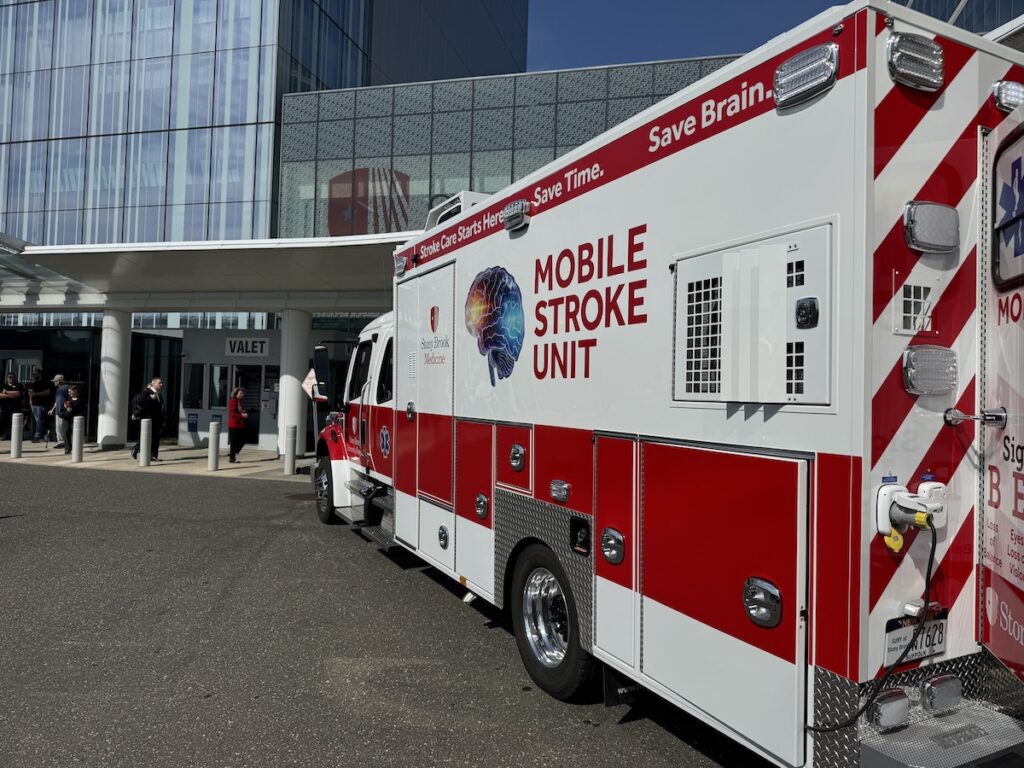
A proposed Riverhead base for a Stony Brook University Hospital mobile stroke unit is igniting a debate over how — and where — East End stroke patients should be treated, as local hospitals rapidly expand their own capabilities.
The $1.5 million Mobile Stroke Unit, operated by Stony Brook University Hospital, is an ambulance equipped with a CAT scan that allows doctors to diagnose strokes in the field and route patients to the most appropriate hospital.
The Stony Brook-based hospital has petitioned the Riverhead Zoning Board of Appeals to approve a 14,236-square-foot ambulance storage bay at Staples Plaza that could house the unit along with up to eight ambulances.
Supporters say the approach speeds care for the most severe strokes. Critics argue patients are better off being taken directly to nearby hospitals — especially as facilities like Peconic Bay Medical Center expand advanced stroke treatment.
Stony Brook officials say the unit would complement local hospitals by determining the type of stroke before a patient reaches the emergency room.
Dr. David Fiorella,director of the Stony Brook Cerebrovascular Center, said the unit can identify severe strokes and direct patients straight to thrombectomy-capable hospitals, avoiding delays from transfers.
“The ability to give it at the patient’s door rather than the emergency room door … markedly reduces death and disability from stroke,” he said.
During an April 16 tour of the Mobile Stroke Unit at Stony Brook, Dr. Fiorella said patients with less severe strokes could still be taken to nearby primary stroke centers, including Peconic Bay Medical Center orStony Brook Eastern Long Island Hospital in Greenport.
PBMC president Amy Loeb said in a phone interview Monday she is concerned a mobile stroke unit planted directly adjacent to a hospital that can provide thrombectomy could cause delays in care. Additionally, she argued that MSUs are better suited for rural or densely populated urban areas.
“There was a point in time where we actually assessed whether or not that was the best care for this community,” Ms. Loeb told the Suffolk Times. “But it’s clear that we are best positioned in this community to have the thrombectomy available in the community.”
Source: The Suffolk Times
