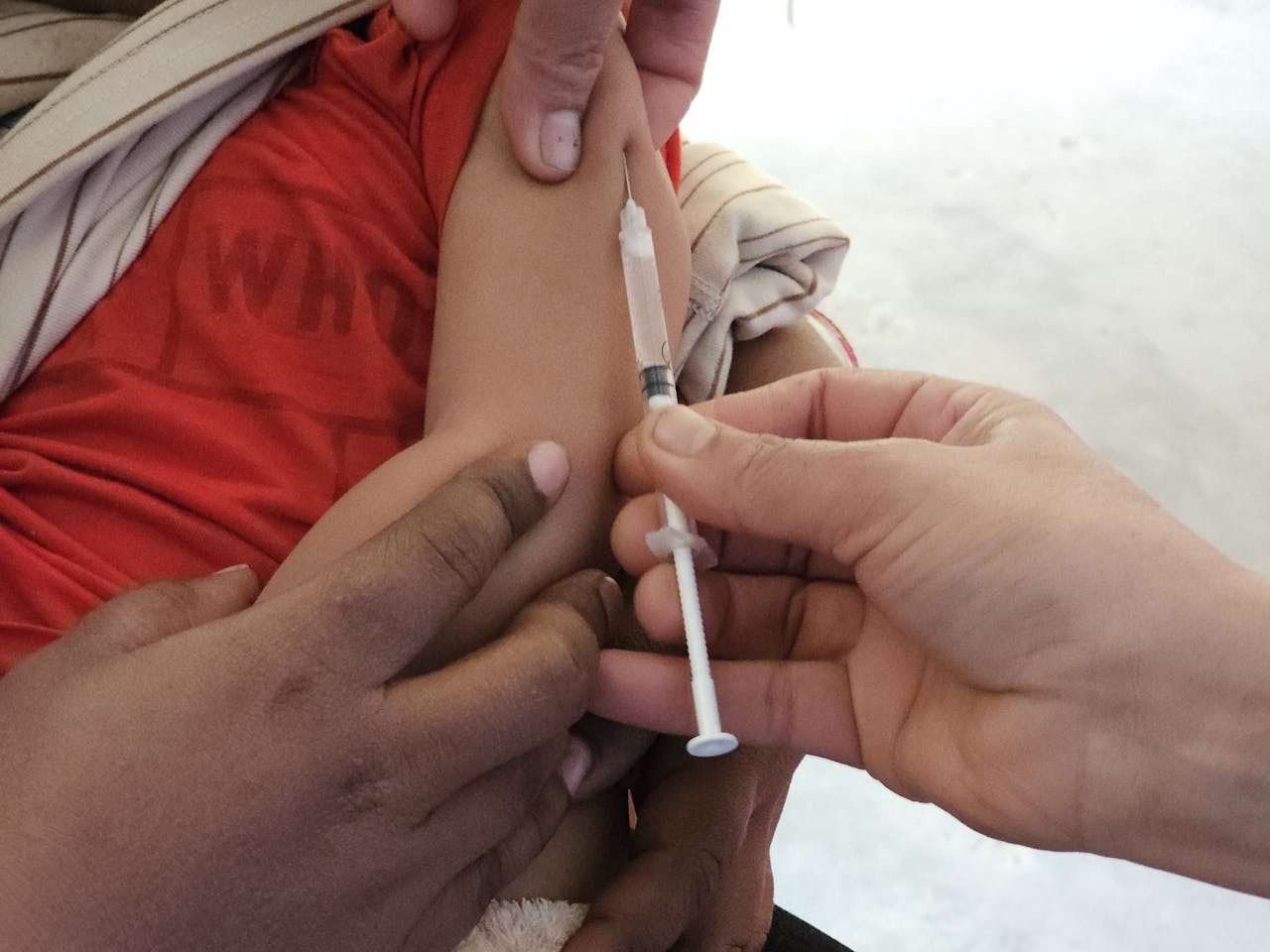
A team of Stanford University epidemiologists ran 2,000 simulations per disease to calculate what happens when childhood vaccination disappears in America, and the findings are almost too catastrophic to process.
The research,published in the Journal of the American Medical Association on 24 April 2025, was led by Stanford epidemiologist Mathew Kiang and infectious diseases physician-scientist Nathan Lo. Their model, a large-scale microsimulation covering all 50 US states and the District of Columbia, assessed what declining or vanishing childhood vaccination would mean formeasles, rubella, polio, and diphtheria over a 25-year period.
ProPublica adapted the worst-case scenario, a full 25-year elimination of vaccines, in adetailed interactive published on 27 March 2026. The timing was deliberate.Health and Human Services Secretary Robert F. Kennedy Jr., founder of an antivaccination group, is reportedly considering policy changes that could cause the handful of remaining childhood vaccine manufacturers to exit the US market. The researchers told ProPublica their findings feel more relevant now than when they first published them.
Kiang and Lo built what epidemiologists call a microsimulation: a model that assigns every individual in the US population an age, vaccination status, level of immunity, and state of residence, then simulates how diseases spread when an infected traveller arrives from abroad.
Outbreaks typically begin that way, when a US resident catches a disease overseas and returns home. Usingvaccination data averaged across 2004 to 2023to establish baseline immunity by state, the model then ran 2,000 simulations for each disease under multiple scenarios: vaccination staying flat, declining by 5 per cent to 50 per cent, and disappearing entirely.
The team chose four diseases for a specific reason. Measles, rubella, polio, and diphtheria had all been formally eliminated from the United States through vaccination. Measles was declared eliminated in 2000, poliovirus from the Americas in 1994, rubella in 2004, and diphtheria effectively after its vaccine was introduced in the 1940s.
None currently circulates within the country on an ongoing basis. That eliminated status means population immunity is now almost entirely vaccine-dependent, and any sustained drop in vaccination creates a growing pool of susceptible people as new babies are born unprotected.
The authors also included four co-researchers: Kate M. Bubar, Yvonne Maldonado, and Peter J. Hotez, alongside Lo. The full author team spanned Stanford's departments of epidemiology, infectious diseases, and paediatrics, plus Baylor College of Medicine's Texas Children's Hospital Centre for Vaccine Development.
Even before discussing the worst-case scenario, the model's findings at today's vaccination levels are alarming. TheJAMA paperfound that at current state-level vaccination rates,measlesis already on course to become endemic again within approximately 20.9 years, appearing in 83 per cent of simulations. Under that status-quo projection, the model estimates 851,300 measles cases over 25 years, leading to 170,200 hospitalisations and 2,550 deaths.
The threshold for preventing measles re-establishment sits on a razor's edge. A 5 per cent increase in MMR (measles, mumps, rubella) vaccination would drop projected cases to just 5,800, virtually eliminating the risk.
Source: International Business Times UK
