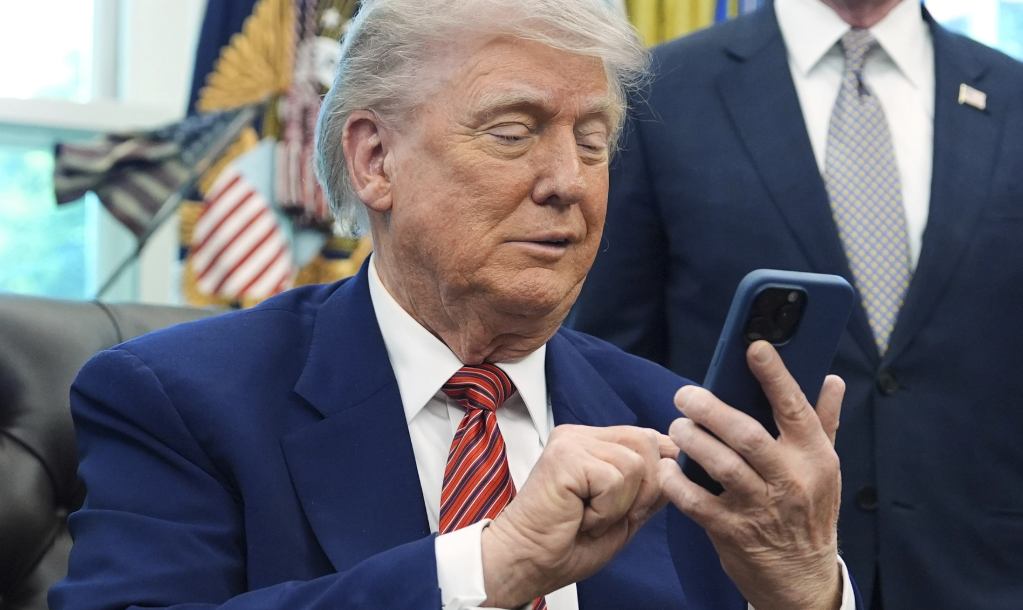
Donald Trump's late night posting habiton social media may point to a'dangerous' cognitive shiftin how the US president processes information and makes decisions, according toclinical psychologist Dr Tracy King. King made the remarks toMirror US, where she analysed both the content and timing of Trump's recent Truth Social activity.
Trump has spent recent weeks flooding Truth Social with posts on an unusually wide range of subjects. The reporting says those messages includeda threat to 'obliterate' Iran's population, criticism of Pope Leo XVI as 'weak,'an AI generated image portraying Trump as a healer, further warnings to Iranian forces and a cryptic clip of Frank Sinatra's My Way.
King argues that Trump's late night use of social media offers more than a glimpse into his mood. In her view, it shows how he is thinking in real time, how quickly those thoughts are being turned into public statements and how little appears to stand between impulse and publication.
King's reading of Donald Trump's late night posting habit is blunt. She told Mirror US that the 'volume, the overnight timing, and the intensity' of his Truth Social activity suggest a 'high level of nervous system activation.'
In practical terms, she is describing a leader who appears overstimulated, posting in bursts that look less like measured communication and more like the release of internal pressure. 'Posting repeatedly in this way can function as a form of regulation, a way of discharging internal pressure by pushing it outward,' she said.
#Trumpposted a video of#FrankSinatraperforming “My Way”.“And now, the end is near / And so I face the final curtain…Regrets, I’ve had a few / But then again, too few to mention…I did it my way.”pic.twitter.com/ThplIEdGLn
What appears to concern her most is the sense that thought and expression are happening almost at once. 'Rather than slowing down, thinking something through, and then communicating it, the thinking and the expression seem to be happening together,' King said.
She also pointed to the timing of the posts.Trump's messages, she said, are 'appearing late at night and into the early morning,'which she argued raises the possibility of reduced or disrupted sleep.
From there, King links Donald Trump's late night posting habit to a wider erosion of cognitive restraint. 'We do know that lack of sleep affects cognitive functioning. It is associated with greater impulsivity, faster but less considered decisions, reduced emotional regulation, and a stronger reliance on instinctive responses,' she said.
In her view, the president's recent posting pattern fits that model. Rapid, emotionally charged messages sent while most people are asleep suggest a mind relying less on nuance and reflection.
Source: International Business Times UK
