Our central assumption for the Iran war had been that by end the third week of April at latest, the Iranian regime faction willing to make a deal in line with Trump’s tweets would have asserted itself over those who won’t, Hormuz would slowly reopen, and energy markets gradually normalise.
As neither the Iranian nor US negotiating teams traveled to Pakistan for the second round of peace talks yesterday, that cannot happen. Our new geopolitical base case is of an extended closure of Hormuz (in the range of 2-4 weeks). However, the likelihood of escalation to achieve that de-escalation is very high, which risks more energy supply damage.
Trump just unilaterally andindefinitelyextended the ceasefire,“based on the fact that the Government of Iran is seriously fractured,” which the Iranians didn’t request, but Pakistan did. In the Middle East, making a threat and not following through smacks of weakness, and will be noted (again) by Tehran’s hardliners. He added US attacks would be held off “until such time as their leadership and representatives can come up with a unified proposal.” That’s as a Saudi tweet claimed Ghalibaf and Pezeskhian, willing to negotiate with Trump, have been arrested by the IRGC.
Iftrue, that points to a unified Iranian position of defiance. That would then require a US response - either an attack or a 1956 Suez Crisis retreat. Of course, Iran may be incapable of a unified answer until its factions turn on each other (which is likely part of the US strategy) - that would also suggest the need for a US attack, to ‘shake the box’. Or this ceasefire extension can be a US deception as its forces continue to fly or sail into the region.
Meanwhile, the US economic blockade of Iran and the de facto Iranian blockade of Hormuz remain in place: critical energy and goods are not going to flow for longer, with exponentially rising economic damage. Indeed, the US says it will ramp up Operation ‘Economic Fury’ at sea and via sanctions.Iran claims it will break its blockade by force, if it persists, which would of course lead us straight to an escalation again.
Importantly,the threat of an extended throttling of Hormuz will increase the global pressure to act. On one hand, US allies might do something, though this seems unlikely. On the other, China may have to given it has already stated it wants Hormuz to reopen.
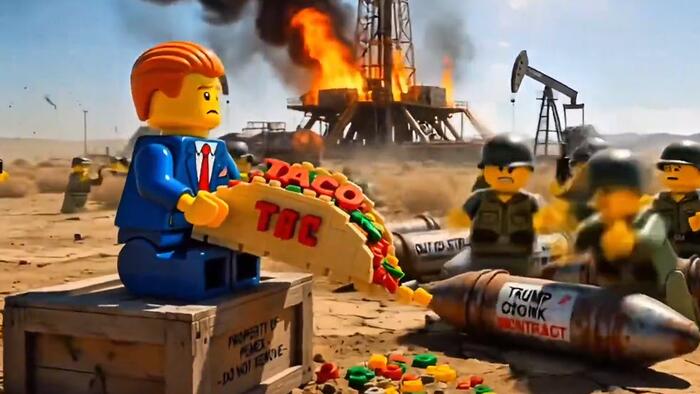
Looked at like this,there is nothing for markets to savor about a ‘chicken TACO Tuesday’. Indeed,screenoil prices only softened a little in response to the US ceasefire extension, and the price of physical oil and products in Asia will continue to rise unless Hormuz reopens.
Yet it’s undeniable the extended ceasefire also points towards a true TACO, which we’ve long made clear would be a geopolitical earthquake on par with the 1956 Suez Crisis.Were that to occur, it might be bearish for energy but could leave Iran in charge of Hormuz, which is less so; or Israel in charge of removing Iran from Hormuz, so far less so.Moreover, it would be it would be bearish for lots of assets markets don’t yet envision.
This is as Trump says a proposed currency swap with the UAE -- which is pegged to the dollar-- is under consideration, with some suggestions China will step in if not.That such an economy might need a dollar facility says a lot about the new world (dis)order that is emerging.
In parallel to Iran, Israel and Hezbollah’s ceasefire is holding on by its fingernails. Lebanon’s PM says his government will not let Hezbollah “intimidate us” – which lack of government actions shows it clearly does; and top US senators are calling to halt aid to Lebanon’s army over its failed Hezbollah disarmament efforts.
Source: ZeroHedge News
